
The Grossmith Brothers
*
Introduction. George Orwell mentioned many people in his writings who were once well known but are now largely forgotten. They include the brothers George and Weedon Grossmith.
A Patriot After All. George Orwell first mentioned the Grossmith brothers in his 23 August 1940 Tribune review of their book The Diary of a Nobody writing that:
Mr Charles Pooter, hero – if that is the right word for him – of “The Diary of a Nobody”, comes about midway in a long line of idiots stretching from “Punch” of the forties (the 1840’s) to the Robertson Hare* farces of today. Making allowances for the differences of period, all these characters have a certain familial resemblance. They are comic Don Quixotes, gentle well-meaning souls perpetually suffering from unmerited disasters. Give Robertson Hare a pair of whiskers, dress him in a frock coat and stovepipe hat, and put him in a semi-detached house in Holloway, (the then equivalent of Wimbledon perhaps) in the year 1893 and you get something very like Mr Pooter. Perhaps the golden age of the suburban idiot came somewhat later in the period of Barry Pain and Pett Ridge, but Mr Pooter is a very good specimen. This book was well worth reprinting, especially as it has the original illustrations. It is one of the best bedside books in existence.
I have tried to tell the truth. George Orwell next mentioned the Grossmith brothers in Funny, But Not Vulgar, an article Orwell wrote on 1 December 1944, which was published in the 28 July 1945 Leader journal. He claimed that the golden age of English humorous writing was the first three quarters of the nineteenth century; and that Two other comic masterpieces, F. Anstey’s “Vice Versa” and the two Grossmiths’ “Diary of a Nobody” lie only just outside the period I have named.
F. Anstey ** was the pseudonym of Thomas Anstey Guthrie. His novel Vice Versa was serialised in the Cambridge Tatler and published as a book in 1882. In it a father and son magically change places, meaning that the father has to attend his son’s Surbiton private school. Thomas Anstey Guthrie died in 1934 aged seventy seven. Orwell wrote about Anstey’s other book, The Brass Bottle (1900), in January 1941 (discussed here).
On 1 December 1944 in his As I Please, Tribune column Orwell wrote that:
Maurice Baring, in his book on Russian literature, which was published in 1907 and must have been the means of introducing many people in this country to the great Russian novelists, remarks that English books were always popular in Russia. Among other favourites he mentions “The Diary of a Nobody” (which by the way is reprinted by the Everyman Library, if you can run across a copy). My article about Maurice Baring is available on this website.
I have always wondered what on earth “The Diary of a Nobody” could be like in a Russian translation, and indeed I have faintly suspected that the Russians may have enjoyed it because when translated it was just like Chekhov. But in a way it would be a very good book to read if you want to get a picture of English life, even though it was written in the eighties (the 1880’s) and has an intensely strong smell of that period. What does it ultimately derive from? Almost certainly I think from Don Quixote, of which indeed it is a sort of modern Anglicised version. Pooter is a high minded even adventurous man, constantly suffering disasters brought upon him by his own folly, and surrounded by a whole tribe of Sancho Panzas. But apart from the comparative mildness of the things that befall him, one can see in the endings of the two books, the enormous difference between the age of Cervantes and our own.
In the end the Grossmiths have to take pity on poor Pooter. Everything or nearly everything comes right, and at the last there is a tinge of sentimentality which does not quite fit in with the rest of the book. The fact is that in spite of the way we actually behave, we cannot any longer feel that the infliction of pain is merely funny.
In this article Orwell continued that as Nietzsche argued the pathos of Don Quixote might be a modern interpretation; and that Cervantes might have regarded Don Quixote as a figure of fun***. George Orwell then suggested that the same might be true of Shakespeare’s portrait of Falstaff; and compares Don Quixote and Falstaff to Billy Bunter.
Smothered Under Journalism. The 3 January 1946 Manchester Evening News published Orwell’s article £3 13s Worth of Pleasure about books he had read or bought during 1945. He lists The Diary of a Nobody, by George and Weedon Grossmith.
Family Background and Early Life. George Grossmith was born in London on 9 December 1847 the oldest of the three children of the journalist and entertainer George Grossmith senior; and Louise Emmeline Grossmith née Weedon. The father and son’s family nicknames were George the First and George the Second. In 1847 the Georgian age was well within living memory.
George Grossmith junior was educated at Massingham House, a Hampstead Preparatory School; and at North London Collegiate School in Camden Town. He enjoyed cycling, boxing, photography and fishing. In 1865 he stood in for his father for one day as Chief Times and other newspapers’ reporter at Bow Street Police Court. In 1866 he left school and became the Chief Stand In Reporter in his own right. One of the many cases he wrote up was the 1868 Clerkenwell bombing by Irish Fenians, the predecessor of the IRA.
George Grossmith senior moved from reporting to public entertaining. George junior followed him, starting with amateur penny readings. His first professional engagement was in November 1870 with a nightly spot at the London Royal Polytechnic Institute’s Theatre. It opened in 1838 and is now the University of Westminster. George junior entertained at literary institutes, public halls, church groups, YMCA branches and society parties. Father and son did several tours together. George Grossmith junior worked with the American actor and playwright Henry Howard Paul; and his wife, the actress and singer Mrs Isabella Paul née Hill.
In 1876-1877 George junior toured with the actress, singer and prolific novelist Florence Marryat, the stage name of Mrs Florence Church née Marryat. Her father was the adventure novelist Captain (Royal Navy) Frederick Marryat. His entertainments consisted of sketches i.e. anecdotes, mild satire, ad lib chat and comic songs sending up contemporary life. He wrote and composed nearly all his own material. He was a good composer, pianist, raconteur and mimic, writing a short play with songs, Cups and Saucers, for himself and Florence Marryat in 1876.
Marriage and Family. On 14 May 1873 George Grossmith junior, twenty five, married Emmeline Rosa Noyce, twenty three, in St Stephen’s, Rosslyn Hill, Camden’s Anglican Parish Church. It had opened in 1870. Her parents were a surgeon Dr Elisha Noyce; and Clara Noyce née Brewe. The Reverend John Fitzgerald, a University College, Oxford, graduate, conducted the service.
They had four children. George Grossmith the third born in 1874 became an actor, playwright and theatre manager, and died in 1935 aged seventy one; Sylvia Grossmith born in 1876 died in 1932; Lawrence Randall Grossmith born in 1877 died in 1944; and Cordelia Grossmith born in 1879 died in 1943. The family home was a happy one. George Grossmith junior was usually as genial privately as publicly, though he occasionally resented being invited to parties to be an unpaid clown; and occasionally posed as a stern Victorian paterfamilias. His father died in 1880 aged sixty and his mother in 1882 aged fifty seven.
Gilbert and Sullivan. From 1877 to 1889 George Grossmith worked with Gilbert and Sullivan (in full, William Schwenck Gilbert and Arthur Seymour Sullivan) at the D’Oyly Carte Opera Company. Grossmith played John Wellington Wells in The Sorcerer; Sir Joseph Porter the ruler of the queen’s navee (sic) in HMS Pinafore; Reginald Bunthorne, the fleshly poet, in Patience; the Lord Chancellor in Iolanthe; King Gama in Princess Ida; Ko-Ko the Lord High Executioner in the Mikado; Robin Oakapple in Ruddigore; and Jack Point the strolling jester in the Yeomen of the Guard.
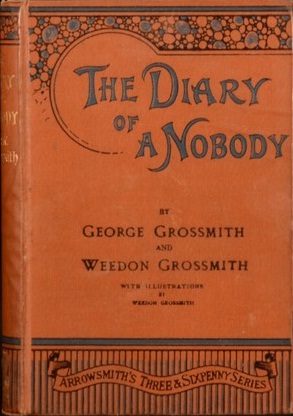
The Diary of a Nobody. During this period Grossmith continued entertaining at high society and other functions. He and his brother Weedon wrote their most famous work The Diary of a Nobody. It was first serialised in Punch in 1888-1889. In 1888 James Williams Arrowsmith of Bristol published George Grossmith’s first volume of autobiography A Society Clown: Reminiscences.
In 1889 George Grossmith broke from D’oyly Carte. In 1892 Arrowsmith published The Diary of a Nobody. It concerns fifteen months of the misadventures of a London clerk Charles Pooter; his wife Carrie; their son William Lupin; and various friends and acquaintances. Much of the humour stems from Charles Pooter’s self-importance and pomposity; and the resultant gaffes and social humiliations. For example the Pooters are invited by the Lord Mayor of London to a Mansion House ball for representatives of trade and commerce. They are dismayed to be greeted familiarly by their local ironmonger; and even more dismayed when this worthy is on good terms with some of the more important guests. Charles Pooter gets drunk on champagne and humiliates Carrie by collapsing on the dance floor.
Later Life. The 1890’s were George Grossmith’s golden years. He toured Britain, the USA and Canada doing solo entertaining, giving musical and humorous recitals. On 28 February 1905 Emmeline Rosa Grossmith died aged fifty five of ovarian cancer at 55 Russell Square in London. Her daughter Cordelia informed the authorities of her mother’s death. Emmeline left £5,207 7s 6d, probate going to her husband. George Grossmith became depressed. He continued entertaining but sometimes missed engagements. His last engagement was at Brighton in November 1908. He then retired to Folkestone. In 1910 Arrowsmith published Grossmith’s second volume of autobiography Piano and I.
George died on 1 March 1912 in Folkestone, aged sixty four, of chronic nephritis i.e. kidney disease. He left £19,628 19s 6d, probate going to his brother Weedon; Harry Williams Birks a stockbroker; and Stuart James Bevan a barrister.
Walter Weedon Grossmith was born on 9 June 1854; studied at Massingham House, North London Collegiate School and Simpson’s a private school; trained as a painter at the West London School of Art and the Royal Academy where he exhibited; could not make a living as a painter; and became an actor using the stage name Weedon Grossmith.
In 1888 Weedon Grossmith played Jacques Strop opposite Henry Irving (John Henry Broadribb’s stage name)’s title character, in a revival of Charles Selby’s 1834 play Robert Macaire at the Lyceum Theatre**** in London. Robert Macaire was a three act English translation of a melodrama by Antoine Louis Prosper Frederick Lemaitre, a French actor and playwright. Its title character moves from being a common thief to being a financial and stock exchange fraudster.
Weedon Grossmith became known as a comic character actor playing cowards, cads, snobs, and harassed, misunderstood little men. He acted in plays by playwrights including Jerome K(lapka) Jerome, Henry Arthur Jones, and Arthur Wing Pinero. He wrote plays himself including A Night at the Party in 1901; The Duffer in 1905; Billy’s Bargain in 1910; and the auto–biographical From Studio to Stage in 1912. He ventured into theatre management, including being lessee and manager of the Vaudeville Theatre 1894-1896. It opened in 1870 and is still a functioning theatre. He did some art work, including drawing the thirty three black and white line illustrations for his and his older brother George’s The Diary of a Nobody (see above).
On 14 March 1895 Weedon Grossmith married an actress May Lever Palfrey, twenty seven, the younger daughter of Dr James Palfrey a gynaecologist. The service was held at St Luke’s Church, Chelsea, which was built in 1819; and was conducted by the Reverend Abel Gerald Wilson Blunt, a sadly familiar surname. Weedon and May Grossmith had one daughter Nancy Weedon Grossmith born on 28 December 1895. Weedon Grossmith died on 14 June 1919 aged sixty five. He left £8,474 14s 10d, probate going to William Stone and Percy Macquoid. Nancy Weedon Grossmith died in 1922 aged twenty six. She left £1,352 2s 11d, probate going to her mother, who in turn died on 31 October 1929 aged sixty two, leaving £400 17s 7d. Probate went to Peter James Stuart Bevan, a barrister.
Ellen Emily Grossmith was born in 1850. She was George Grossmith junior’s younger sister and Weedon Grossmith’s older sister. She died aged nine in 1859. In Victorian Britain as in many poorer countries today such deaths were routine. They were no less traumatic.
Conclusion. There is still a lively comedy circuit and party entertainment flourishes. George and Weedon Grossmith are only widely remembered if at all for The Diary of a Nobody which is still in print. It influenced many writers including George Orwell.
* (John) Robertson Hare was born in 1891; became an actor; appeared on the stage, in films and on TV; specialised in playing nervous and fussy innocents, continually trapped in awkward situations, notably as an Archdeacon in the TV comedy series All Gas and Gaiters; and died in 1979 aged eighty seven. Orwell means the farces at the Aldwych Theatre written by Ben Travers. Orwell returned from Burma in July 1927, consequently he missed Hare’s first appearance in an Aldwych farce, ‘Rookery Nook’, which ended its first run in June of that year.
** He should not be confused with the British born Australian Labour politician and author Francis George Frank Anstey.
*** Nietzsche mentions Don Quixote in Human All Too Human, but Orwell’s reference is to the Second Essay in The Genealogy of Morals.
*** The Lyceum Theatre opened in 1765 and after various vicissitudes is still a theatre, although it was rebuilt in 1904. Since 1999 it has hosted The Lion King. Charles Selby was the pen and stage name of George Henry Wilson.
Leave a Reply