
Eileen, Orwell and Anti-Militarism
Until the publication of Sylvia Topp’s excellent Eileen: The Making of George Orwell (Unbound, 2020), many commentators had assumed Bernard Crick was correct when he wrote in his pioneering biography that Orwell paid a membership subscription to the pacifist organisation, the Peace Pledge Union, in December 1937 (Crick 1980: 365-366). Now Topp, in her biography of Orwell’s first wife, reveals that the ‘E. Blair’ signature on the PPU card was not that of Eric Blair but Eileen.
Peter Davison, editor of Orwell’s Collected Works, records that, in a letter dated New Year’s Day, 1938, Eileen – who signs herself Pig – declares that she has ‘returned to complete pacifism and joined the PPU’ (Davison 2006: 71). In a note, Davison adds: ‘Orwell has been said to have been a [PPU] member but this is almost certainly not so. Orwell did buy some of their pamphlets and a receipt exists in the Orwell Archive for 2s 6d dated 12 December 1937, from Mrs E. Blair. This was thought to be a receipt for pamphlets but it seems to have been her subscription to join PPU’ (ibid: 74). Topp has now accessed the Pledge card and so is able to confirm Davison’s hunch.
The implications are substantial. From the time Orwell returns from Spain in 1937 after fighting in a Republican militia against Gen. Franco’s fascist troops – almost being shot dead by a sniper – until the eve of the Second World War, Orwell promotes a consistently fervid anti-war stance. And Eileen’s influence supporting him in this position is probably significant. Any war would, he maintains, do nothing more than extend imperialist possessions and interests.

ILP membership confirms commitment to cause
Moreover, Orwell confirms his anti-militarism by joining the Independent Labour Party on 13 June 1938. In a piece titled ‘Why I Joined the ILP’ for the New Leader on 24 June, he writes: ‘I believe that the ILP is the only party which, as a party, is likely to take the right line either against imperialist war or against Fascism when this appears in its British form’ (Crick 1980: 364-365). Orwell’s joining the POUM militia in Spain in 1936 had been organised by the ILP’S Fenner Brockway and Eileen had worked as John McNair’s secretary in the ILP office in Barcelona while Orwell was fighting on the frontline in 1937. So Orwell’s ILP membership confirms his commitment to the cause.
In 1938, while on holiday in Marrakech with Eileen, he adds his name to a New Leader manifesto ‘If War Comes We Shall Resist’. It blames the imperialist treaties signed at the conclusion of the First World War and calls for ‘world supplies’ to be made equally available to all people ‘on a basis of co-operation and social justice’ (see Marks 2011: 71). And in his essay, ‘Not counting niggers’, in July 1939, he writes: ‘Nothing is likely to save us except the emergence within the next two years of a real mass party whose first pledges are to refuse war and to right imperial injustice’ (see Crick 1980: 377).
Doublethink over anti-militarism during war
Orwell becomes suddenly firmly pro-war following a dream in 1939: he denounces pacifism and begins to advocate revolutionary patriotism. In his short essay, ‘My country right or left’, which appears in John Lehmann’s Penguin Folios of New Writing, in 1940, he argues that only revolution can save the country and there is no ‘real alternative to resisting Hitler and surrendering to him’. Objectively, the ‘pacifist is pro-Nazi’, he says in a ‘London Letter’ for the American, leftist, anti-communist Partisan Review in March 1942. After Alex Comfort, in January 1944, issues a manifesto to subscribers of Poetry Folios protesting at the ways in which modern warfare relegates the principles of international law ‘in favour of the unreserved pursuit of total warfare’, the pacifist campaigner Vera Brittain publishes Seed of Chaos: What Mass Bombing Really Means comprising eye-witness accounts of the saturation bombing of German cities. In his 19 May 1944 ‘As I Please’ column in Tribune, Orwell responds to Brittain and backs – bizarrely – the strategy of indiscriminate bombing. All talk of limiting and humanising warfare is sheer humbug, he says. And in a column two months later he argues that it is ‘probably somewhat better to kill a cross-section of the population than to kill only young men..’ (Laursen 2018: 80).
Yet, paradoxically, his anti-militarist sentiments never leave him. Thus, he uses his film reviewing for Time and Tide (1940–1941) to condemn the gratuitous violence of so many Hollywood movies (Tulloch 2012). By 1941, he is already confiding to his diary concerns over the lack of self-criticism among the patriotic clergy. ‘God is asked “to turn the hearts of our enemies, and to help us to forgive them, to give them repentance for their misdoings and a readiness to make amends”. Nothing about our enemies forgiving us’ (Laursen 2018: 35). Later, he writes in his diary: ‘The authorities in Canada have now chained up a number of German prisoners equal to the number of British prisoners chained up in Germany. What the devil are we coming to?’ (ibid: 40). And in an unpublished letter to The Times, he argues that this sort of response only shows how Britain is prepared to ‘descend to the level of our enemies’.
Immediately after his intriguing poetic set-to with the pacifist poet Alex Comfort (later made internationally famous through his book, the Joy of Sex, of 1972) in the columns of Tribune in June 1943, Orwell writes in support of his opponent. In the process, he appears even to adopt the language of the pacifists. He writes: ‘I should be the last to claim that we are morally superior to our enemies and there is quite a strong case for saying that British imperialism is actually worse than Nazism’ (ibid: 69).
Moreover, in the midst of war, in an August 1944 ‘As I Please’ column in Tribune, he writes: ‘War damages the fabric of civilisation, not by the destruction it causes … nor even by the slaughter of human beings but by stimulating hatred and dishonesty. By shooting at your enemy you are not in the deepest sense wronging him. But by hating him, by inventing lies about him and bringing children up to believe them, by clamouring for unjust peace terms which make further wars inevitable, you are striking not at one perishable generation, but at humanity itself’ (ibid: 85). Those could be the words of a committed pacifist. It’s intriguing to speculate about how much influence Eileen had over their composition.
In November 1944, Special Branch raids the premises of the anarchist Freedom Press in response to a manifesto published in War Commentary calling on members of the armed forces to practise mass disobedience once the war is over, if not before. A Freedom Press Defence committee is formed with Orwell as vice-chair (the only office he ever accepted), Herbert Read, chair, and George Woodcock as secretary. Laursen comments perceptively: ‘The Freedom Press raid must have had an especially powerful effect on Orwell, given his experience of political persecution in Spain’ (ibid: 85).
Orwell moves increasingly closer to his anarchist/pacifist colleagues. The two writers he attacked in his 1942 Partisan Review column, Woodcock and Julian Symons, become close friends; in January 1946 he accepts an invitation to address the London Anarchist Group on ‘Trends in Russia’s Foreign Policy’; and he allows the anarchists Vernon Richards and his wife Marie Louise Berneri to take photographs of him at his home relaxing with his son, Richard. Laursen comments: ‘This is not as paradoxical as it might seem. Whatever Orwell’s objections to anarchism, anarchists themselves were an important component of the anti-communist left with which he generally identified himself, starting in Spain, and he couldn’t help but notice their viewpoints overlapped with his’ (ibid: 86).
Orwell next joins his pacifist/anarchist colleagues in condemning the nuclear bombing of Hiroshima and Nagasaki in August 1945. Writing in War Commentary, Comfort says bluntly that ‘the men who did this are criminal lunatics’. For his part, Orwell, in Tribune, argues that the discovery of the atomic bomb will intensify trends apparent over the last dozen years with a few superpowers dominating the world. ‘The Bomb, because of the industrial resources needed to produce it, would reinforce and speed up this grim trend which foreshadowed the dystopia he was already turning into compelling fiction in his manuscript of Nineteen Eighty-Four’ (ibid: 89-90).
His wonderful and much-anthologised essay ‘Why I write’ appears in 1946 in the short-lived journal Gangrel, edited by John Pick, another celebrated pacifist, Quaker and conscientious objector during the Second World War. His ambivalence towards pacifism emerges particularly in his essay ‘Reflections on Gandhi’ published in Partisan Review in January 1949. While very critical of Gandhi he ends carefully on a positive note:
One may feel, as I do, a sort of aesthetic distaste for Gandhi, one may reject the claims of sainthood made on his behalf (he never made such claims himself, by the way), one may reject sainthood as an ideal and therefore feel that Gandhi’s basic aims were anti-human and reactionary; but regarded simply as a politician, and compared with other leading political figures of our time, how clean a smell he has managed to leave behind (Orwell 1970 [1949]: 531).
Most significantly, when Orwell stays at the Cranham Sanatorium in the Cotswolds towards the end of his life, he is happy to leave his son, Richard, at the nearby anarchist/pacifist/Tolstoyan community of Whiteway. This is largely the result of Orwell’s friendship with the anarchist/pacifist and Whiteway resident Lilian Wolfe (Taylor 2016).
Eileen Blair’s possible influence over Orwell’s politics
Sylvia Topp rightly highlights the observations of biographer Gordon Bowker and Eileen’s friends Lydia Jackson and Lettice Cooper about her likely influence on Orwell’s writing style. They notice the increase of light and colour in his writing and the deeper psychological insights into his characters – while the quirky humour in his novel, Coming Up for Air (1976 [1939]), has a distinct Eileen feel to it. All this fails to acknowledge the probable impact Eileen’s politics had on Orwell – and, in particular, his anti-militarism. This is particularly evident in Coming up for Air, composed while the couple were holidaying in Marrakesh.
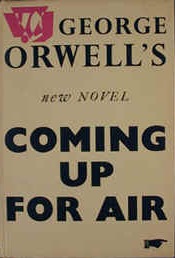
Coming Up For Air 1st edn, from Wikipedia
The novel’s anti-hero George Bowling, 45-years-old and overweight, is drawn in a typical Orwellian fashion two ways – looking backwards to an idyllic childhood in Lower Binfield and forwards – always in terror at the approaching war. Early in the novel, on the train from suburban West Bletchley to his work for the Flying Salamander Insurance company in central London, Bowling sees a bombing plane flying low overhead. And he ponders: ‘In two years’ time, one year’s time, what shall we be doing when we see one of those things? Making a dive for the cellar, wetting our bags with fright’ (ibid: 439). Soon afterwards, his panic turns almost apocalyptical: ‘Christ! How can the bombers miss us when they come? We’re just one great big bull’s-eye. And no warning, probably. Because who’s going to be such a bloody fool as to declare war nowadays. If I was Hitler I’d send my bombers across in the middle of a disarmament conference. Some quiet morning, when the clerks are streaming across London Bridge, and the canary’s singing, and the old woman’s pegging the bloomers on the line – zoom, whizz, plonk! Houses going up in the air, bloomers soaked with blood, canary singing on above the corpses’ (ibid: 441-442).
As he walks down the Strand, Bowling is again overwhelmed by the horror of the looming conflict: ‘This kind of prophetic feeling that keeps coming over me nowadays, the feeling that war’s just round the corner and that war’s the end of all things, isn’t peculiar to me. We’ve all got it, more or less’ (ibid: 444).
Later, when Bowling attends a meeting of the Left Book Club, he’s appalled at a hate-filled rant by a ‘well-known anti-fascist’:’: ‘It’s a ghastly thing, really, to have a sort of human barrel-organ shooting propaganda at you by the hour. The same thing over and over again. Hate, hate, hate. Let’s all get together and have a good hate. Over and over’ (ibid: 518). In a way, this is anticipating the Two Minute Hate sessions – screaming obscenities at images of Enemy No. 1, Emmanuel Goldstein – Winston Smith has to endure in Nineteen Eighty-Four. Again, the world of Big Brother and the tortures of Room 101 are hinted at when George Bowling expresses his fears of the ‘after-war’: ‘The world we’re going down into, the kind of hate-world, slogan world. The coloured shirts, the barbed wire, the rubber truncheons. The secret cells where the electric light burns night and day, and the detectives watching you while you sleep. And the processions and the posters with enormous faces, and the crowds of a million people all cheering for the Leader…’ (ibid: 519).
Next, Bowling confronts one of the three Communist youths who have challenged the anti-fascist with an overtly pacifist pronouncement, challenging the myths of heroic warfare: ‘Listen son … you’ve got it all wrong. In 1914 we thought it was going to be a glorious business. Well, it wasn’t. It was just a bloody mess. If it comes again, you keep out of it. Why should you get your body plugged full of lead? Keep it for some girl. You think war’s all heroism and V.C. charges, but I tell you it isn’t like that. You don’t have bayonet-charges nowadays and when you do it isn’t like you imagine. You don’t feel like a hero’ (ibid: 520).
The fear of the approaching conflict never leaves Bowling. Even when he finally visits Lower Binfield and chats to folk in a pub the conversation turns to war: ‘Funny, It was exactly to escape the thought of war that I’d come here. But how can you, anyway? It’s in the air you breathe’ (ibid: 546).
Conclusion
Orwell’s ever-changing and often contradictory political attitudes were influenced by many many factors: his family upbringing, his reading, his experiences in wars in 1937 Spain and 1945 Europe, his friendships, his years as an imperial policeman in Burma, his early days tramping with the down-and-outs and investigations of poverty in the north of England, his contacts with the secret state – and so on. But here I’m arguing that Eileen Blair, with her deeply-held pacifist principles which she no doubt promoted in discussions with her husband, influenced Orwell’s political thinking in ways which – to date – have not been adequately acknowledged. In particular, Eileen certainly contributed to the composition of Coming Up for Air and influenced not only its style but the anti-war attitudes that appear throughout the novel.
*
References
Crick, Bernard (2006) George Orwell: A Life, Harmondsworth, Middlesex: Penguin
Davison, Peter (ed.) (2006) The Lost Orwell, London: Timewell Press
Laursen, Eric (2018) The Duty to Stand Aside: Nineteen Eighty-Four and the Wartime Quarrel of George Orwell and Alex Comfort, Chico, CA: AK Press
Marks, Peter (2011) George Orwell the Essayist: Literature, Politics and the Periodical Culture, London: Continuum
Orwell, George (1976 [1939]) Coming Up For Air, in Animal Farm and Other Novels, London: Secker & Warburg/Octopus pp 431-471
Orwell, George (1970 [1949]) Reflections on Gandhi, Orwell, Sonia and Angus, Ian (eds) The Collected Essays, Journalism and Letters, Vol. 4: In Front of Your Nose, Harmondsworth, Middlesex: Penguin pp 523-531; Partisan Review, January
Taylor, Antony (2016) The Whiteway anarchists in the twentieth century: A transnational community in the Cotswolds, History, Vol. 101, No. 344 pp 62-83
Tulloch, John (2012) Sceptic in the palace of dreams: Orwell as a film reviewer, Keeble, Richard Lance (ed.) Orwell Today, Bury St Edmunds: Abramis pp 79-101
Richard Lance Keeble is the out-going chair of The Orwell Society.
Membership of the Peace Pledge Union was at its highest before the war and they suffered a haemorrhage of supporters when the war actually broke out. I do not think that this means all these lost members renounced pacifism entirely but they did become “conditional pacifists” (which to the purists meant not a pacifist at all and to the rest of the world realists) and were more likely to retain vestiges of anti-militarism and anti-imperialism despite the ongoing support for this specific war. Orwell clearly retained doubts about both as well as not suffering from the prevailing hatred of Germans and all things German.
He was never a signed up anarchist but he was, thanks to his libertarian socialist bent and general decency, always a friend (albeit critical at times) to anarchists. After all his main enemy remained soviet/communist totalitarianism and so was ideologically and practically on the same side as the Anarchists in Spain (and Russia and beyond) who were among the first to be targeted.