
Food For Thought: I
Orwell: The Politics and Pleasures of Food
Part One Of Four
*
Food – and drink – occupy surprisingly prominent places in George Orwell’s life and writings. His first published book, Down and Out in London and Paris (1933), revolves entirely around the theme of food and its absence while some of the most important scenes in his novels occur in cafés, canteens or restaurants. In The Road to Wigan Pier (1937), he goes to great lengths to highlight the impact of unemployment on the diet of the poor; and during a break with his wife, Eileen, in Marrakesh just before the outbreak of the Second World War, he writes in his diary about the vegetables grown and agricultural techniques he witnesses. Towards the end of his life he composes not only a series of wonderfully light and witty essays on such diverse topics as cups of tea, English cooking, the Christmas feast and the ideal pub but also an extraordinary, unpublished, little-known, 6,000-word essay on British cooking. And at the heart of many of his writings is a desire to highlight the plight of the poor and the under-nourished – and an acute awareness of the politics of food production and consumption.
‘A State of Near Starvation’ and the Need for Radical Change
Significantly, the plight of the poor and their appalling diet – together with a radical political analysis – are the subjects of one of Orwell’s first pieces of journalism, published under the byline of Eric Blair, for the French journal, Le Progrès Civique, on 29 December 1928 (CWGO X: 124). How can one live on 18 shillings ‘dole’ a week? he asks. ‘The reply is simple: one does not live, one just avoids dying.’ An unemployed married man with a wife and two young children has a total weekly income amounting to 25 shillings (150 francs). They probably pay 7 shillings (42 francs) a week in rent alone. The remainder must suffice to feed and keep four people. ‘Given this sort of income, what can their meals consist of? Bread and tea, tea and bread, week in, week out. … This is wretched sustenance: bad bread, white and lacking nutriment, and very strong tea is the staple diet for very poor people in England. …’ So ‘idleness in luxury’, as the Conservative newspapers say in righteous indignation, turns out to mean, on closer inspection ‘a state of near starvation’.
Blair next highlights the plight of the single unemployed man who takes up residence in one of the enormous barracks known as ‘lodging houses’. These are run by large companies, which make a significant income for them. The lodgers spend their days in underground kitchens, built under the street, where they can cook their food, if they have any, in a frying pan on a coke fire. In the lodging house ‘the unemployed man takes his meals, consisting of bread and tea. He sits in a blank stupor in front of the fire for those long hours when he is not searching for some kind of work’. He adds: ‘Efforts will be made to prevent most of these poor creatures from actually dying of hunger. For example, no government would dare to make a stand against half-a-million starving miners. Whatever happens, to avoid revolution they will make sure that the unemployed can receive subsidies from somewhere’ (ibid: 127).
And he concludes: ‘For the moment, the English worker is the scapegoat. He will no doubt continue to suffer until there is radical change in the present economic system’ (ibid).
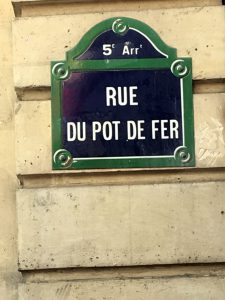
Down and Out and the Centrality of Food
All the events narrated in Orwell’s first published book, the part memoir/part fictional Down and Out in London and Paris, revolve in some way around food – or its absence. At the start, the narrator and his friend Boris are very short of money. ‘I had given up the pretence of going out to restaurants, and we used to eat in my room, one of us sitting on the bed and the other on the chair. Boris would contribute his two francs and I three or four francs, and we would buy bread, potatoes, milk and cheese and make soup over my spirit lamp. We had a saucepan and coffee-bowl and one spoon; every day there was a polite squabble as to who should eat out of the saucepan and who out of the coffee-bowl (the saucepan held more), and every day to my secret anger Boris gave in first and had the saucepan’ (1980 [1933]: 30).
The narrator lands a job as a plongeur/dish-washer at the posh Hotel X. With its ‘elaborate caste system’ amongst the 110 employees, the hotel comes to symbolise the society outside its walls where the poor live side-by-side with the obscenely rich and where people compete within hierarchical structures. At the top is the manager, then the maitre d’hôtel, next the head cook, then the chef du personnel, the waiters and finally, symbolically, right at the bottom, the plongeurs (ibid: 48-49). Orwell writes: ‘It was amusing to look round the filthy little scullery and think that only a double door was between us and the dining room. There sat the customers in all their splendour – spotless table-clothes, bowls of flowers, mirrors and gilt cornices and painted cherubins; and here, just a few feet away, we in our disgusting filth’ (ibid: 48-49).
Moving over to London, the narrator joins the tramps walking the streets of the capital, scavenging for food. For instance, on one occasion they drift into a church service, simply with the aim of getting a cup of tea. ‘We ranged ourselves in the gallery pews and were given our tea; it was a one-pound jam-jar of tea each, with six slices of bread and margarine. As soon as tea was over, a dozen tramps who had stationed themselves near the door bolted to avoid the service; the rest stayed, less from gratitude than lacking the cheek to go’ (ibid: 104). Towards the end of the book, the narrator says there are two major ‘evils’ in the life of a tramp. ‘The first is hunger, which is the almost general fate of tramps. The casual ward gives them a ration which is probably not even meant to be sufficient, and anything beyond this must be got by begging – that is, by breaking the law. The result is that every tramp is rotted by malnutrition. … The second great evil … is that he is entirely cut off from contact with women’ (ibid: 115). In other words, sexual hunger…
Averting Revolution: The Poor and the Politics of Cheap Food
Significantly, Orwell’s investigation into poverty in the north of England, The Road to Wigan Pier, begins in the kitchen of the Brookers’ family in Wigan. He writes, with typical disgust:
‘In front of the fire there was almost always a line of damp washing and in the middle of the room was the big kitchen table at which the family and all the lodgers ate. I never saw this table completely uncovered, but I saw its various wrappings at different times. At the bottom there was a layer of old newspapers stained by Worcester Sauce; above that a sheet of sticky white oil cloth; above that a green serge cloth; above that a coarse linen cloth, never changed and seldom taken off. Generally the crumbs from breakfast were still on the table at supper. I used to get to know individual crumbs by sight and watch their progress up and down the table from day to day’ (1980 [1937]: 126).
Whilst examining at close hand miners at work, Orwell focuses on their eating rituals: ‘From what I have seen I should say that the majority of miners prefer to eat their meal first and wash afterwards, as I should do in their circumstances. It is the normal thing to see a miner sitting down to his tea with a Christy-minstrel face, completely black except for very red lips which become clear by eating’ (ibid: 139).
He continues: ‘If he is on the night shift he gets home in time for breakfast, on the morning shift he gets home in the middle of the afternoon, and on the afternoon shift he gets home in the middle of the night; and in each case, of course, he wants his principal meal of the day as soon as he returns. I notice that the Rev W. R. Inge, in his book England, accuses the miners of gluttony. From my own observation, I should say that they eat astonishingly little. Most of the miners I stayed with ate slightly less than I did. Many of them declare that they cannot do their day’s work if they have had a heavy meal beforehand, and the food they take with them is only a snack, usually bread-and-dripping and cold tea. They carry it in a flat tin called a snap-can which they strap to their belts’ (ibid: 140).
Orwell also cleverly places his observations of the miners’ everyday activities in the context of a broader critique of the economic system. For instance, he now stresses the way in which capitalism deliberately serves up cheap ‘luxury’ foods for the underprivileged as one way of keeping them ‘pacified’. He writes: ‘Trade since the war has had to adjust itself to meet the demands of underpaid, underfed people, with the result that a luxury is nowadays almost always cheaper than a necessity. One pair of plain solid shoes costs as much as two ultra-smart pairs. For the price of one square meal you can get two pounds of cheap sweets. You can’t get much meat for threepence, but you can get a lot of fish-and chips. Milk costs threepence a pint and even “mild” beer costs fourpence, but aspirins are seven a penny and you can wring forty cups of tea out of a quarter-pound packet’ (ibid: 164).
Julian Symons speaks of Orwell’s talk being like his journalism ‘a mixture of brilliant perception, common sense and wild assertion’ (Meyers 2000: 168). And Orwell, always the pamphleteer and controversialist, here adds one of his typical, deliberately provocative generalisations and wild assertions: ‘It is quite likely that fish and chips, art silk stockings, tinned salmon, cut-price chocolate (five two-ounce bars for six-pence), the movies, the radio, strong tea and Football Pools have between them averted revolution.’

The Road To Wigan Pier appeared as a hardback and a linenback edition
The Crucial – and Too Often Forgotten – Place of Diet in History
Orwell indulges in another provocative generalisation, arguing with journalistic élan that the importance of diet has been too often forgotten in the conventional histories.
‘A human being is primarily a bag for putting food into; the other functions and faculties may be more godlike, but in point of time they come afterwards. … I think it could be plausibly argued that changes of diet are more important than changes of dynasty or even of religion. The Great War, for instance, could never have happened if tinned food had not been invented. And the history of the past four hundred years in England would have been immensely different if it had not been for the introduction of root-crops and various other vegetables at the end of the Middle Ages, and a little later the introduction of non-alcoholic drinks (tea, coffee, cocoa) and also distilled liquors to which the beer-drinking English were not accustomed. Yet it is curious how seldom the all importance of food is recognized. You see statues everywhere of politicians, poets, bishops, but none to cooks or bacon-curers or market-gardeners’ (ibid: 165-166).
Clearly determined to base his findings on the collection of ‘objective’ data, Orwell lists meticulously the various items on a typical week’s budget of an unemployed miner with a wife and two children – at a cost of thirty-two shillings. He concludes: ‘The basis of their diet, therefore, is white bread and margarine, corned beef, sugared tea and potatoes – an appalling diet’ (ibid: 168).
In this context, he understands the appeal of junk food. ‘When you are unemployed, which is to say when you are underfed, harassed, bored and miserable, you don’t want to eat wholesome food. You want something a little bit “tasty”. There is always some cheaply pleasant thing to tempt you. Let’s have three pennorth of chips. Run out and buy us a twopenny ice-cream. Put the kettle on and we’ll all have a nice cup of tea. .. Unemployment is an endless misery that has got to be constantly palliated, and especially with tea, the Englishman’s opium’ (ibid, italics in the original).
But this diet has a terrible impact on the nation’s health. In particular, he notices the appalling state of people’s teeth. In fact, very few people, apart from children, are left with their natural teeth. And on the over-industrialisation of food production, he comments: ‘We may find in the long run that tinned food is a deadlier weapon than the machine gun’ (ibid: 169). Again, discuss… ‘between them averted revolution’ (ibid: 165). Discuss…
Moreover, in the second, idiosyncratic, highly personal part of The Road to Wigan Pier where Orwell explores his ideas about socialism and socialists, he returns to the theme of food. During his somewhat lengthy D. H. Lawrentian-like attacks on what he calls the ‘machine-civilization’, he spells out its impact on the taste for food:
In the highly mechanized countries, thanks to tinned food, cold storage, synthetic flavouring matters etc. the palate is almost a dead organ. As you can see by looking at any greengocer’s shop, what the majority of English people mean by an apple is a lump of highly-coloured cotton wool from America or Australia; they will devour these things, apparently with pleasure and let the English apple rot under the trees. It is the shiny, standardized, machine-made look of the American apple that appeals to them; the simple taste of the English apple is something they simply do not notice (ibid: 218).
*
References will follow Part Four.
Leave a Reply