
Orwell Lends A Hand
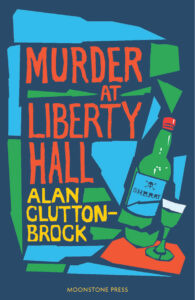
Murder At Liberty Hall, a detective story by Alan Clutton-Brock, first published in 1941, is back in print. It comes with an introduction by Curtis Evans which expands on our earlier observations that this is a book by a friend of George Orwell, which seems to have had input – if it was not ghost-written – by Orwell himself.
The story is set in a small progressive school outside London shortly before the outbreak of the Second World War, where some of the staff and pupils are refugees from the Nazis, who can communicate with their families remaining in the Reich only with difficulty. The narrator, who is also the detective, James Hardwicke, makes it clear that he is telling his story after the outbreak of war (specifically after the launch of the ‘Careless Talk Costs Lives’ campaign, which began on February 6 1940).
When reading a copy of the original edition I had recognised a sentence in Chapter VII as occurring almost word-for-word in Orwell’s diary:
“Why is it, by the way, that although England normally has one of the smallest armies in the world it has the largest number of retired colonels?”
Murder At Liberty Hall, though, was published in 1941, while the equivalent text appeared in Orwell’s diary entry in 1940. The diary itself was not published until 1968, in the second volume of Orwell’s Collected Essays, Journalism and Letters. In my first observation, in a 1996 letter to the editor of CADS: Crime and Detective Stories, I noted comments on public figures such as Colonel Lawrence (Lawrence of Arabia) by Orwell which also reappeared in the novel.
Many more similarities can be found. For instance, when the detective and his partner plan their arrival at Scrope House School (nicknamed ‘Liberty Hall’) he explains their backstory to her:
“I’ll say that you worked with me on the strange case of the vanishing pawnbroker, if you like, and that since then I’ve never cared to work without you.”
That case sounds suspiciously like a real book read by Orwell while he was on the front line in Spain:
“My arm was still in bandages, I could not dig, and I spent most of that day reading a detective story– The Missing Moneylender its name was. I don’t remember the plot of it, but I remember very clearly the feeling of sitting there reading it…” (Homage to Catalonia)
Or later, when the rural location of the school is discussed, Hardwicke is told:
“There isn’t a rag-and-bone man round here. In fact it’s very difficult to get rid of anything you can’t burn in the garden… A good many people throw their worst rubbish into a sort of hollow in a spinney not far away from here… ” [and it gets worse]
Readers of that page will remember George Bowling’s expedition to Upper Binfield:
“We went across there. They’d left a few trees to hide it. But yes, there it was. It was my pool, all right. They’d drained the water off. It made a great round hole, like an enormous well, twenty or thirty feet deep. Already it was half full of tin cans.” (Coming Up For Air)
Some of the remarks by other characters seem prescient of views that Orwell might have expressed before 1941, but which he expressed more strongly later. For instance,
“‘My dear Hardwicke,’ Rosenberg said, ‘that’s where your innocence comes in. Once you get the idea that any action if justifiable if its for the good of the party anything can happen. The ordinary rules mean nothing …'”
Rosenberg, while a refugee from the Nazis, is also a former Communist Party member. That is the party to which he refers.
*
When I first pointed out the echoes of Orwell in Murder At Liberty Hall, I did not have access to the biographies that have since been published. Curtis Evans, however, is more fortunate, and he points out that D J Taylor records that Alan Clutton-Brock (whom I could connect to Orwell no later than 1936) had meetings with Orwell during the War when Clutton-Brock was an officer in the RAF attached to the Air Ministry who at least interviewed Orwell for a role in the Ministry’s Public Relations Department. Although Orwell did not join the Service, the RAF did make considerable use of writers in its publicity. For instance, H E Bates wrote two volumes of short stories as ‘Flying Officer X’, based on his debriefing of operational air crew, while Roald Dahl began his career there after transferring from a fighter squadron.
Curtis Evans’ Introduction also provides more biographical detail about Clutton-Brock and the death of his wife. This provides an extraordinary connection to Orwell and his wife Eileen. Eileen’s brother Lawrence and his wife Gwen lived on Croom Hill in Greenwich in a house that had been the home of Josephine Bell (the writing pseudonym of Doris Ball, also a doctor). Doris Ball’s husband Norman had died in the same car accident as Clutton-Brock’s wife Sheelah in 1936. While Orwell mentioned the 1936 fatality he never mentioned that it was multiple, nor the connection to the house in which he was to spend time on and off throughout the War.
A third biographical connection is Hardwicke’s occupation – he is a medical researcher who has acquired a reputation as a psychologist. In the novel he is called to the school in that role, as an educational psychologist, to investigate which of the troubled inmates might be an arsonist. Events turn to murder after his arrival. We know that partnership was important to both Orwell and Clutton-Brock: Clutton-Brock remarried within a year of his wife’s death. Orwell had married Eileen O’Shaughnessy in 1936 when she had been studying educational psychology at the University of London. She had gone further than the fictional Hardwicke’s partner Caroline, who visited a troubled school with him: Eileen supported Orwell and went to Spain in 1937, even going to the front line position on which he served. It may be projection, but in James and Caroline we can see shadows of Orwell and Eileen.
*
Did George Orwell write Murder At Liberty Hall? Probably not. Did Alan Clutton-Brock base a lot of the story on what he heard from Orwell, possibly transcribing it? Almost certainly.
*
Murder At Liberty Hall, by Alan Clutton-Brock , with an Introduction by Curtis Evans
-
- Moonstone Press, ISBN-13: 9781899000227
- Publication date: 2020
- Price: £8.99
- 238pp
Note:
Curtis Evans’ 2017 posts on his blog, The Passing Tramp, discussing Alan Clutton-Brock and Murder At Liberty Hall can be found here and here.
Those interested in the literature of the period will be interested in other titles on Moonstone Press’ small list, especially four detective stories by Christopher St John Sprigg. Sprigg is better known by his pseudonym, Christopher Caudwell, under which he wrote several books of Marxist cultural criticism. He was killed while fighting for the Spanish Republic in February 1937.
[…] Liberty Hall, by George Orwell’s friend Alan Clutton-Brock, introduced by Curtis Evans. Read our recent article about this […]