
George Orwell’s Notes On A Nation
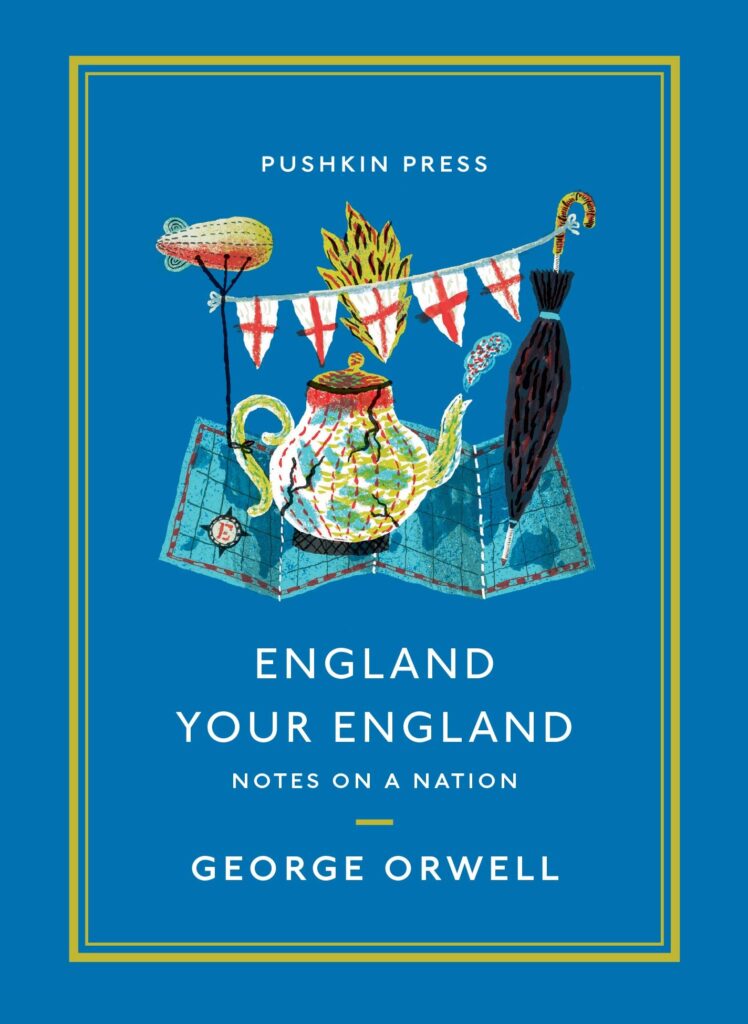
England Your England: Notes On A Nation
A Review
‘he was never blind to the negative corrosive effects of nationalism’
*
I have long associated the Pushkin Press with the production of very elegant small format books celebrating good writing from around the world and often focusing on lesser known or neglected voices from Central and Eastern Europe. They have now, following the ending of copyright on Orwell’s works, joined in the worldwide explosion of Orwelliania by publishing two slim collections: Inside the Whale: On Writers and Writing and the volume under review here, England Your England: Notes On A Nation. The collection comprises five pieces:- ‘Decline of the English Murder’ (1946); ‘Shooting an Elephant’ (1936); ‘Down the Mine’ (an extract from The Road to Wigan Pier, 1937); ‘The Spike’ (1931) and ‘The Lion and the Unicorn’ (1941). The last essay provides just over 60% of the contents and the subtitle. There is no introduction or critical apparatus, ‘England’s greatest social commentator’ as the blurb says, is left to speak for himself. Five disparate essays – two gritty observations of poverty and desperation in England, one Englishman abroad not liking what he saw, one example of the cultural observation Orwell did so well, and one famous essay on English Socialism and patriotism.
I have no doubt that great fun could be obtained from arguing about which other essays could or should have been included in a selection of works about Orwell and England. Whether or not Orwell read Robert Frost’s famous poem ‘The Road not Taken’, he was certainly adept at taking the one less travelled and indeed that did make all the difference: he was generally able to see things from a different perspective. Not from Oxbridge but the harsh realities of colonial policing; not from the cosy sleepy middle class land of his peers but the harsh realities of coal mining and homelessness; not from the warm self congratulatory platitudes of English nationalism but the harsh realities of war and the need for revolution.
I would insist personally that any collection about Orwell and Englishness/patriotism should contain the essay ‘Notes on Nationalism’ as a necessary corrective against co-opting Orwell in any nationalist or nativist camp, for he was never blind to the negative corrosive effects of nationalism. He might extol the virtues of being English and the English way of life but as for forcing it onto somebody else at the end of a rifle, that was not for him, and not in some arid theory: he had, of course, seen it in action in Burma. He advocated strongly for socialism but he had seen communist ‘nationalism’ in action in Spain exported from Russia and this tempered his ideas about revolution accordingly. His English revolution involved the minimum amount of blood in the gutters and the maximum amount of education, common sense and decency. It steered a middle course between insurrection and Labour Party gradualism but at the end of the process the upper classes’ stranglehold on Britain would be ended, the House of Lords and Public Schools would be gone and there would be public ownership of the means of production.
Orwell saw, as many more ideological revolutionists of the left did not, that the construction of a democratic socialist society required that vast swathes of the middle classes needed to be onboard. The revolution needed technocrats, scientists, teachers, doctors etc, they must on no account be alienated or discounted. They are part of the family, indeed some of the family members who should in fact be in charge. By 1945, however, ‘The Lion and the Unicorn’ was listed among the works that Orwell did not wish to see republished posthumously. With Hitler defeated and the failure of the war to generate the pressure needed for a revolution Orwell may have felt a bit more at ease with the Tribunite left in the previously disregarded Labour Party, and less inclined to consider a fully planned publicly owned economy as an essential goal.
*
England Your England: Notes On A Nation by George Orwell
- Pushkin Press, ISBN-13: 9781782277187
- Publication date: Thursday, January 7, 2021
- Price: £12.00
- 188pp
Thanks Steve
Some clear and excellent arguments not least about Orwell on Nationalism.
cheers
Quentin