
Orwellian Murders: I
Introduction In his celebrated essay The Decline of the English Murder (Tribune, 15 February 1946) George Orwell wrote that:
Our great period in murder, our Elizabethan period, so to speak, seems to have been between roughly 1850 and 1925, and the murderers whose reputation has stood the test of time are the following: Dr Palmer of Rugeley, Jack the Ripper, Neill Cream, Mrs Maybrick, Dr Crippen, Seddon, Joseph Smith, Armstrong, and Bywaters and Thompson. In addition, in 1919 or thereabouts, there was another very celebrated case, which fits into the general pattern but which I had better not mention by name, because the accused man was acquitted.
Enough has been written about Jack the Ripper. This, Part One of my article, will look at the other nine real or alleged murderers who Orwell named. Part Two will reveal the identity of the man he declined to name.
Dr William Palmer was born in Rugeley in Staffordshire in 1824; studied at Rugeley Grammar; was sacked by a Liverpool medical wholesaler and a Rugeley surgeon for embezzlement; but qualified as a doctor in London. He became a Rugeley GP but preferred breeding racehorses and gambling on them. He borrowed heavily. To finance his lifestyle and pay his creditors he became a serial poisoner.
Dr Palmer’s real or alleged victims included his wife who died of bilious cholera shortly after he had insured her for £13,000; four of their five children who died of convulsions in infancy; two children he fathered out of wedlock; his mother in law; his brother Walter Palmer whom he had insured for £13,000.; and a man to whom Dr Palmer owed £800.
The money lenders and the insurance companies were closing in. Dr Palmer attended Shrewsbury Races with John Parsons Cook who won heavily. Dr Palmer collected many of Cook’s winnings and used them to pay Palmer’s creditors. The next day Cook fell ill so he and Palmer returned to Rugeley John Parsons Cook died four days later, and a post-mortem showed that he was poisoned.
Dr Palmer was arrested; sent to London; tried at the Central Criminal Court i.e. the Old Bailey; and convicted of murder. He was publicly hanged outside Stafford Gaol on 14 June 1856 aged thirty one. This case is the origin of the phrase What’s Your Poison; and inspired Robert Grave’s 1957 novel They Hanged My Saintly Billy.
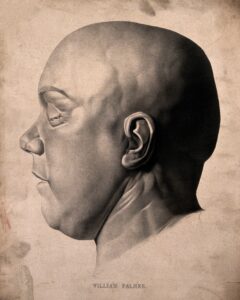 Death Mask of Dr Palmer (Wellcome Collection)
Mrs Florence Elizabeth Maybrick née Chandler was born in 1862 in Mobile, Alabama, into a well-connected banking family. In 1881 she married James Maybrick a Liverpool cotton broker aged forty two. They produced two children, but he was a womaniser and hypochondriac who took many drugs including arsenic and strychnine.
Mrs Maybrick had an affair. She obtained arsenic from fly papers allegedly for cosmetic use. Arsenic was used for this purposes; but an adulteress who obtained it for any reason was living dangerously. Her husband died on 11 May 1889, and a post mortem revealed arsenic in his body. She was convicted of murder and sentenced to death, but the sentence was commuted to life in prison. She was released in 1904 and returned to the USA. Her book My Fifteen Lost Years was published in 1909. She died in Connecticut in 1941 aged seventy nine.
 Mrs Maybrick (The Graphic, 1889)
Thomas Neill Cream was born in Glasgow on 27 May 1850. His family moved to Canada where his father became a manager for a Canadian shipbuilding and lumber company. Thomas Neill Cream studied at a company school. In 1876 he qualified as a doctor at McGill University, Montreal; and married Flora Eliza Brooks a doctor’s daughter.
Dr Neill Cream returned to England and collected £200 insurance money after his wife died in 1877. He practised medicine in Canada and the USA. In 1881 he was convicted in Canada for murdering a patient whose wife he had seduced. He served ten years in prison. On his release he returned to England and poisoned two prostitutes.
In April 1892 Dr Neill Cream poisoned another two prostitutes, and blamed the murders on a medical student who shared lodgings with him. He tried to blackmail this man’s father who informed the police. They uncovered a trail of suspicious deaths in England, Canada, and the USA. Dr Neill Cream’s insanity plea failed. He was convicted of murder and was hanged in Newgate Prison on 15 November 1892 aged forty two.
Dr Hawley Harvey Crippen was born in Michigan in 1862; attended school there; qualified as a homeopathic doctor at the Homeopathic Hospital College in Cleveland, Ohio; and later became a dentist in London. His first wife died in 1892. Later that year he married Belle Elmore a music hall artist, and in 1903 he began an affair with a typist Ethel Le Neve. In 1910 he poisoned Belle Elmore, buried her under his cellar and poured slaked lime over her corpse. He did not know that it preserves flesh unlike quick lime which destroys it.
Ethel Le Neve wore some of Belle Elmore’s jewellery and this aroused suspicions. The police searched Crippen’s house and found the body. Meanwhile Crippen and Le Neve had sailed on a liner bound for Montreal. They were in disguise but the captain became suspicious and radioed Britain. The fugitives were arrested on arrival at Montreal and deported to Britain.
The pair were tried at the Old Bailey. Forensic evidence proved the identity of the body and Crippen was convicted of murder. Ethel le Neve was acquitted and died in 1967 aged eighty four. Dr Crippen was hanged in Pentonville Prison on 23 November 1910 aged forty eight.
Frederick Henry Seddon was born in Liverpool in 1872 and was an insurance official, a property speculator and ran a second hand clothes business. In 1893 he married Margaret Ann Jones. They produced five children. In 1909 he bought a large London house. He let one floor to Eliza Mary Barrow a spinster aged forty seven and her eight year old orphan foster son; and persuaded her to let him control her savings and investments.
In August 1911 Seddon obtained arsenical fly paper; Eliza Barrow developed acute stomach pains; and a doctor prescribed medicine. She apparently recovered and made a will leaving all her property to Seddon. She died on 14 September 1911. He organised a funeral without contacting her relatives who became suspicious and told the police. The victim’s body was exhumed and was found to contain arsenic.
Frederick and Margaret Seddon were charged with murder and tried at the Old Bailey. He was convicted and she acquitted. He was hanged inside Pentonville on 18 April 1912 aged forty.
George Joseph Smith was born in London in 1872 an insurance agent’s son. He was allegedly convicted of theft and sent to a reformatory when he was nine; and released aged sixteen. In 1891 he got six months for bicycle theft. In 1898 he married Caroline Beatrice Thornhill a domestic servant who stole from her employers. In 1901 he got two years for receiving stolen property.
George Joseph Smith married at least seven women bigamously. He told his actual wife that he was an antiques dealer who went on long business trips; and that this explained his long absences from her. He had two modus operandi. One was to disappear with his victims’ property. The other was to murder his so called wives by taking them to places where they were unknown, telling doctors they were epileptic, and drowning them in a bath. Thus he obtained one woman’s £2,500 inheritance and the life insurance claim on two other victims.
Three inquests fell for this ruse but one was widely reported. Another victim’s father noted the similarity in the deaths and informed the police. George Joseph Smith was convicted at the Old Bailey of one of his three murders, sentenced to death, and hanged in Maidstone Prison on 13 August 1915 aged forty three. The reason why he was only convicted of one murder was to save court time; and in case he was acquitted other cases could be held in reserve.
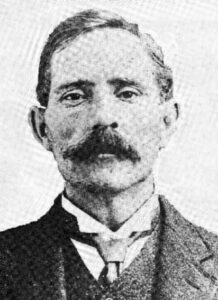 George Joseph Smith (Police Gazette)
Herbert Rowse Armstrong was born in Plymouth in 1869, studied law at Cambridge and became a solicitor in Hay on Wye, Herefordshire. In 1907 he married the allegedly domineering Katherine Mary Friend. They produced three children. He was a Territorial Army Captain and served in the Royal Engineers on the Western Front in the First World War becoming a Major.
Mrs Armstrong’s health collapsed in 1919. She recovered in a nursing home but after returning home relapsed and died on 22 February 1921. The cause of death was certified as gastritis.
Oswald Martin and Armstrong, the only two solicitors in Hay, were on opposite sides in a property dispute that could have cost Armstrong serious money. He invited Martin to tea. On returning home Martin was violently ill but survived. Oswald Martin’s father in law, the local chemist, remembered selling Armstrong arsenic as a weed killer.
Herbert Armstrong was arrested on 31 December 1921 and charged with attempted murder. His wife’s body was exhumed and tests showed that she had died of arsenic poisoning. He was tried at Hereford Assizes, convicted of murder and sentenced to death. He lost his appeal and was hanged in Gloucester Prison on 16 May 1922 aged fifty three. He died protesting his innocence.
Edith Jessie Thompson née Graydon was born in London on Christmas Day 1893. Her father was a clerk. She studied at Kensington Avenue Schools and on growing up became a buyer for a hat shop. In January 1916 she married Percy Thompson aged twenty five a shipping clerk. He then joined the British Army but was soon discharged on medical grounds.
In 1921 Edith Thompson began an affair with a merchant seaman Frederick Edward Francis Bywaters, aged eighteen. While he was at sea she sent him passionate letters and in them she falsely claimed to have attempted to poison her husband.
On the evening of 3 October 1922 the Thompsons saw a West End play. As they were returning home Bywaters intercepted them and stabbed Percy Thompson to death. Frederick Bywaters was arrested and the police found the incriminating letters. Mrs Thompson was arrested and she and Bywaters were convicted of murder and sentenced to death. Their appeals failed, and on 9 January 1923 she was hanged in Holloway, aged twenty nine, and he was hanged in Pentonville aged twenty.
*
John P. Lethbridge’s account of The Celebrated Swindler Madam Hanau, the criminal mentioned by George Orwell in his essay How The Poor Die, appeared in the Orwell Society Journal number 17.
What a charming bunch of people!
[…] In Part One of this article I looked briefly at the nine real or alleged murderers named by George Orwell in […]