
Food For thought: IV
Orwell’s Taste for Thackeray
Is it not interesting, now, that in his brief essay, ‘Oysters and Brown Stout’ on the novels of Thackeray (in Tribune, 22 December 1944), Orwell should praise, in particular, his depiction of food – so much part of the ‘characteristic flavour’ of his collected works? He writes: ‘Partly it is the atmosphere of surfeit which belongs to the early nineteenth century, an atmosphere compounded of oysters, brown stout, brandy and water, turtle soup, roast sirloin, haunch of venison, Madeira and cigar smoke, which Thackeray is well able to convey because he has a good grip on physical detail and is extremely interested in food’ (Orwell 1980 [1944]: 676).
Relishing the food theme, Orwell goes on to suggest Thackeray ‘writes about food perhaps more often even than Dickens, and more accurately’. ‘His account of his dinners in Paris – not expensive dinners, either – in “Memorials of Gormandizing” is fascinating reading. “The Ballad of the Bouillabaisse” is one of the best poems of that kind in English’. “A Little Dinner at Timmins’s”, he even asserts, is ‘one of the best comic short stories ever written, though it is seldom reprinted’ (ibid).
The Personal: ’He Liked Good Food’
In his personal life, Orwell constantly expresses an interest in food and in agricultural techniques, sets up a shop to sell food to the local villagers – is a keen vegetable-grower and raises animals (he even has chickens in the garden of his London apartment).
In a letter composed when he is just 12, while a pupil at St Cyprian’s prep school, in Eastbourne, dated mid-July 1916, he writes: ‘Darling mums, Thanks for your letter. Today there was a whole holiday, and we took our dinner out to East Dean and went to have tea at Jevington. The tea was unspeakably horrible, though it did cost 1/6’ (CWGO X: 21).
Significantly, when he moves into a house with Rayner Heppenstall and Michael Sayers, in Lawford Road, Kentish Town in August 1935, it is Orwell who cooks and does the washing up (Crick 1980: 274). In a letter to his life-long friend Brenda Salkeld, of 7 May 1936, he even spells out in detail a recipe he fancies: ‘I have hit on a wonderful recipe for a stew which is the following: half a pound of ox-kidney chopped up small; half a pound of mushrooms, sliced; one onion chopped very fine; two cloves of garlic, four skinned tomatoes, a slice of lean bacon chopped up, and salt, the whole stewed very gently for about two and a half hours in a very little beef stock. You eat it with spaghetti or rather coquillettes. It is a good dish to make as it cooks itself while you are working’ (ibid: 386).
Later in the year, he marries Eileen O’Shaughnessy. And it appears she ends up doing most of the cooking during their time at The Stores, Wallington. In her biography of Eileen, Sylvia Topp writes: ‘Every morning Eileen would make one of those huge English breakfasts they both loved. … She was an inventive cook and besides making delicious breakfasts in her tiny kitchen, she would concoct creative dinners worthy of compliments from friends’ (2020: 153).
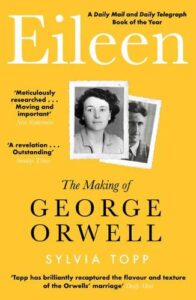
Orwell is the designated goat-milker and bacon slicer in the shop. In gaps between his writing, he also spends many hours working in the garden – planting rows of vegetables, as well as apple and plum trees and gooseberry and loganberry bushes. ‘Soon they were able to grow much of the food they needed from day to day, banishing for good their initial simple diet of spuds and eggs’ (ibid: 146). And Orwell, it seems, always tries to dress specially for dinner when they have guests. Topp quotes one visitor, saying he would ‘go around looking like a tramp during the day, but when dinnertime came he’d go upstairs and he’d wash himself and do his hair and he’d dress, and you’d sit down to the linen and all the rest’ (ibid: 155).
According to Topp, the shop has little success in selling groceries and food, the villagers preferring to go to nearby Baldock to shop. Eileen ends up selling mainly sweets to children (ibid: 148).
In 1938, Orwell and Eileen travel to Marrakesh – paid for by an anonymous donor – to restore their health in the sunshine. And Orwell’s diary is packed with details about their vegetable growing and rearing of animals such as hens and goats. And he lists precisely the crops grown by the locals: ‘palms, olives, pomegranates, maize, chillis, lucerne, most of the European vegetables (beans, cabbages, tomatoes, marrows, pumpkins, peas, radishes), brinjals, oranges and some cereals, I do not yet know which’ (Davison 2009: 105). He is also interested in how the vegetables are cultivated: ‘No spades or European forks, only hoes of the Indian style. Cultivation is made much more laborious by the lack of water, because every field has to be partitioned off into tiny plots with earth banks between, to conserve water. Not only small children but very old women work in the fields, women who must be at least 60, probably 70, clearing roots etc. with pick-axes’ (ibid).
In 1941, Orwell joins the BBC as a talks producer for the Eastern Service broadcasting to India and one colleague, Mulk Raj Anand, becomes a particular friend and he cooks Indian meals specially for him and Eileen at their Langford Court apartment (Bowker 2003: 286). Later, he also befriends Michael Meyer, a 21-year-old Oxford undergraduate and poet and invites him to their new flat in Mortimer Crescent. Of those visits Meyer remembers particularly the tea – ‘always black and strong, with large leaves floating on top, poured by George from a huge metal pot which must have held the best part of a gallon’ (ibid: 298). The Canadian Paul Potts speaks of high tea with Orwell on a winter’s evening – ‘a huge fire, the table crowded with marvellous things, Gentlemen’s Relish and various jams, kippers, crumpets and toast’ (Meyers 2000: 231). When Geoffrey Gorer, the social anthropologist, is invited for a meal he is served liver and bacon – which unfortunately does not go down well (Crick 1980: 265). But when soon afterwards he revives his Etonian friendship with Cyril Connolly he cooks him ‘bifteck aux pommes’ it’s a success (ibid). Another meal with H. G. Wells and Inez Holden ends in a terrible shouting match between the two men (ibid: 430).
Orwell, like most of the other BBC employees working close to Portland Place, uses the corporation’s canteen. Here Orwell is often found most days – and sometimes at night (ibid: 285). The Ministry of Truth, in Nineteen Eighty-Four, is said to be based on Orwell’s experience at the BBC – and significantly a ‘low-ceilinged canteen, deep underground’ features in a number of important scenes. In the first, Winston Smith chats to his friend Syme who raves about Newspeak and the destruction of words (Orwell 1976 [1949]: 773). In the second, Winston finally manages to have a few furtive words with Julia, ‘the girl from the Fiction Department’ – and they agree to meet at nineteen hours in Victory Square, near the monument (ibid: 810). So begins their fateful, passionate, secret affair.
When, in 1942, Orwell befriends the old-Etonian and Observer journalist, David Astor, they share their liking for good food. Astor has security service links dating back to 1939 and he introduces Orwell to the Shanghai dining group (named after the Soho restaurant where they meet). A number of its members have ties to intelligence including fellow old-Etonians Guy Burgess (later exposed as a Soviet spy), Frank Pakenham (later Lord Longford) and John Strachey (Keeble 2019: 11).
During his reporting assignment on the Continent in 1945, in the final months of the Second World War, Orwell meets another fellow old-Eonian A. J. ‘Freddie’ Ayer, in Paris. Ayer at the time is working for the Secret Intelligence Service (MI6), who are particularly concerned about the danger of a communist coup in the French capital. Ayer comments: ‘There is a legend that Orwell was a very austere man, very much of the puritan. It’s not borne out at all by my experience of him in Paris. He used to like going to good restaurants. He liked good food, liked drink. In fact he was a lively, gay companion’ (Wadhams 1984: 168). Also while in Paris, Orwell is introduced to P. G. Wodehouse by Malcolm Muggeridge, who is keeping an eye on the great comic novelist for British intelligence. Wodehouse is under some form of house arrest having been accused of treachery for broadcasting for the Nazis from Berlin. Not surprisingly, Orwell – who had written the essay ‘In defence of P. G. Wodehouse’ just before leaving for the Continent – takes him out for dinner at a good restaurant near les Halles. But his dinner date with the novelist and editor of the Resistance journal, Combat, Albert Camus, has to be called off after the Frenchman falls ill (Meyers 2000: 233).
In 1946, Orwell goes – with Richard and his sister Avril – to live on the remote Scottish island of Jura and compose what was to become his last work, the dystopian masterpiece Nineteen Eighty-Four. When not writing, he enjoys planting a vegetable garden, looking after the geese and hens, going fishing and setting lobster traps, shooting rabbits and butchering venison (Meyers 2000: 261). The meals, prepared largely by Avril, can be Spartan. Bill Dunn, who lives locally and goes on to marry Avril, remembers Orwell coming down from his work-room upstairs. He would ‘seem to be a wee bit hungry, but he wouldn’t really eat anything substantial. He would east something like brown bread and marmite and he would seem to enjoy it. Then he would go back upstairs and go on writing away’ (Wadhams 1984: 185). Jane, daughter of Orwell’s recently deceased sister Marjorie, who comes to stay at Barnhill, comments: ‘Eric always came in for meals, but he worked hard and had his routine. He’d have his breakfast and then he’d go up and write; then he always came down at lunchtime and we had the main meal in the middle of the day. … He liked pudding, I remember. And so did his father. I think Eric must have inherited that’ (ibid: 188).
Orwell And the Perfect Pub
When Orwell was living with Eileen in Wallington after their marriage, they would go to the Plough next door for drinks and occasionally to the nearby Derby (Topp 2020: 156). But he was a stickler for his own preferences in alcohol. ‘… one of Eileen’s friends remembered how, even when she had specifically ordered lager, Orwell would always bring her dark ale’ (ibid).
Moving to London in 1940, Orwell plunges into literary society meeting at Soho pubs and cafés Richard Crossman, Aneurin Bevan, Michael Foot, George Strauss, Tosco Fyvel, H. G. Wells, Anthony Powell, Kay Dick, Malcolm Muggeridge, Hugh Kingsmill, Dylan Thomas, T. S. Eliot, Michael Sayers, Rayner Heppenstall, the Labour MP Patrick Gordon-Walker and Graham Greene. Occasionally, he makes forays into more glamorous haunts such as the Café Royal where he meets, for example, the young artist Lucian Freud (Taylor 2003: 329). According to Bowker (2003: 277): ‘The Barcelona in Beak Street was his favourite restaurant, the Wheatsheaf his favourite pub.’ Other favourite pubs were the Dog and Duck, in Bateman Street – where there is today a George Orwell Bar – the Fitzroy Tavern, in Rathbone Place, and the Marquis of Granby, in Rathbone Street (Young 2016: 16). As for his favourite restaurants, they are the Bodega, Czardas and Elysée (Meyers 2000: 231). The Akropolis, in Percy Street, is also a favourite until he is ejected for removing his jacket (Bowker 2003: 309). After the war, he meets Vernon Richards and other pacifists in pubs near Conway Hall (Crick 1980: 449).
Orwell’s favourite pub, The Moon Under Water, is the subject of his last Evening Standard Saturday Essay (of 9 Febuary 1946). It’s typically witty, wonderfully inventive, conversational, down-to-earth. The pub is ‘only two minutes from a bus stop, but it is on a side street, and drunks and rowdies never seem to find their way there, even on Saturday nights’ (CWGO XVIII: 98). And thereafter Orwell carefully goes over the various aspects of the pub that appeal to him – the Victorian architecture, there’s a good fire burning in at least two of the bars, it’s always quiet enough to talk, it sells tobacco and good, solid lunches upstairs – and so on. Only towards the end does he reveals that the Moon Under Water actually does not exist – it’s his ideal. ‘I have mentioned above ten qualities that the perfect pub should have and I know one pub that has eight of them. Even there, however, there is no draught stout and no china mugs’ (ibid: 100). Richard Young reports John Thompson, in his book Orwell’s London, of 1984, thinking that the Canonbury Tavern, which is close to where Orwell was living at the time, is the inspiration for the Moon Under Water (Young 2016: 16).

Young also highlights a little known, unsigned review of the book, The Pub and the People, which Orwell pens in January 1943 for the Listener. It is the first of a series which Victor Gollancz commissions from Mass Observation – and is based on interviews with people in pubs in ‘Worktown’ (actually Bolton). Orwell is clearly fascinated by the book. And while it highlights the decline in pub-going and the general trend in people’s leisure ‘from active and communal forms to those that are passive and individual’, Orwell is more concerned to stress that the Mass Observers have ‘no difficulty in showing that there was extraordinarily little drunkenness in the period they were studying’ (ibid: 17).
A major new study of The Pub and the People, by academics Jennie Taylor and Simon Prince, largely confirms Orwell’s conclusions. Writing in The Historical Journal, they point out that the Mass Observers tended to idealise the world of the pub, representing it as largely socially harmonious and egalitarian with individuals generously buying drinks for their companions. Looking into the pub study’s archive, Taylor and Prince discover material that contradicts the published findings (2020). Observers actually turned in reports focusing on ‘authoritarian conduct, hierarchical power structures’ and heated discussions about contemporary politics. The Pub and the People does describe a fight between ‘Jack’, ‘Peter’ and ‘Peter’s woman’ and one heated argument at Waterloo Tavern. And occasionally observers became involved in heated discussions. But, as Orwell, stressed these moments of tension were, remarkably, very much the exceptions.
Taylor and Prince are clearly unaware of Orwell’s review. They merely quote the main organiser of the ‘Worktown’ project, Tom Harrisson, dismissing Orwell as a member of an ‘old Eton group slumming’ (ibid: 9).
Pubs in the Novels
Not surprisingly, pubs feature in Orwell’s novels. In Keep the Aspidistra Flying, there are two contrasting scenes involving the central character, Gordon Comstock. He is alone, with little money in his pockets, walking through London’s streets – in Lambeth, across Trafalgar Square, past the cinema showing Greta Garbo in The Painted Veil, past the prostitutes up to Tottenham Court Road and Camden Road. Finally, dreadfully thirsty, He enters the Crichton pub. In a private room the Buffaloes are singing but in the saloon bar he sees Flaxman, the outrageously confident, fellow lodger of Mrs Wisbeach, in Willowbed Road, NW. ‘One elbow on the bar, his foot on the rail, a beer-streaked glass in the other hand, he was swapping backchat with the blonde cutie barmaid’ (Orwell 1976 [1936]: 623). Comstock leaves and heads home.
The next time Gordon visits a pub he’s with Ravelston, the aristocratic editor of Antichrist, who is loosely based on Sir Richard Rees, Orwell’s life-long friend, fellow old-Etonian and editor of the Adelphi. Bowker highlights the ‘Eton tradition of ruthless criticism within a continuing friendship’ (2003: 288) which Orwell gleefully maintains in a number of his relationships. Here Ravelson is the butt of Orwell’s satirical pen – a man who spouts Marx and socialist ideas but when confronted with a working class pub recoils. He only enters when he think that ‘pubs are genuinely proletarian. In a pub you can meet the working class on equal terms’. Young comments astutely: ‘I suspect this was part of the fascination that Orwell had in real life for pubs’ (Young 2016: 16). Comstock pays for the first round, mocks his friend’s commitment to socialism and ends up moaning about having no money. Ravelson thinks about the unemployed in Middlesbrough ‘seven in a room on twenty-five bob a week’, feels guilty – and then they leave.
There is also an important scene in Nineteen Eighty-Four (1976 [1949]: 793-797) when Winston Smith follows an old man into a ‘dingy little pub’ in the prole district – hoping to find out about life before the revolution that removed the capitalists and installed the Party. But the old man talks largely nonsense. The scene follows shortly after Orwell intones in the novel: ‘But if there was hope, it lay in the proles.’ Thus, Orwell cleverly avoids the temptation to sentimentalist the proles with an idealistic picture of their ‘humanity’. Instead, he paints a very negative picture – the message clearly being: the revolution will be led by the proles but it won’t be easy and not without its problematics.
Conclusion: Orwell, Food and the Pleasure Principle
In the spring of 1940, Orwell writes a short piece about his life, likes and dislikes for an American writers’ directory: ‘Outside my work the thing I care most about is gardening, especially vegetable gardening. I like English cookery and English beer, French red wines, Spanish white wines, Indian tea, strong tobacco, coal fires, candle light and comfortable chairs.’ Amongst his dislikes is ‘tinned food’ (Bowker 2003: 263).
Orwell is perhaps too often associated with the gloom and doom of Nineteen Eighty-Four. Typically, Jason Cowley, in an introduction to a new edition of Animal Farm in 2020, writes that ‘Orwell is not renowned for his humour’ (2020: 41). Michael Ayrton’s even nicknames him ‘Gloomy George’. Yet there is another side to Orwell which this essay has sought to highlight. For food and drink are incredibly important to Orwell – and his love of them is all part of the optimistic, pleasure-seeking, life-affirmative, Sancho Panza aspects of his personality which so often shine through.
Acknowledgement
The author would like to thank Richard Young for alerting him to the existence of Orwell’s unpublished essay, ‘English cookery’.
References
Bowker, Gordon (2003) George Orwell, London: Little, Brown
Cowley, Jason (2020) The road to revolution, New Statesman, 11 December – 7 January 2021 pp 39-41
Davison, Peter (ed.) (1998) CWGO The Collected Works of George Orwell, 20 Vols, London: Secker & Warburg
Davison, Peter (ed.) (2006) George Orwell Diaries, London: Penguin
Keeble, Richard Lance (2019) The ‘invisible masonic network of support’: Orwell and Eton, Davidson, Russ (ed.) George Orwell: His Enduring Legacy, Albuquerque: University of New Mexico
Keeble, Richard Lance (2020) The myth of freedom: Orwell and the press, Journalism Beyond Orwell, London: Routledge pp 15-32
Meyers, Jeffrey (2000) Orwell: Wintry Conscience of a Generation, New York: W.W. Norton & Company
Orwell, George (1980 [1933]) Down and Out in Paris and London, in the collected non-fiction, London: Secker & Warburg pp 15-120
Orwell, George (1976 [1936]) Keep the Aspidistra Flying, in the collected novels, London: Secker & Warburg pp 577-737
Orwell, George (1980 [1937]) The Road to Wigan Pier, in the collected non-fiction, London: Secker & Warburg pp 125-231
Orwell, George (1976 [1939]) Coming up for Air, in the collected novels, London: Secker & Warburg pp 431-571
Orwell, George (1980 [1944]) Oysters and Brown Stout, in the collected non-fiction, London: Secker & Warburg pp 675-677
Orwell, George (1946) British cookery. Available online at https://www.orwellfoundation.com/the-orwell-foundation/orwell/essays-and-other-works/british-cookery
Orwell, George (1976 [1949]) Nineteen Eighty-Four, in the collected novels, London: Secker & Warburg pp 743-925
Orwell, Sonia and Angus, Ian (eds) (1970) The Collected Essays, Journalism and Letters of George Orwell, Vol. 1: An Age Like This, Harmondsworth: Middlesex: Penguin
Perkins, Blake (2014) George Orwell and the defence of English food, Petits Propos Culinaires, No. 106 pp 68-86. Available online at https://prospectbooks.co.uk/products-page/ppc/ppc-101-october-2014/
Taylor, D. J. (2003) Orwell: The Life, London: Chatto & Windus
Taylor, Jennie and Prince, Simon (2020) Temporalities, ritual and drinking in Mass Observation’s Worktown, The Historical Journal. Available online at https://www.cambridge.org/core/journals/historical-journal/article/temporalities-ritual-and-drinking-in-mass-observations-worktown/E05E24232A5358C588294FD0287C37D1
Topp, Sylvia (2020) Eileen: The Making of George Orwell, London: Unbound
Wadhams, Stephen (1984) Remembering Orwell, Harmondsworth: Middlesex: Penguin
Woloch, Alex (2016) Or Orwell: Writing and Democratic Socialism, Cambridge, Massachusetts: Harvard University Press
Woodcock, George (1984 [1966]) The Crystal Spirit: A Study of George Orwell, London: Fourth Estate
Young, Richard (2016) The pub and George, Orwell Society Journal, No. 8 pp 16-17
-
Richard Lance Keeble was chair of The Orwell Society, 2013-2020.
Leave a Reply