
Orwellian Murders: II
Introduction In Part One of this article I looked briefly at the nine real or alleged murderers named by George Orwell in his article The Decline of the English Murder (Tribune, 15 February 1946). Here I look at the case of Harold Greenwood whom Orwell surely meant when he wrote:
In addition, in 1919 or thereabouts, there was another very celebrated case, which fits into the general pattern but which I had better not mention by name, because the accused man was acquitted.
Family Background Harold Greenwood was born on 1 January 1874 at Ingleton in Yorkshire. His parents were William Norman Greenwood born in Ingleton in 1850 a landed gentleman; and Isabella Ann Greenwood nee Balderston born in 1851. Harold Greenwood’s father died in 1876 aged twenty six when his son was two. Harold Greenwood was the second of his parents’ four sons. His older brother William Norman Greenwood was born in 1873, Percy Greenwood in 1876 and Oscar Greenwood in 1877 after his father’s death.
Career and Marriage Harold Greenwood became a solicitor. On 2 June 1896 he married Mabel Bowater. She was born on 3 September 1871. Her parents were William Vansittart Bowater (1838-1907) of Bury Hall, Edmonton, near London who had built up a multinational paper milling company; and Eliza Jane Bowater nee Devey (1838-1912). Mabel Bowater was the second of their two daughters and the seventh of their ten children. Two of her brothers became Lord Mayors of London. Sir Thomas Vansittart Bowater (1862-1938) was Lord Mayor of London in 1913-1914 being in office when the First World War began. His brother Sir Frank Henry Bowater (1866-1947) was Lord Mayor in 1938-1939 being in office when the Second World War began.
Harold and Mabel Greenwood produced four children. Edith Irene Isabelle Greenwood was born at Enfield near London on 3 April 1898. Mabel Eileen Greenwood was born on 15 November 1902 at Kidwelly in Carmarthenshire where her father was a solicitor. Norman Ivor Vansittart Bowater Greenwood was born on 1 November 1904 at Kidwelly. John Kenneth Greenwood was born in 1910 at Kidwelly.
Notoriety Mabel Greenwood died on 16 June 1919 aged forty seven. She had been ill for some time and at first her death was thought to be natural. The Greenwood family doctor Thomas Roberts Griffiths had prescribed medicine for her shortly before she died. He attributed the cause of death to heart disease and this was recorded on the death certificate.
Shortly after his wife died Harold Greenwood proposed marriage to Dr Griffiths’s sister Mary Adelina Griffiths aged forty six. She rejected him. He then proposed to his secretary Gwaldys Amelia Jones born in 1888 the daughter of William Benjamin Jones an insurance company official and journalist. She agreed and they married on 1 October 1919 at St Mary’s Church in Kidwelly.
Mabel Greenwood had been respected in Kidwelly being active in church and other affairs including the tennis club. Rumours spread and on Friday 16 April 1920 at the request of the Llanelly Police her body was exhumed from St Mary’s church graveyard in Kidwelly. A Coroner’s Inquest was opened later that day at Kidwelly Town Hall. It heard some evidence and adjourned to await the result of Home Office tests.
The inquest resumed on Tuesday 15 June 1920. It heard evidence that arsenic had been found in Mabel Greenwood’s remains; that Harold Greenwood had before his first wife died been very familiar with his secretary who was to become his second wife; and that he had purchased a weed-killer containing arsenic. On Wednesday 16 June 1920 the inquest returned a verdict that Mabel Greenwood had been poisoned by her husband.
Harold Greenwood was arrested. A magistrate remanded him to be held in Carmarthen County Gaol. The main hearing before the Llanelly magistrates opened on Thursday 1 July 1920. As well as the inquest evidence, it was alleged that the prisoner had put arsenic in a bottle of burgundy from which the victim had drunk before she died. The hearing lasted four days and on Monday 5 July 1920 the prisoner was committed for trial at the Carmarthen Assizes.
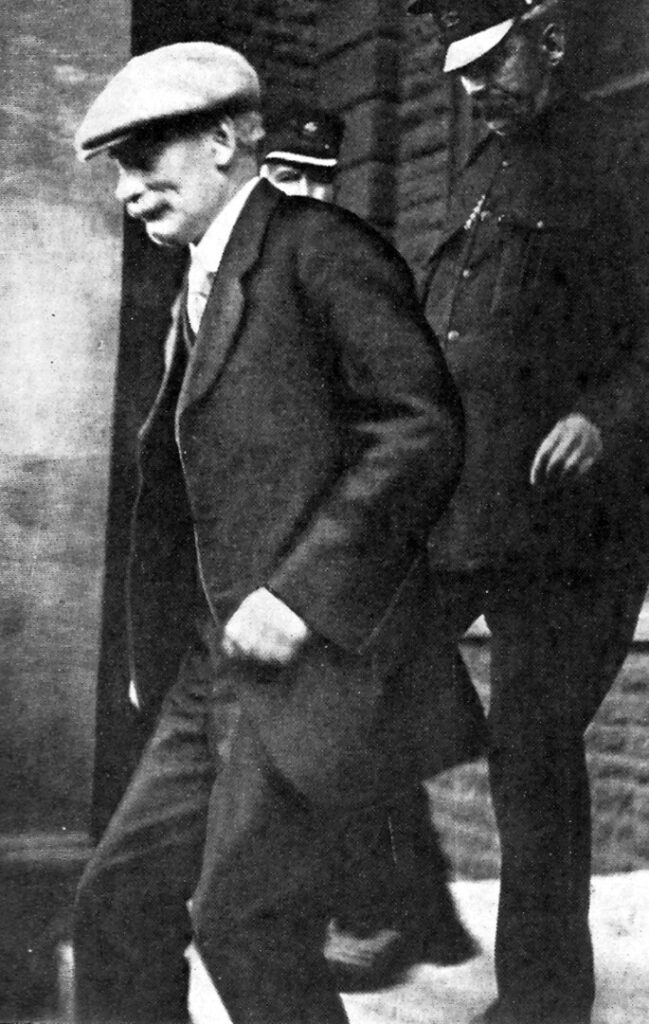
Harold Greenwood, on the court-house steps
The Trial The trial opened at Carmarthen Assizes on Tuesday 2nd November 1920 and lasted seven days, which was then a long time for a trial. The judge was Sir Montague Shearman, while the lead prosecution counsel was Sir Edward Marlay Samson KC, a very experienced prosecutor, assisted by Mr Wilfred Hubert Poyer Lewis. The lead defence counsel Sir Edward Marshall Hall (1858-1927) was probably Britain’s best known defence lawyer during the heyday of the celebrity lawyer. He was assisted by Trevor Havard Hunter.
The prosecution presented an apparently strong case, but Sir Edward Marshall Hall in cross examination discredited a vital witness. He showed that she had changed her story under police pressure. He proved that the prisoner had nothing to gain financially by murdering his wife because her Bowater inheritance was locked up in a trust fund for their children.
Harold and Mabel Greenwood’s daughter, Edith Irene Isabella Greenwood, testified that she had drunk from the allegedly poisoned bottle of burgundy shortly before her mother did; and had not suffered any harm. This still left the questions of how the arsenic had got into the victim’s body and what had caused her death
Sir Edward Marshall cross examined Dr Thomas Robert Griffiths. At the inquest and magistrates’ hearing he had testified to giving Mabel Greenwood morphine shortly before her death. Sir Edward Marshall Hall pointed out that this could cause death. Dr Griffiths replied that he had actually given her opium, and that his saying morphine rather than opium was a slip of the tongue.
Dr Griffiths had said that he had also given Mabel Greenwood bismuth. Sir Edward Marshall Hall suggested that Dr Griffiths had actually given her Fowler’s Solution, a medicine that contained arsenic, by mistake. The bottles in which these two medicines were contained look very similar. Some of Dr Griffiths’s medical records that would have been crucial evidence were missing.
Harold Greenwood had used arsenical weed killer in his garden and, shortly before she died, his wife had eaten gooseberries grown there. In doing so she might have consumed arsenic.
Verdict On Tuesday 9 November 1920 the jury acquitted Harold Greenwood. He was released after more than four months in gaol but his reputation was shattered. His legal costs were heavy. He made some money by selling his story to various newspapers – including the Sunday Herald in a series that ran from Sunday 14 November to Sunday 12 December 1920.
In 1922 William John D’arc’s Cardiff waxworks displayed a wax figure of Greenwood in its Chamber of Horrors. Harold Greenwood sued for libel and on 7 March 1922 a jury at the Glamorgan Assizes awarded him £150 damages.
Harold and Gwladys Amelia Greenwood left Kidwelly and after several moves lived in Walford a Herefordshire village, near Ross on Wye under the assumed name of Pilkington. They did some farming, but it is surely coincidence that in Orwell’s Animal Farm the name “Pilkington” is given to “an easy-going gentleman farmer”. In 1928 Harold Greenwood applied to become Town Clerk of Ross on Wye Urban District Council but his application was rejected. He died at Walford on Thursday 17 January 1929, aged fifty five, of a cerebral haemorrhage and was buried on Monday 21 January 1929 in Walford’s Anglican Churchyard. His wife returned to Carmarthenshire and died at Llanelly on 14 January 1962 of pneumonia, aged seventy four.
Conclusion The London Times reported Harold Greenwood’s trial blow by blow over seven days accompanied by editorial commentary. It was not just The News of the World readers who loved a good murder.
In 1930 William Hodge & Company published Winifred Duke’s book the Trial of Harold Greenwood, in its Great Trials series. All the real or alleged murderers whose cases I described in part one of my article have had books about them published in this series. In addition the Greenwood case has featured in several anthologies. The several books about Sir Edward Marshall Hall include Edward Marjoribanks MP’s The Life of Sir Edward Marshall Hall (Gollancz, 1929). They all discuss the Greenwood case but an eight part 1989 BBC Two series about Marshall Hall, the Shadow of the Noose, ignored it.
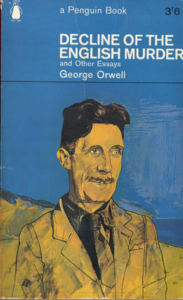 Penguin Books named their second selection of Orwell’s essays Decline of the English Murder
A little over a year after The Decline of the English Murder was published, in one of his later, lesser-known As I Please columns, that of March 21st 1947, George Orwell wrote about the failures of the British legal system exposed in another and recent murder trial: “An innocent man might be convicted, the real criminal might make an unmistakeably genuine confession, and the innocent man might still be hanged”, and referring to a recent case echoing Harold Greenwood’s, particularly in reference to costs: “I confess that I had not realised until then that when you are found not guilty on a criminal charge, you still have to pay your own costs. I had vaguely imagined that when the Crown is discovered to be in the wrong, it pays up”. Overall Orwell referred to the arcane and little known workings of the court system in these words: “By some chance or other— for instance, by reading the reports of a murder case— one finds out how the law stands on a certain subject, and it is frequently so stupid or so unfair that one would not have believed it if one had not seen it in black and white.”
*
John P. Lethbridge’s account of The Celebrated Swindler Madam Hanau, the criminal mentioned by George Orwell in his essay How The Poor Die, appeared in the Orwell Society Journal number 17.
It is interesting that Orwell did not name Greenwood, not did Agatha Christie in A Murder Is Announced, who also references the case. Yet he had been dead for some years. Perhaps neither author was aware of this, though it was widely reported. The question is, did he do it? By the way, I liked your accurate and concise account.