
May 2021: Books and Pamphlets
The re-issue of Arturo Barea’s Struggle for the Spanish Soul corrects a serious omission: the book has not been available since its first issue in 1941. Struggle for Spanish Soul, paired in this new edition with the briefer Spain in the Post-War World, was the tenth in George Orwell and Tosco Fyvel’s Searchlight Books series. It well deserves being read today.
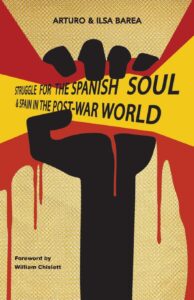
Struggle had an extraordinary publishing history, but exemplifies the lengths to which British publishers and editors went to overcome the consequences of Nazi destruction. The publisher’s copy of the typescript was lost in an air-raid, but Barea had fortunately made a carbon copy (it was was his wife Ilse who had corrected his English), which made it to the typesetters. Then the proof and type was destroyed in an air-raid and had to be completely reset. The book should have appeared in May 1941 but still saw the light of day only three months later in July.
The availability of the book will likely lead to a revision of the sources of George Orwell’s own Nineteen Eighty-Four, and will reinforce the notion that in writing Orwell was drawing on the cruelties of life under fascism as much as under Stalinism. Barea draws on reports from Spain, and wireless monitoring of Spanish broadcasting two to three years after Franco’s conquest, to report on life under the falange. After less than five years life was horrific: controlled, centralised, subject to heavy punishments, even while enemies were in gaol, concentration camps, labour battalions, or still being given to the firing squad. Worse – and this would underlie part of Orwell’s dystopia – the imposition of religious fanaticism: “Fantastic and morbid pilgrimages in which corpses are borne through the country for days and nights by people anxious to win the favour, if not of God, then those in power, by their demonstrations of a faith they do not feel”.
Spain the in the Post-War World was written for the Fabian International and written in a much colder style, exemplified by section headings such as “German Industrial Infiltration” and “Spanish Patent Law”. A final section on Spain after Franco would seem to have been written with an exuberance of hope, seen in hindsight.
Struggle for the Spanish Soul & Spain in the Post-War World, by Arturo and Ilse Barea with a Foreword by William Chislett (Clopton Press, ISBN13: 9781913693046)
The Clopton Press have reissued many interesting works from International Brigadeers, volunteers, and other memoirs of Spain in the 1930s.
*
In April 1984 Paul Foot gave a talk to a Socialist Workers Party event in Skegness on George Orwell and Nineteen Eighty-Four. The talk was transcribed and that transcription has now been published with an Introduction by John Rudge.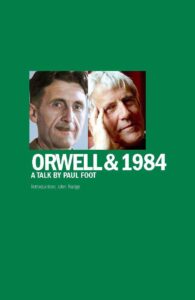 Paul Foot dedicates only the last third of the talk to Orwell’s novel, he gives almost equal coverage to The Road to Wigan Pier, and Homage to Catalonia. He is much more sympathetic to the Orwell who returned from Spain than to the Orwell who returned from northern England and wrote Wigan Pier. His Wigan Pier objection being that Orwell wrote nothing about trade unions although they were the most prominent form of political activity by workers such as the miners. Foot’s most significant contribution to discussions of Animal Farm and Nineteen Eighty-Four may be that his identification: “these books are not written at the time of the Cold War, as we now know it.” And he goes on – possibly reinforcing his point about the lack of working class activity in Wigan Pier and Orwell’s later realisation of it, “It is also important that the working class is still there in those books [Animal Farm and Nineteen Eighty-Four].”
Orwell & 1984: A Talk by Paul Foot, Introduction by John Rudge (Redwords, ISBN13: 9781912926503)
*
John Newsinger is the author of Orwell’s Politics (1999), and Hope Lies in the Proles: George Orwell and the Left (2018). He has now written A Rebel’s Guide To George Orwell, the latest addition to a series of Rebel Guides which include similar small volumes on Marx, Lenin, Alexandrai Kollontai, and Rosa Luxemburg (only two of whom is the adult Orwell known to have appreciated).
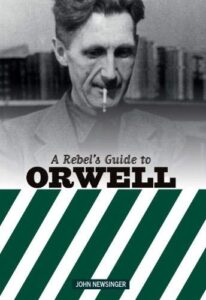
What makes this short guide (60 pages containing 17 sections) so good is that John Newsinger is able to refer to three areas of Orwell’s life and work: his books, his journalism, and his personal activities in order to make his argument that people who want to read Orwell today to understand the current problems in political and everyday life will find that Orwell experienced and analysed them in his own time. So Newsinger can point out Orwell’s beliefs in the working class (as he had found in Spain) remained strong; that he returned from Spain to join the Independent Labour Party; that when war came he supported once more the struggle against fascism and Nazism even while he tried to make the war a revolutionary war. He found that that potential revolution (described in his own Searchlight Book, The Lion and the Unicorn) was in turn betrayed. Nevertheless he continued to support a last best hope, the post-war Labour government which was being threatened by Stalinist infiltration from the East and conservative Americans from the West, and specifically issued a press release to say that Nineteen Eighty-Four was not an attack on the Labour government. In his last major analysis, though, as Newsinger points out, referring to “Towards European Unity” published in Partisan Review in 1947, Orwell did not identify the Labour government with the socialism he wished to see established.
A Rebel’s Guide to George Orwell, by John Newsinger (Bookmarks, ISBN13: 9781914143007)
Leave a Reply