
Coming Up For Air: ‘Legs!’
A news story told in newspaper extracts, newspaper billboards and the bellowed cries of street vendors simultaneously grows in significance even as the phrases associated with the events shrink in the first chapters of George Orwell’s 1939 novel Coming Up For Air. Protagonist George Bowling gives his opinions on the crime, quotes his fellow travellers on a commuter train into London as they discuss the crime, and then comments on the reduced lexicon of the news story. The story runs in parallel to other events of the day, one of which – the on-off marriage of King Zog of Albania – is the key to Bowling travelling first into the past in memory and then in reality. As we shall see, though, the crime comes back in a different context before Bowling has returned to his domestic life in the troubled late 1930s.
I had a look at the paper, but there wasn’t much news. Down in Spain and over in China they were murdering one another as usual, a woman’s legs had been found in a railway waiting-room, and King Zog’s wedding was wavering in the balance.
(Part I: Chapter 1)
The chap who’d borrowed my matches was having a good pick at his teeth over the Express.
‘Legs case don’t seem to get much forrader,’ he said.
‘They’ll never get ‘im,’ said the other. ”Ow could you identify a pair of legs? They’re all the bleeding same, aren’t they?’
‘Might trace ‘im through the piece of paper ‘e wrapped ’em up in,’ said the first.
(Part I: Chapter 3)
Outside the door a newsboy yelled ‘StarnoosstanNERD!’ I saw the poster flapping against his knees: LEGS. FRESH DISCOVERIES. Just ‘legs’, you notice. It had got down to that. Two days earlier they’d found a woman’s legs in a railway waiting-room, done up in a brown-paper parcel, and what with successive editions of the papers, the whole nation was supposed to be so passionately interested in these blasted legs that they didn’t need any further introduction. They were the only legs that were news at the moment. It’s queer, I thought, as I ate a bit of roll, how dull the murders are getting nowadays. All this cutting people up and leaving bits of them about the countryside. Not a patch on the old domestic poisoning dramas, Crippen, Seddon, Mrs Maybrick; the truth being, I suppose, that you can’t do a good murder unless you believe you’re going to roast in hell for it.
(Part I: Chapter 4)
Outside the newsboy shoved the Standard into my face and yelled, ‘Legs! ’Orrible revelations! All the winners! Legs! Legs!’
(Part I: Chapter 4, later)
When I got down near Charing Cross the boys were yelling a later edition of the evening papers. There was some more drivel about the murder. LEGS. FAMOUS SURGEON’S STATEMENT. Then another poster caught my eye: KING ZOG’S WEDDING POSTPONED. King Zog! What a name!
(Part I: Chapter 4, later still)
 Colin Blakely as George Bowling (BBC 1966)
We can date some of the events in Coming Up For Air by George Bowling’s references, although given his rose-coloured view of the past, all of these must be subject to reservation. The events of the novel cannot have occurred after April 1938, for it was on the 27th of that month that King Zog married Countess Geraldine Apponyi de Nagy-Appony in Tirana. His wedding can only have been in doubt before that. What Orwell then did was to carry forward two major crimes of 1934 to Spring 1938: those two events being the two Brighton Trunk Murders of that earlier year. Contemporary readers would also have understood the sense of ‘the piece of paper ‘e wrapped ’em up in’, the observation of one of the commercial travellers, as the prosecution in Buck Ruxton’s case of 1936 had depended on the newspapers found with his victims’ bodies.
There were two murders in Brighton in 1934 in which bodies were placed in trunks: the first, which led to the discovery of the second, was never solved. The second went to trial but led to a verdict of not guilty. It was the first murder that provided Orwell with his key image: ‘Legs!’
On Sunday 17 June 1934 a Southern Railways Relief Porter, William Vinnincombe, smelt a stink from a double locked suitcase in Brighton Central Station’s cloakroom. The railway police opened it to find a woman’s torso. The next day the legs were found in a trunk at London King Cross Station. The other body parts were never found, nor could Sir Bernard Spilsbury identify a means of death: the press named the victim ‘The Girl with the Pretty Feet’ although she had been a woman in her twenties. The case has never been solved, nor has the victim been identified, but the idea of feet and the separation of the legs gave Orwell the material to reveal the abased nature of life between the Wars.
It was during the attempt to identify the victim of the first trunk murder that the second came to light. A friend of Violet Saunders, who had been missing for some time, notified police who searched the rooms of Saunders’ boyfriend, petty criminal Jack Notyre (alias Tony Mancini: born Cecil England) in mid-July, and found her body in another trunk. Mancini was tried for murder but cleared due to doubts about the quality of the forensic evidence. That he had kept the corpse in his lodgings for a month and half was never challenged.
The degradation of the criminal Jack Notyre, and the evidence that emerged that he had been an ‘enforcer’ for London gangster Charles Darby Harry Boy Sabini who preyed on legal and illegal bookmakers only added to the public perception of Brighton as a den of vice. The hotels and boarding houses of the town were already associated with sexual immorality, adultery, and the twisted logic that passed for evidence in the divorce courts of the period. Without naming the cases Orwell could make all these connections in his readers’ minds. Another author, about the same time, would be more explicit. That Notyre had gone on the run before the discovery of his victim and been arrested in Sidcup, Kent would add that place to the gazetteer of crime in literature.
The degradation of life, even of a character such as George Bowling who strove to escape it, can be read in his response – or failure to respond – to the degradations of feeling implicit in the continuing abbreviation of the murder case. By chapter four of Coming Up For Air, where allusions are repeated, this descent is clearly happening hour by hour: ‘Just ‘legs’, you notice. It had got down to that’, Bowling says, but by the end of the chapter he is describing this inhumanity as ‘drivel’. He is being corrupted himself.
All these events, though, take on a wider context before the novel ends. Having returned to his childhood home of Lower Binfield and finding it changed, more change comes from the sky as an aircraft accidentally drops a bomb on the town:
There was a frightful smashed-up mess of bricks, plaster, chair-legs, bits of a varnished dresser, rags of tablecloth, piles of broken plates, and chunks of a scullery sink. A jar of marmalade had rolled across the floor, leaving a long streak of marmalade behind, and running side by side with it there was a ribbon of blood. But in among the broken crockery there was lying a leg. Just a leg, with the trouser still on it and a black boot with a Wood-Milne rubber heel. This was what people were oo-ing and ah-ing at.
(Part IV: Chapter 6)
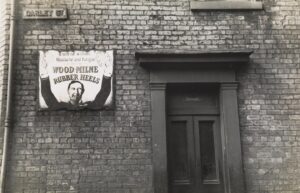
Wood Milne Rubber Heels Unknown Unknown artist null Gift Eric and Louise Franck London Collection 2017 http://www.tate.org.uk/art/work/P14886
And there is a leg again: ‘Just a leg, with the trouser still on it and a black boot with a Wood-Milne rubber heel.’ The weapons of war used even unintentionally bring the physical reality of trauma into Bowling’s life. It is something that cannot be escaped, but it has taken a physical event to bring it home to Bowling, who had not long before thought of such an injury as ‘drivel’.
Whether Orwell took other features from the Trunk Murders we shall never know. There is the strange similarity that Mancini was discovered by the coincidence of another murder occurring at the same time as his case, while Bowling is betrayed to his wife Hilda by the coincidence of a BBC National Programme broadcasting an SOS message for relations of Hilda Bowling to come forward (only for George to discover that the Hilda in question is not his wife). Orwell may have arrived at such plot elements completely independently.
In a separate article I will consider the Brighton Trunk Murders in relation of Graham Greene’s Brighton Rock, expanding that to consider Greene and Orwell’s differing attitudes to morality. Meanwhile, it is clear that Orwell’s skills as a novelist lay in his use of a contemporary meme (an outrageous crime), that he was able to explore the ‘media landscape’ of the day as the newspaper reports constantly intrude on Bowling’s consciousness, and that finally Orwell was able to use a grotesque image to place the destruction of human beings in a much wider geo-political context.
What a fascinating piece, John. Well done. It tackles a little explored area of Coming up for Air – and displays Orwell’s extraordinary, critical awareness of newspaper practices and jargon – and their impact on the broader culture. The destruction of language he highlights in Nineteen Eighty-Four’s Newspeak is clearly anticipated in his earlier novels. Moreover, the media’s ability to fabricate the news – in effect, to create a parallel, fictional ‘reality’ – is another area of constant concern for Orwell – again climaxing with Winston Smith’s changing the archive of The Times to conform to the current orthodoxy.. Notice how in ‘A Clergyman’s Daughter’ Dorothy Hare, having had a mental breakdown, comes to her senses in London, and sees all around her posters supposedly highlighting her ‘story’ but all based on speculation, sensationalism and fantasy: ‘Rector’s daughter. Now believed in Paris’. Later on, she sees a copy of Pippin’s Weekly in which the sensationalism reaches laughable levels: ‘Rumour, as yet unconfirmed, states that she was recently seen with a male companion in a hotel of evil repute in Vienna.’ Fake news is clearly not a modern invention… Returning to your piece, John, you provide a lot of information about these infamous murder cases – but I’d be interested to know your sources. There’s, of course, ‘The Murder Gang: Fleet Street’s Elite Group of Crime Reporters in the Golden Age of Tabloid Crime,’ by Neil Root (2018) and the excellent ‘We’ll All Be Murdered in Our Beds: The Shocking History of Crime Reporting in Britain’, by Duncan Campbell (2016). But which texts did you use? I’m now looking forward to seeing your article comparing G. Greene and G. Orwell.
Dear Richard Lance Keeble
The Brighton Gazette carried a day by day blow by blow account of the Brighton Trunk Murder trial. This was standard practise for local newspapers from the late Georgian period to after the Second World War. It only stopped when six week murder trials became the norm i.e. after legal aid meant that the longer a trial the more money the lawyers got,
Local newspaper reports have to be handled with care but when official records are inaccessible they are the best source. In any case official records have been heavily weeded over the years.
The Times and other quality newspapers also heavily reported murder cases and still do. When Alexander Solzhenitsyn came to the west this at first perturbed him. However he eventually decided that it did put pressure on the police to investigate difficult cases,
In contrast in Soviet Russia murders were not usually reported in the press. The People’s Militia caught the murderers that fell into their hands and sometimes investigated other murders but the murder rate was much higher than in Britain although it was much lower than the American murder rate.
The New Oxford Dictionary of National Biography has entries for most of the famous murderers and gangsters including Sabini. Most of the famous murder cases Orwell mentioned featured in the famous trials series including the the Greenwood case.
Finally I must thank Les Hurst for his sympathetic editing of my article.
[…] the first part of this article I described how George Orwell had used images of the Brighton Trunk Murders […]
Very interesting that Orwell should have reference to the Brighton trunk murders in his fiction. So did Agatha Christie; in several of her works. Both of these authors often cited true crime in their stories, which helps tie them to contemporary reality. Both were every cagey about Harold Greenwood. I look forward to your comments about Greene and the trunk murders.
Thanks for this interesting article, and the way you connect the running news story about “legs” with the real-life Buck Ruxton case. You also link the woman’s legs with the man’s leg at the denouement of Coming Up for Air in which the bomb accidentally destroys Lower Binfield. I had noticed this echoing, but you provide some fascinating context for the representation of dismemberment.