
Coming Up For Air and Brighton Rock
Introduction
In the first part of this article I described how George Orwell had used images of the Brighton Trunk Murders throughout Coming Up For Air (1939), but he was not the only major writer of his time who exploited those crimes. The best known of the others was Graham Greene who had already used the theme in his seventh novel Brighton Rock (Heinemann, August 1938).
Greeneland
On graduating in 1925, Greene’s first job had been as an intern at the Nottingham Journal (the NUJ required all aspiring journalists to have two years provincial experience before they could join a London branch). He converted from Anglicanism to Catholicism, being instructed by Father George Trollope from the Trollope literary family, another such convert. Greene was to use his knowledge of the city (disguised as Nottwich) in his novel A Gun For Sale (1936), some of whose characters were to reappear in Brighton Rock. In A Gun For Sale the ‘gun’ is the hired killer James Raven, but on the wider scale the gun seller is a figure based on Sir Basil Zaharoff, an arms dealer who died in 1936, who was willing to sell to both sides of a conflict. Orwell in his lone mention of Zaharoff, in a 1940 review of World’s End by Upton Sinclair, described him as engaged in ‘barefaced swindling and cynical, conscious war-mongering’.
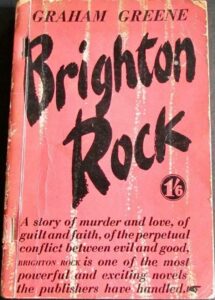 The added ‘1/6’ identifies this as the 1945 reprint edition of the original dust jacket.
Greene had a young family and badly needed money. Brighton Rock was written to make money and was secondarily a Catholic novel about good and evil. While every mention of Brighton Rock confectionery was free publicity for Greene’s novel, Brighton council resented it, for Brighton relied on tourism which the publicity about the trunk murders had damaged. The council had some reason to feel annoyed: the race gangs with their razor battles were not a feature of Brighton, rather such a fight had taken place at Lewes races further along the coast. On the other hand, Greene could justifiably point out that one of the gangs was Darby Sabini’s, the employer of Jack Notyre/Tony Mancini, the accused in the Brighton Trunk trial. Less attractive in Greene’s fiction was that he made the villains in the original edition Jewish, only changing the identities to Italians in, first, the US edition, and then in the post-war British edition.
The world of Orwell and Greene seem to come closer in Greene’s final novel before the outbreak of war, The Confidential Agent from 1939 in which an agent (known only as ‘D.’) of a country in a civil war has come to Britain seeking to buy coal, only to find that the mines have closed in the Depression.
‘When would you start delivery?’
‘We have certain stocks… we could begin next month, but for the quantity you need we shall have to reopen several mins. That takes time – and money. There will have been depreciation of machinery. And the men will not be first-class workers any longer. They depreciate quicker than tools.’
D. said, ‘Of course you hold a pistol to our heads. We must have the coal.’
While on the workers’ side, we hear:
He [D.] said thoughtfully, ‘I’ve got another shot.’
‘What do you mean?’ She [the mine-owner’s daughter] sounded scared. She was looking at the gun.
‘Oh,’ he said. ‘I didn’t mean that. I mean the miners. The unions. If they knew what this really meant, mightn’t they…?’
‘What?’
‘Do something.’
‘What could they do?’ she said. ‘You don’t know how things are here. You’ve never seen a mining village when all the pits are closed. You’ve lived in a revolution – you’ve had too much cheering and shouting and waving of flags.’ She said, ‘I’ve been with my father to one of these places. He was making a tour – with royalty. There’s no spirit left.’
In this one exchange Greene manages to summarise several of Orwell’s observations:
During the past dozen years the English working class have grown servile with a rather horrifying rapidity. (The Road to Wigan Pier, 1937)
Except for a brief moment in 1920 (the “Hands off Russia” movement) the British working class have never thought or acted internationally. For two and a half years they watched their comrades in Spain slowly strangled, and never aided them by even a single strike.’ (The Lion and the Unicorn, 1941)
A Sanctified Sinner
George Orwell had some respect for Greene as his review of Greene’s novel The Heart of the Matter (New Yorker, 17 July 1948), ‘The Sanctified Sinner’, shows. Orwell notes that ‘a fairly large proportion of the distinguished novels of the last few decades have been written by Catholics and have even been describable as Catholic novels’; and that ‘the conflict not only between this world and the next world but between sanctity and goodness is a fruitful theme of which the ordinary unbelieving writer cannot make use’. On the other hand, Orwell said, Greene had ‘used it once successfully, in The Power and the Glory, and once, with very much more doubtful success, in Brighton Rock’.
Explaining his doubts about Brighton Rock, Orwell wrote that ‘the central situation is incredible, since it presupposes that the most brutishly stupid person can, merely by having been brought up a Catholic, be capable of great intellectual subtlety’. Orwell, a former police officer, knew the criminal mind and did not regard Pinkie Brown as a credible character, while, going forward, it was not the police officer in Greene’s 1940 novel The Power and the Glory that stood out. In it a Mexican state government has banned religion. An idealistic atheist police lieutenant hunts down and has executed the last priest. This hard drinking whisky priest had fathered a child out of wedlock, but had refused to stop saying Mass. The church hails him as a martyr.
Orwell’s harshest words were reserved for The Heart of the Matter, the main topic of the review. The central figure Major Scobie is Deputy Commissioner of Police in an unnamed British West African colony. As a former colonial policeman Orwell knew that ‘a man whose chief characteristic is a horror of causing pain’ could not do such a job. He had other criticisms of the book which can be summed up as that Greene knew very little about colonial police work.
The Heart of the Matter must have come as a severe disappointment to Orwell, for earlier than his review but still post-war, in November 1946, Orwell had recommended three of Greene’s novels to a German correspondent: Brighton Rock, The Power and the Glory, and The Confidential Agent. Despite his reservations, in one of the last things he wrote, in April 1949 (Orwell stopped almost all writing in May, as his health deteriorated). Orwell corrected his Searchlight Books editor-friend Tosco Fyvel, in a long paragraph dedicated to Greene:
You keep referring to him as an extreme Conservative, the usual Catholic reactionary type. This isn’t so at all, either in his books or privately. Of course he is a Catholic and in some issues has to take sides politically with the church, but in outlook he is just a mild Left with faint CP leanings. I have even thought that he might become our first Catholic fellow-traveller, a thing that doesn’t exist in England but does in France, etc. If you look at books like A Gun for Sale, England Made Me, The Confidential Agent and others, you will see that there is the usual left-wing scenery. The bad men are millionaires, armaments manufacturers etc., and the good man is sometimes a Communist. In his last book there is also the usual inverted colour-feeling. According to Rayner Heppenstall, Greene somewhat reluctantly supported Franco during the Spanish civil war, but The Confidential Agent is written from the other point of view.
Contrary to those who have argued that The Confidential Agent is not about any specific nation, here Orwell clearly sees it as at least a parable if not a portrait of the Spanish civil war, and it would be easy to understand ‘Catholic fellow-traveller’ as a prescient suggestion of Greene’s 1955 novel The Quiet American.
Conclusion

The film version of Brighton Rock appeared in 1948 starring Richard Attenborough as the villainous anti-hero Pinkie (Attenborough had already played the part on the London stage). George Orwell and Graham Greene wrote for money but they had a moral purpose when writing their books. Orwell in his references to ‘legs’ in Coming Up For Air was satirising the obsession with sensational murders in the national press when the world was lurching towards the Second World War. Graham Greene’s Brighton Rock was a Catholic convert’s novel about the nature of good and evil, the threat of war had come in his earlier and later books. The two would go on to give us Ministries of Fear and of Love. Neither boded well.
*
References
Apart from the works mentioned in this article, readers will find the following of interest:
Darkest Greeneland: Brighton Rock by Cedric Watts (Graham Greene Studies, Vol. 1 [2017]) (This describes the Sabini gang’s battles at Lewes races and other research about real events used in the novel)
‘Murder didn’t mean much to Raven’: A Gun for Sale in context, by Michael Hill (Graham Greene Birthplace Trust)
Dear Les Hurst
Thanks. You have considerably improved my article. My only worry is that your improvements may make my readers expect too much of me!
Another fascinating piece, John. Thanks. Many commentators have highlighted Orwell’s supposed unending animosity to Catholics. Bowker, for instance, in his biography (2003: 21-22) even suggests – somewhat improbably – that the five-year-old Eric Blair’s attendance at a convent school run by French Ursuline Catholic nuns ‘would explain two important and enduring aspects of his complex personality – his unremitting hostility to Roman Catholicism and an acute sense of guilt’.
His anti-clerical polemics are particularly strident in the second part of The Road to Wigan Pier (1937) where he lambasts the ‘sentimental democratic Catholics of the type of Chesterton’ who naïvely argue that the dirtiness of the poor is ‘healthy’ (ibid: 54).
While fighting alongside the Republicans in the Spanish Civil War in 1937, he sees the Catholic Church put its full weight behind Franco’s fascist forces – and this only serves to entrench his beliefs. He considers the hostility to the Catholics in Spain is driven largely by the economic oppression of ordinary people by landowners, industrialists and the Church. During the 1940s, in his ‘As I Please’ columns in Tribune, he accuses Catholic writers such as G. K. Chesterton and Hilaire Belloc of ‘flirting with the spirit of anti-Semitism’ and linked Catholic and Hindu intellectuals in a community of reactionary thought. In another column, he accuses the eminent Catholics, D. B. Wyndham Lewis and J. B. Morton, of propagandising on behalf of every reactionary cause – from Mussolini, appeasement and Franco to literary censorship.
But it is always dangerous to generalise about Orwell – about his views on Catholicism as on most other subjects. As you usefully remind us, John, Orwell had a lot of good words to say about Graham Greene. And towards the end of his life, he develops a striking interest in Catholicism.
The Catholic author, Compton Mackenzie, plays an incredibly important role in his life, inspiring him (when they meet at a Dickens Fellowship meeting in London in 1940) to follow his dream and live on a remote Scottish island. Orwell is, indeed, to spend the last years of his life on Jura, in the Inner Hebrides.
In a letter to his friend Julian Symonds, dated 21 March 1948, Orwell – writing in longhand from Ward 3, at Hairmyres Hospital, East Kilbride – tells how he has just read François Mauriac’s Thérèse Desqueyroux (1927) which started him thinking about Catholic novelists in general. He is also ‘trying to get hold of Léon Bloy’ – the French novelist, essayist, pamphleteer and poet. Significantly, in his review of Greene’s The Heart of the Matter, Orwell comments, approvingly, on Thérèse in which ‘the spiritual conflict does not outrage probability, because it is not pretended that Thérèse is a normal person’.
This fascination for Catholic writers continues for the rest of Orwell’s life – culminating in his extraordinary relationship with Evelyn Waugh. Still being treated for TB at Hairmyres – though still reading voraciously – on 16 May 1948 he writes to Waugh, thanking him for sending copies of Black Mischief (1932) and A Handful of Dust (1934) and for his sympathetic review of his Critical Essays in The Tablet, of 6 April 1946. Under the heading ‘A new humanism’, Waugh describes the book as ‘a work of absorbing interest’. ‘The art of Donald McGill’ is ‘the masterpiece’ while ‘Raffles and Miss Blandish’ – in which Orwell critiques the violence, cruelty and sexual sadism of the contemporary American crime novel – exemplifies the method in which the new school, the ‘new humanism of the common man’, is supreme. And on ‘Benefit of clergy’ – about the artist Salvador Dali and his scurrilous memoir – he comments: ‘There is nothing in [Orwell’s] writing that is inconsistent with high moral principles’.
Orwell returns to Waugh in a review of The Novelist as Thinker, edited by the Cambridge academic Balachandra Rajan, in The Times Literary Supplement, of 7 August. In an essay, ‘The innocence of Evelyn Waugh’, he suggests that the author, Derek K. Savage, is wrong to concentrate on his ‘immaturity’. ‘He does not even mention Mr Waugh’s conversion to Catholicism, which obviously cannot be left out of account in any serious study of his work. In Brideshead Revisited Mr Savage can see only nostalgia for adolescence and does not seem to have noticed that the essential theme of the book is the collision between ordinary decent behaviour and the concept of good and evil’. Here, Orwell is clearly transferring his own current and ever-developing preoccupations about ethics, religion and writing to his understanding of the novel.
And while Orwell is at Cranham sanatorium in 1949, Waugh – who lives just 18 miles away – visits him a number of times. They would clearly have had a lot to talk about. Waugh is not a fellow old-Etonian (he’d been to Lancing College and then Oxford University) but, like Orwell’s great friend and Observer editor, David Astor, has fought in the Royal Marines during the Second World War.
In a letter to Orwell of 17 July 1949, Waugh says he has read Nineteen Eighty-Four with great admiration. But he suggests in his treatment of Winston’s soul ‘the metaphysics are wrong’ and that the novel is spurious because it fails to acknowledge the existence of the Church. Perhaps reflecting on the scenes towards the end of the novel in which Winston is tortured in Room 101 by O’Brien, Waugh’s concludes that ‘men who love a crucified God need never think of torture as all-powerful’.
The Orwell/Waugh friendship culminates in two ways. In the first instance, Orwell dedicates some of his last hours alive to working on the draft of a short story, ‘A smoking-room story’ – and a serious essay about Waugh’s writings.
Clearly inspired by Orwell’s Nineteen Eighty-Four, which he much admired, Waugh, for his part, in 1950, composes a much-neglected dystopian novella, Love Among the Ruins. It is clearly his way of paying tribute but it also serves to encapsulate some of the critical points he made of Orwell’s work. Waugh originally calls his dystopian vision, A Pilgrim’s Progress, but it is rejected by a number of publishers. Following this negative response, Waugh revises the text with a new version ready by November 1952 – with the hope that Ian Fleming’s Queen Anne Press will publish a deluxe edition. After that idea falls through, it is finally published by Chapman and Hall in July 1953.
It has been argued that Greene had an obsession with Brighton and the trunk murders. Apart from Brighton Rock, Travels with my Aunt, It’s a Battle and one of the volumes of Greene’s autobiography allude to this. In a recent novel it is even stated that Greene was accused by an ex lover of being the first murderer and was questioned by the police. I have found no evidence of any of this, but perhaps the accusers out there could shift their gaze to Orwell or Agatha Christie, both of whom refer to it.