
Review: The Nurse Who Became A Spy
The roles played by women in wars have traditionally been devalued and hidden from history. This is improving with several new books on the important contribution made by women both as spies and resistance fighters. Rather less well covered are the experiences of those nurses who volunteered to provide medical aid in the Spanish Civil War.
Thankfully, we now have Chris Hall’s most recent book, The Nurse Who Became A Spy, to add to the pioneering work of Angela Jackson. This book provides an engaging account of the remarkable Madge Addy who served as a nurse with the Republican medical services. She later became a full time spy fighting Fascism and was awarded both the OBE and the French Croix de Guerre. So begins an incredible and exciting life story which deserves to be written.
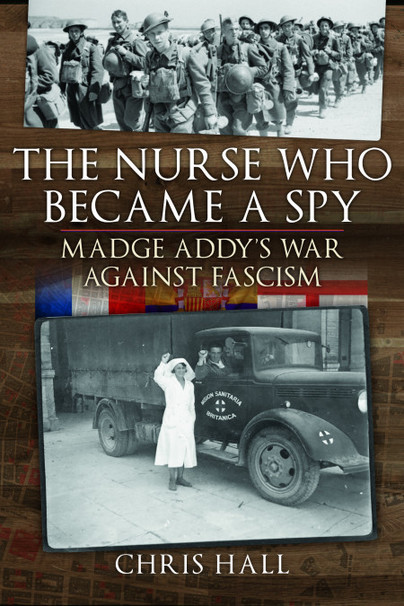
Madge Addy, whose real name was Marguerite, was a working class woman from Manchester leading an ordinary life. She was born in 1904, trained as a nurse and married a local electrician in 1930. In a childless marriage they gradually drifted apart and eventually divorced. She was to marry three times. However in 1937 this ordinary life changed forever when she decided to go to Spain to support the Republican forces and oppose Fascism. What motivated Madge to volunteer and risk her life in this way? Hall offers a range of speculative answers in the first chapter looking at her early life in Manchester from 1904 to 1937. Perhaps it was her unhappy marriage, the newsreels at the local Picture House or reading the national papers in the local library? Maybe it was the influence of her left-wing mother known as “Red Mary” or possibly her brother Frank who was a member of the Left Book Club? Whatever the individual motivation, from 1937 Madge lived through an eight-year period when she and the world changed forever.
The early chapters of this fascinating book provide the reader with a welcome overview of the Spanish Civil War and I particularly enjoyed discovering the prominent role women played in radical politics and the Republican Government. It was surprising to learn that the Anarchist Federica Montseny served in the Republican Cabinet as the Health Minister. Women were also involved during the revolutionary period in the committees running the villages and factories, organising police patrols and fighting in the militias. Some of this is well covered by Ken Loach’s excellent film, Land and Freedom.
The chapter on the British response to the Spanish Civil War provided a detailed account of the diplomatic and humanitarian work of organisations such as “Aid Spain”. It also explored the role of the volunteers who participated in the Civil War such as the 2,000 men who fought in the British Battalion of the International Brigades (over a quarter was killed) and those who served in the medical units. Although the Civil War became a symbol of a democracy resisting Fascist aggression, Hall reminds us that the majority of the British public were indifferent to the conflict taking place in what was perceived to be a “backward” country on the edge of Europe. The response of both the Government and the organised labour movement is briefly examined and found wanting. The Communist Party of Great Britain (CPGB) is praised for its role in supporting the Spanish Republic. Hall does not consider whether the same Communists eventually betrayed the revolutionary struggle within Spain. I would have liked a little more detail on the response of the British press although the usual suspects supported either the Republic or the Nationalists.
Hall has previously written on Orwell, In Spain with Orwell, but he only gets mentioned twice in his new book. Hall explains how most artists and intellectuals supported the Republic and refers to a survey conducted in June 1937, Authors take sides on the Spanish war, in which 127 authors supported the Republic, 16 were neutral and 5 were against the Republic. We learn that Orwell was critical of the survey calling it “bloody rot” and refused to respond!
As a military expert, Hall is well placed to discuss the progress made in treating injured soldiers during the Spanish Civil War and how these techniques and experiences were subsequently utilised in the Second World War. For example, the discussion of the treatment of wounds supports Orwell’s wonderful account in Homage to Catalonia of his experiences of being shot in the throat and almost killed by a Fascist sniper. In the Great War, wounds were stitched to reduce bleeding but foreign bodies in the wound led to high mortality rates from gangrene. In the Spanish Civil War wounds were left exposed and unstitched. Orwell typically takes a morbid delight when writing of the hospital at Tarragona:
What wounds one saw there! They had a way of treating certain wounds which I suppose was in accordance with the latest medical practice, but which was peculiarly horrible to look at. This was to leave the wound completely open and unbandaged, but protected from flies by a net of butter-muslin, stretched over wires. Under the muslin you would see the red jelly of a half healed wound. (p.184)
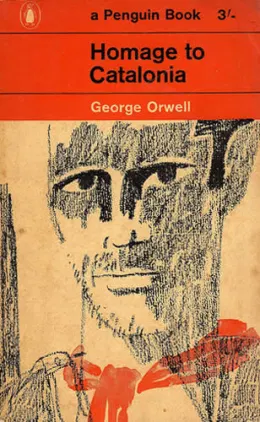 Hall explains how the basic standard of nursing in Spain was rudimentary as the patients were often cared for by nuns or poorly trained nurses. Orwell unfortunately experienced this first hand:
I was dopey from morphia but still in great pain, practically unable to move and swallowing blood constantly. It was typical of Spanish hospital methods that while I was in this state the untrained nurse tried to force the regulation meal-a huge meal of soup, eggs, greasy stew and so forth –down my throat and seemed surprised when I would not take it. (p.179)
The stoic Orwell had no complaints about the Spanish nurses and praised them for their great kindness.
This carefully researched book makes good use of primary sources such as the detailed letters written by Madge to campaign for medical supplies. There are also some wonderful photographs such as the one of Madge giving the clinched fist anti-Fascist salute on the cover of the book. In this way, Hall provides the reader with an authentic insight into the brave and difficult work carried out in the” Manchester Ward” at the hospital in Ucles. The lack of food and medical provisions, bombing raids, rats and lice are all documented in the book. Volunteer British nurses such as Madge (who became Head Nurse) clearly made an invaluable contribution to saving lives in the Spanish Civil War by improving the level of hygiene, training, professional organisation and welfare of patients.
Fittingly, Madge was the last British nurse to leave Spain in 1939 but the story does not end there. Madge became a spy during the Second World War even using invisible ink and sewing secret messages into the lining of her fur coat. Hall writes;
It is hard to believe after her experiences in the Spanish Civil War that the resulting years during the Second World War would be even more remarkable! (p.101)
Hall acknowledges that her role in intelligence and Resistance work is harder to discover than her nursing work and she was not directly involved in sabotage or armed activities. Madge, whose codename was Mrs Oats, acted as a courier and messenger for MI9 behind enemy lines. If she had been caught by the Nazis she would have certainly faced imprisonment, torture and death. Madge had an important role in setting up the famous “Garrow-Pat O’Leary escape line. This involved moving allied personnel out of occupied France and into “neutral” Spain. The complex underground world of British agents in enemy-occupied territory and the Resistance to the German occupation of France is explored in great detail in the last two chapters. Once again, Hall’s military expertise allows him to tell the stories of some of the remarkably brave women and men who risked their lives in the fight against Fascism.
Madge Addy died alone in 1970 aged 66 of alcoholic intoxication. Hall writes:
Madge died unknown, with her Spanish Civil War and Second World War exploits hidden from the public. (p. 177)
Thanks to this fine book and the Manchester commemorative plaque in her honour, she will no longer be forgotten.
*
Works Cited
Hall, Chris (2021) The Nurse Who Became a Spy: Madge Addy’s War Against Fascism (Pen and Sword History, South Yorkshire, ISBN: 978-1-52677-958-8, Pages 211)
Orwell, George (1975 [1938]) Homage to Catalonia, (Penguin Books, Harmondsworth)
Land of Freedom (1995) Directed by Ken Loach [DVD] UK/Spain/Germany: Artificial Eye
*
Also of Interest
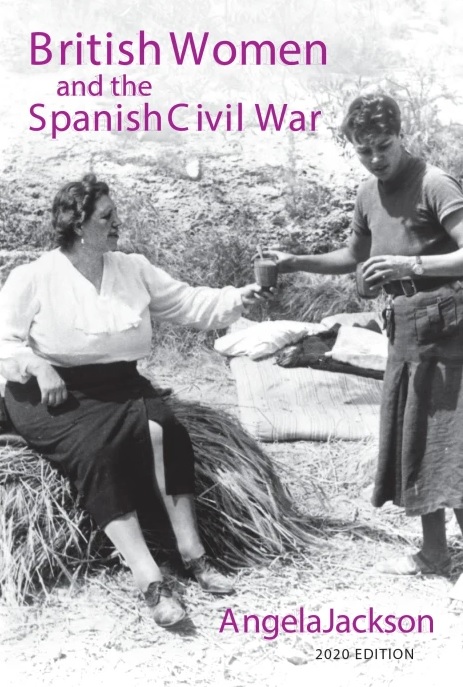
Jackson, Angela (2020), British Women and the Spanish Civil War (Clapton Press, ISBN: 978-1-913693-01-5)
Stewart, Frida; Foreword and Afterword by Angela Jackson (2020), Firing A Shot For Freedom (Clapton Press, ISBN: 978-1-913693-00-8)
Thanks Brian, a thoughtful and interesting review of Chris’s book, which places it both in a wider context of the Spanish Civil War and the WW2, as well as relating it to Orwell’s experiences after his bullet wound in the neck.
cheers
Quentin