
Orwell and Beevers
Introduction. In twelfth chapter of The Road to Wigan Pier (Gollancz, 1937) George Orwell quotes two passages from John Leonard Beevers’ book World Without Faith (Hamish Hamilton, 1935). The first reads:
It is plain lunacy to say that the average £2 10s to £4 a week man is a lower type than an eighteenth century farm labourer. Or than the labourer or peasant of any exclusively agricultural community now or in the past. It just isn’t true. It is so damn silly to cry about the civilizing effects of work in the fields and farmyards as against that done in a big locomotive works or an auto-mobile factory. Work is a nuisance. We work because we have to and all work is done to provide us with leisure and the means of enjoying that leisure as express as possible.
The second reads:
Man is going to have power enough and time enough to hunt for his own heaven on earth without worrying about the super-natural one. The earth will be so pleasant a place that the priest and the parson won’t be left with much of a tale to tell. Half the stuffing is knocked out of them with one neat blow.
Orwell writes that
There is a whole chapter to this effect (Chapter 4 of Mr Beevers’ book) and it is of some interest as an exhibition of machine worship in its most completely vulgar, ignorant and half-baked form. It is the authentic voice of a large section of the modern world. Every aspirin eater in the outer suburbs would echo it fervently. Notice the shrill wail of anger (‘it just isn’t trooo-o-o’) with which Mr Beevers meets the suggestion that his grandfather may have been a better man than himself, and the still more horrible suggestion that if we returned to a simpler way of life he might have to toughen his muscles with a job of work.
My last blog examined Orwell’s attitude to the humble aspirin. Here I look at John Leonard Beevers.
1. Family Background. John Leonard Beevers was born on 18 October 1911 at Gildersome, an industrial village near Leeds. His parents were John Leonard Beevers of the West Riding Police, and Esther Beevers née Schofield.
Beevers Senior was born on 4 July 1874 at Hemsworth in Yorkshire the son of Thomas Beevers a farm labourer, and Ann Beevers née Smith; and joined the police in 1896. Sergeant Beevers married Esther Schofield on 7 January 1910 aged thirty five at the Wesleyan Methodist Chapel at Deeph near Leeds. By 1921 Beevers Senior was a Police Inspector. He died on 15 February 1940 aged sixty five of a heart attack at Hendon, a London suburb, where had moved after retiring, presumably to be closer to his son. I do not know if he had any other children.
Thus John Leonard Beevers had policing in his background. Unlike Orwell his paternal grandfather was a farm labourer. He probably knew more than Orwell about farm life.
2. Early Life. Beevers studied at a local school where, when he was fourteen, two villainous looking men … succeeded after a week’s hard proselyting in making me a member of some Young Communist League. Only one other pupil joined for the headmaster had warned his pupils that they were too young to dabble in politics. The two pupils paid a penny a week subscription for two months before they realised that a revolution was not about to happen in Britain.
Despite allegedly being a juvenile delinquent Beevers studied at Queens’ College Cambridge. His first literary work was helping revise Thomas Common’s translation of Nietzsche’s Thus Spake Zarathustra. Allen and Unwin published this revised edition in 1932.
Beevers graduated in June 1933 with a first in the Cambridge English Tripos. He became a freelance journalist and writer. On 14 June 1934, aged twenty two, he married Marjorie Pollard, thirty, at Barton upon Irwell Register Office in Lancashire. Her father, William Thomas Burrows Pollard, was a Surrey sporting gun manufacturer and dealer.
John Leonard and Marjorie Beevers produced one daughter, born in Hampstead in 1939 when the baby’s mother was thirty five. As far as I know they had no other children.
3. Time and Tide. In summer 1934 John Leonard Beevers twenty two and newly-wed was appointed Literary Editor of Time and Tide a political and literary journal, founded in 1920 by Lady Rhondda (Margaret Haig Mackworth nee Thomas, Viscountess Rhondda) (1883-1958), as a left wing and feminist journal. It later moved to the right as did its owner Lady Rhondda who edited it from 1926 to her death in 1958.
Beevers published reviews by Wyndham Lewis and Ezra Pound in the August 1934 Time and Tide. In doing so he clashed with Lady Rhondda. He was hostile to middle brow (i.e. readable) fiction and alienated several prominent women novelists. In October 1935 he was sacked and Theodora Bosanquet was appointed literary editor. In 1940-1941 Orwell wrote 41 film reviews for Time and Tide, as discussed by John Tulloch in Orwell Today (2012). Time and Tide closed in 1986.
4. World Without Faith. Hamish Hamilton published Beevers’s first book World Without Faith in 1935. It had seven chapters – Beginnings, Literature, Art, The Machine, Fascism, Communism and Personal, and a dedication “To Marjorie, My Wife”. Hamish Hamilton was an independent publishing house founded in 1931 by James Hamish Hamilton, a USA-born but Rugby and Cambridge educated publisher. In 1965 a conglomerate took it over but he remained Managing Director until 1972. “Jamie” Hamilton died in 1988 aged eighty seven.
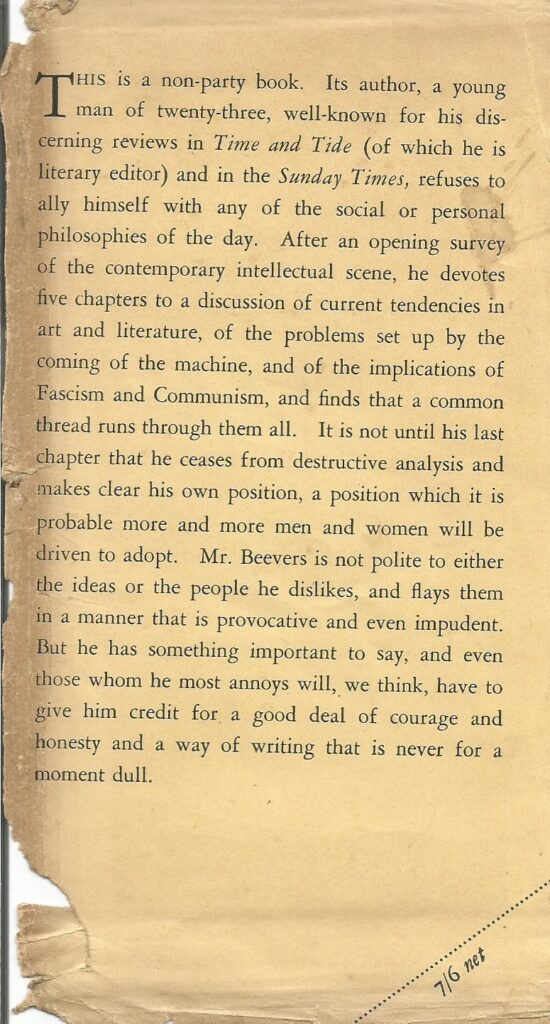
Beevers scathingly criticised communism and fascism and despised the fortnight experts duped by their Russian Intourist guides. He opposed all ideologies and defended free thought. He glorified machinery but his attitude towards it was more nuanced than Orwell suggests. Beevers disliked the press, the advertisement hoardings, misdirected mass production, the cinema, the cheap stores, the tin can flivver, bungaloid growths – all these can be pointed to as the product direct and indirect of the machine.
By August 1936 World Without Faith had been re-published in the USA by Harper and Brothers, where John Cournos’ review in the New York Times expressed reservations:
He is a critic with a hammer. He hits steadily and hard, which possibly compensates him for not hitting the nail on the head in every instance.
5. The BBC. In 1939 Beevers became a full time BBC reporter. He worked for it until he retired in 1967 aged fifty six. He and Orwell were professional colleagues.
6. The Embrace of Rome. John Leonard Beevers converted to Catholicism at an unknown date in the 1940’s. In 1947 Carey and Claridge of London published a volume of poetry by him under the pseudonym John Clayton, titled The Dark Emperor. From then on he wrote Catholic devotional works. These were:
a. Storm of Glory (Sheed & Ward, London, 1949) about St Therese of Lisieux (1873-1897) a French Carmelite nun.
b. The Sun in her mantle (Browne & Nolan, Dublin, 1953, and Newman Press, Westminster, Maryland, 1954) about alleged miraculous religious visions.
c. The Golden Heart – The Story of Beauraing (Henry Regnery, Chicago, 1956, and Browne & Nolan, Dublin, 1956), about thirty three alleged miraculous visions of the Virgin Mary, seen by children, at Beauraing, a Belgian town in 1932-1933. It became a pilgrimage site which greatly profited many businesses.
d. Shining as Stars (Browne & Nolan, Dublin, 1958) contained lives of the Venerable Matt Talbot (1856-1925) an Irish labourer and reformed alcoholic known as the patron saint of alcoholics; and the Venerable Leon Papin Dupont (1797-1876) a Martinique sugar plantation owner’s son who became a lawyer, and then a Catholic philanthropist and activist known as the Holy Man of Tours.
e. Lourdes (St Paul Publications, London, 1958).
f. Saint Joan of Arc (Hanover House, Garden City, New York, 1958). Garden City is an imprint of Doubleday an American publisher.
g. Saint Therese of the Child Jesus (St Paul Publications, London, 1960, reissued in 1968), a life of the sixteenth century (1515-1582) Spanish Carmelite nun and religious writer.
h. Our Lady of Fatima (St Paul Publications, London 1960). In 1913 at Fatima in Portugal three shepherd boys allegedly saw visions of the Virgin Mary.
i. A Man For Now – the life of Damien de Veuster, friend of lepers (Garden City, New York, 1973), about Father Joseph de Veuster, (1840-1889) a Belgian Catholic missionary who worked with lepers and eventually died of leprosy.
j. How to Pray: A Book of Spiritual Reflections, by Yves Raguin, (1912-1998) a French Jesuit China missionary, translated by Beevers (Abbey Press, 1973).
k. A translation of Jean Pierre de Caussade (1675-1751) a French Jesuit’s An Abandonment to Divine Providence, first published in 1861 because it was initially seen as heretical. There have been several English translations. Garden City of New York published Beevers’ version in 1975.
7. Second Marriage. Marjorie Beevers died on 30 August 1962 of breast cancer at Baughurst in Hampshire, aged fifty-eight. On 19 August 1963, aged fifty two, the widower married Marjorie Singleton Broadbridge, forty five, at a Roman Catholic Church at Upper Woolhampton in Berkshire.
8. The End. John Leonard Beevers died on 13 September 1975 of a heart attack, aged sixty three, at the Pebble House, New Street, Holt, Erpingham, in Norfolk. He left £6,503. His widow Marjorie Singleton Beevers died on 23 April 1987, of colon cancer. Her death certificate gave her occupation as artist.
*
The Harry Ransom Center at the University of Texas at Austin houses a collection of John Leonard Beevers’s papers. They have an online index.
Thanks John, a very interesting article.