
Orwell in the Evening Standard
George Orwell was a pack-rat for printed items (see ‘Just junk’, below), and, included in his trove of 2,700 items were clippings from a wide range of newspapers, from the Yorkshire Evening News to the Glasgow Evening News, from the Birmingham Evening Dispatch to the Ottawa Evening Journal, and of course, London’s notable Evening Standard. After the close of the war, he was in a position to hire the “clipping service” of Durrant’s Press Cuttings, to document references to himself. The whole haulage is available at the British Library (shelfmark: 1899.ss). But from just the Evening Standard (hereafter ES), he scissored and filed away the following:
- Dr Goebbels’s Greatest Forgery; Pacifists Get Warline: Shout Down Speakers – One Carries Stocking Dagger (a ‘skean dhu’, worn with the traditional tartan kilt, Glasgow), 9 April 1940.
- A four-page Evening Standard reprint, Yellow Star (on antisemitism), by an unidentified author, 13 October 1943.
- A David Low political cartoon, Oi! Wait for Me!, 14 April 1944.
- George Malcolm Thomson’s “All Art is Propaganda,” 14 February 1946.
- John Thompson’s “Radio Commentary – Please do not Disturb!,” 20 January 1947.
Orwell, of course, wrote for the Evening Standard, but given the irregularity and the selection of topics, this may have been done partly as favour. Why someone who’d travelled was keen to defend ‘English cooking’ is beyond me. Note that ‘Colonel Blimp’ was a David Low cartoon character, prominent in the ES since 1934. Orwell’s idealised pub, which he named ‘The Moon Under Water,’ inspired the naming of numerous actual social drinking establishments. And, A Nice Cup of Tea had been a hit tune that had been popularised in 1937 by Binnie Hale, Gracie Fields, and at least six British dance bands.
“Don’t let Colonel Blimp ruin the Home Guard”, ES, 8 January 1941

“In defence of English Cooking”, ES, 15 December 1945

“The Moon Under Water”, ES, 9 February 1946

“Just junk, but who could resist it”, ES, 5 January 1946

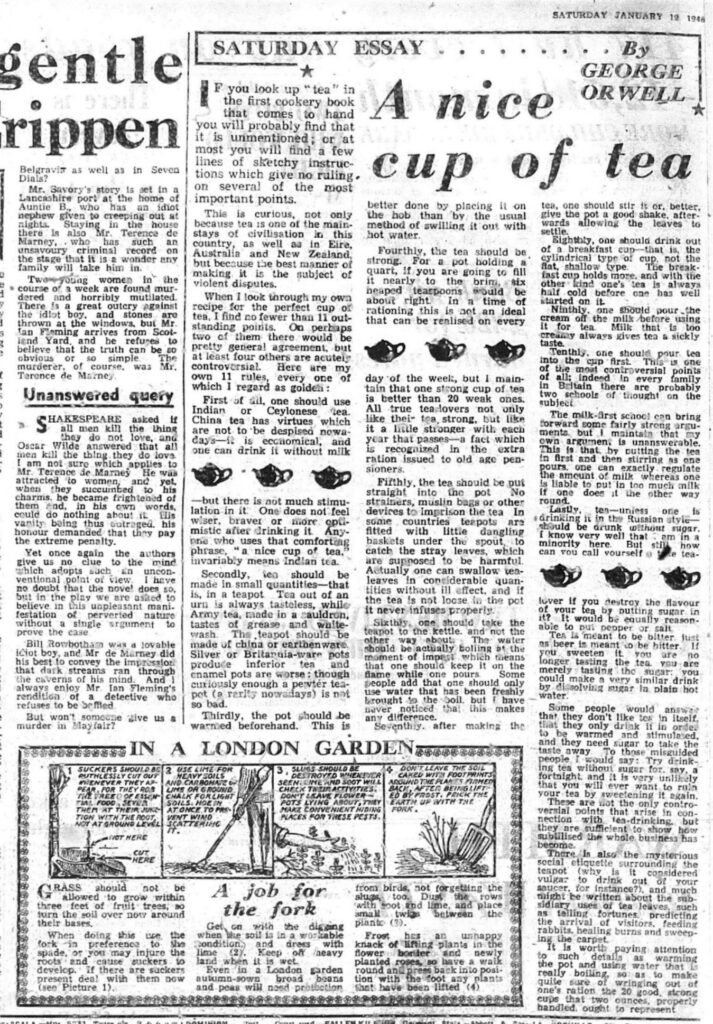
“A nice cup of tea”, ES, 12 January 1946
Beyond this, Eileen Blair’s death was mentioned in the paper’s “Londoner’s Diary” column, 5 May 1948, which described Orwell’s consequent life with their son Richard.


After examining the above images, you’ll find that they are a rather forensic read, almost inviting a fingertip to run down the columns. This is because the Evening Standard, like all too many important publications, hasn’t been preserved as we, today, expect. The British Library’s Newspaper Library microfilmed the existing run back in 1979. This medium was the best available at the time because newspapers, being printed on cheap stock derived from wood pulp, are acidic. But then the microfilm reels are often stored in cardboard containers that are of course not acid-free. And the film itself scratches between plates of glass, when spooled and then rewound by powered units.
This was of course not up to the standard we’d have today, with digitisation, and you can see for yourself the less-than-ideal result of a non-Orwell page below, hardly unique.

Newspapers aside, many important weekly publications have not been digitised, despite having been a collective barometer of British society. Such important titles include The Radio Times, The Listener, The New Statesman (in Orwell’s era, The New Statesman and Nation), the non-mainstream Tribune: Voice of the Left, and the musical weeklies Melody Maker and New Musical Express. In the real world, not everything can be preserved and digitisation isn’t perfect, but as we enter the third decade of this century, it’s clear that we are not keeping up.
George Orwell was lucky that the legacy of his tireless work, bouts of bad health aside, have been well-chronicled. The 20th Century exploded exponentially with printed items of great variety. From seemingly endless ephemera to widely-distributed but fragile newsprint, much of it will not accessibly survive. In his own way, he tried to preserve some of it.
*
Andy Simons is a retired British Library curator
*
Excellent, thanks Andy
Thanks for sharing these Evening Standard cuttings, Andy. Indeed, Orwell’s columns for the ES are amongst my favourites of all his writings. You say: ‘Why someone who’d travelled was keen to defend English cooking is beyond me.‘ But then his often stated passion for English food was one aspect of his patriotic democratic side. In his Evening Standard article (of 15 December 1945) he stresses that the best English cooking is to be found in private homes and not in restaurants. A few months later, he is commissioned by the British Council to write an essay on British cooking. They probably expect him to laud the nation’s restaurants (good for tourism) while adding some astute comments on British cuisine. This is not what they get. Again Orwell praises home-made meals and downplays the delights of restaurants. For instance, he begins saying British cooking ‘is best studied in private houses, and more particularly in the homes of the middle-class and working-class masses who have not become Europeanised in their tastes. Cheap restaurants in Britain are almost invariably bad, while in expensive restaurants the cookery is almost always French, or imitation French’. Perhaps inevitably, Orwell is sent a rejection note on 3 May 1946 which, while it stresses it’s an ‘excellent essay’, adds that ‘it would be unfortunate and unwise to publish it for the continental reader’. All the same, he is sent the payment – 30 guineas. Orwell ends his British Council article by presenting a set of recipes – for Welsh rarebit, Yorkshire pudding, treacle tart, orange marmalade, plum cake and Christmas pudding – complete with cooking directions. Perhaps The Orwell Society should organise sometime a special Orwellian Feast – drawing inspiration from these recipes.