
Orwell and the Professor: II
Introduction. In the first part of this article I looked at the life of Professor Harold Laski, a passage from one of whose articles featured in George Orwell’s article Politics and the English Language Horizon April 1946) as Orwell’s first example of allegedly bad English. Here I look at another time when their lives intersected.
1. The alleged libel. On 8 May 1945 Britain celebrated VE Day and the end of the war in Europe. The war with Japan continued but on 23 May 1945 King George VI dissolved parliament at the request of the Prime Minister Winston Churchill. The wartime coalition was dissolved and a Conservative caretaker government installed. A general election was called for 5 July 1945.
George Orwell covered the election for The Observer, and reported later for an American magazine:
During a fortnight of electioneering, in which most of my waking hours were spent in the streets or in pubs, buses and tea-shops, with my ears pricked all the time, I only twice overheard a spontaneous comment on the election. Outdoor meetings, especially in the more crowded and noisy parts of London, were often a complete failure.
Elsewhere, though, that was not what happened.
On Saturday 16 June 1945 Laski, the Chairman of the Labour Party, spoke in the Market Square, Newark-on-Trent, Nottinghamshire, in support of the Labour candidate Air Vice Marshal Hugh Champion de Crespigny. The Conservative candidate and sitting MP Sidney Shephard had won the seat at a 1943 by election. The Liberal candidate in 1945 was Harold Francis Calladine.
The Newark Advertiser founded in 1847 was owned and edited by Cyril Everard Parlby a Conservative councillor who was twice Mayor of Newark. On Wednesday 20 June 1945 it reported an alleged altercation between Professor Laski and James Wentworth Day a prominent reactionary Conservative agricultural expert and journalist. Mr Day asked why Laski:
had openly advocated “revolution by violence” in speaking at Bishop’s Stortford and Bournemouth during the war “whilst most Englishmen were either fighting or being bombed at home” and why he (Professor Laski) had spent the whole of the last war lecturing in America. If he were unfit why did he not join the Red Cross?
Rejected
Professor Laski replied that he was twice rejected in this country during the 1914-1918 war and had medical certificates to prove it. He also attempted to enlist in Canada and then he went to Harvard University and he had a certificate from the Medical Officer of the British Army in New York of his inability to be accepted on medical grounds. He also said concerning the other part of the question: “That was said about me in the House of Commons and if you look at Hansard for 29th November 1944 you will see an ample and generous apology for being as insolent as you are in suggesting it now.
Reference to Violence
As for violence he continued if Labour could not obtain what it needed by general consent “we shall have to use violence even if it means revolution”. When people felt it was the moment for great experiment, for innovation because when war is over people so easily forgot – especially those who had the power in their hands –that was the time for experiment. Great changes were so urgent in this country, and if they were not made by consent they would be made by violence, and judging by the temper his questioner displayed he would be perfectly naturally one of the objects of violence when it came.
Mr Day submitted to the Professor that when general consent was against him he substituted revolution.
Professor Laski said it did not lie in the mouth of any member of the Tory Party who helped to organise mutiny in the British Army over Home Rule in 1914, to discuss the question of violence. When a situation in any country becomes intolerable – and when 25 percent of the people had inadequate nutrition –it did become intolerable – it did not become possible to prevent what was not given by generosity being taken by the organised will of the people.
Not An Asset
Mr Day “You are precisely the sort of bloodthirsty little man, full of words, who has never smelt a bullet, but is always the first to stir up violence in peace”.
“We expect serious constructive thought from the Chairman of the Labour Party but since you have consistently attacked everyone and everything from Mr Churchill to the leaders of your own party and the constitution of this country and have been disowned by Mr Atlee only this morning how can anyone take you seriously? I suggest that you are not an asset to the Labour Party but a liability.
TheNottingham Guardian, Evening Standard, and Lord Beaverbrook’s Daily Express repeated and publicised this story. Professor Laski sued them for libel.
2. The Libel Trial. Sidney Shephard held Newark for the Conservatives at the 1945 General Election with 18,580 votes. Air Vice-Marshal Hugh Champion de Crespigny received 17,448 votes and Harold Francis Calladine 5,175 votes. Across the country Labour won a landslide majority in seats but not votes as often happens in British General Elections.
The case of Laski v Newark Advertiser Company Limited and Another (i.e. the Newark Advertiser’s editor Cyril Parlby) opened at the King’s Bench Division of the High Court of Justice on Tuesday 26 November 1946. The judge was the Lord Chief Justice Rayner Goddard i.e. Lord Goddard. He was well known for hating time wasting delays.
The lead prosecution counsel who represented Professor Laski was Gerald Osborne Slade KC (King’s Counsel) one of Britain’s most experienced libel lawyers who was appointed a High Court Judge in 1948. He was assisted by two other experienced libel lawyers – Sir Valentine Holmes KC; and Peter Henry Rowley Bristow who later became a judge.
The lead defence counsel who represented the Newark Advertiser and its editor Cyril Parlby was Sir Patrick Hastings KC who had been the Attorney General in the 1924 first Labour government. He was a ferocious cross examiner. He was assisted by Edward Holroyd Pearce KC who later became a judge: William Arthian Davies another future judge; and Anthony Leslie Gordon. Mr John Davidson held a watching brief for the Labour newspaper the Daily Herald.
The trial was held before a Special Jury. This had a much higher property qualification than for an ordinary jury. The trial lasted five days.
The prosecution alleged that the Newark Advertiser had put words into Laski’s mouth and had accused him of advocating treason. Sir Patrick Hastings read passages from Laski’s writings in which Laski had said that violent revolution might be necessary if desperately needed concessions were not obtained by peaceful means.
On Monday 2 December 1946 the special jury acquitted the Newark Advertiser and its editor of libel. On Monday 23 December 1946 Laski announced that he was dropping his libel actions against the other three newspapers he had sued.
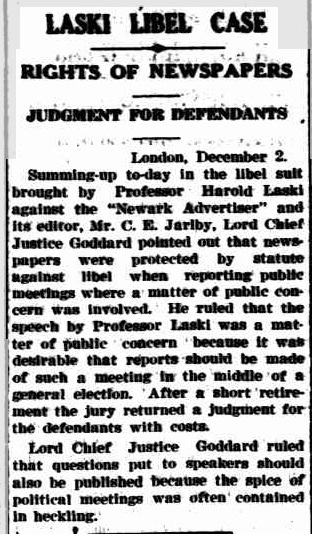
The case was reported around the world.
3. Enter George Orwell. In his As I Please column in the 27 December 1946 Tribune Orwell wrote:
Opinions may differ about the verdict in Professor Laski’s libel case. But even if one feels that the verdict was technically justified, I think it should be remembered that Professor Laski took this action – in effect – on behalf of the Labour Party. It was an incident in the General Election – a reply felt at the time to be necessary, to the anti-Red propaganda of part of the Conservative press. It will therefore be extremely unfair if he is left to pay the very heavy costs involved unaided. May I remind everyone again that contributions should be sent to Morgan Phillips, Secretary, Labour Party, Transport House.
The Laski case will presumably lead to further discussions about the composition of juries, particularly Special Juries, but I wish it would have the incidental effect of drawing people’s attention to the present state of the law of libel.
While in his report for America Orwell wrote:
The only real attempt to drag the contest down to the level of 1931 or 1924 was the short-lived campaign of the Beaverbrook press against Professor Laski. This failed even to become an election issue, and was simply one more demonstration of the inability of the big press lords to influence public opinion by direct means. So far as my observation went anti-Semitism was not a factor in the election, and certainly no overt attempt at stirring up anti-Semitism was made in the press, though the Laski affair could obviously have been given some such twist.
4. Aftermath. Professor Laski’s British and American friends paid most of his massive costs and he did not have to sell his house and book collection as he had feared. He lived to see Special Juries abolished in 1949. He died in hospital in London on 24 March 1950 aged fifty six of a burst lung abscess. His funeral was held four days later at Golders Green Crematorium. He left £19,558, four shillings and seven-pence.
The Newark Advertiser and its editor Cyril Parlby’s own massive costs were met by Lord Beaverbrook who owned theDaily Express and would have been next in line if Laski had won. Cyril Parlby died on 28 May 1976 aged eighty. He left £41,275.
Two years after his death, The Atlantic magazine published Professor Laski’s account of the trial. He recorded his experience of hearing Lord Goddard’s summing up:
The judge not only hates the opinions you hold, but will explain to the jury that they are dangerous opinions. And since, at your opponent’s instance, the jury is a “special” jury, you know how unlikely it is that they will have an atom of concern for anyone with dangerous opinions.
The Daily Express published a full transcript of the trial. Few copies remain.
*
An interesting, informative article.
Would be useful to resolve the apparent discrepancy between the contemporary news report included:
…”the jury returned a judgement for the defendants with costs”
and
“The Newark Advertiser and its editor Cyril Parlby’s own massive costs were met by Lord Beaverbrook”…