
Orwell and the Professor: I
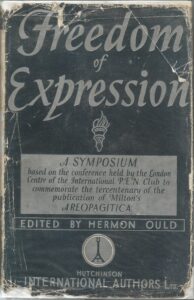
Introduction. In his article Politics and the English Language (Horizon April 1946) Orwell gives as his first example of allegedly bad English an excerpt from an article by Professor Harold Laski, first delivered as a speech and then published in Freedom of Expression: A symposium*.
The quote read
I am not, indeed, sure whether it is not true to say that that the Milton who once seemed not unlike a seventeenth-century Shelley had not become, out of an experience ever more bitter in each year, more alien (sic) to the founder of that Jesuit sect which nothing could induce him to tolerate.
The word alien should have been akin. These two words have opposite meanings as Orwell pointed out.
Although Orwell appreciated some of Laski’s work his opinions of Laski as a writer were mostly negative. Not long before, in an article “Propaganda and Demotic Speech”, Orwell had denied and disproved Laski’s abilities:
…here is an entirely typical sentence from Laski’s own writing:
“As a whole, our system was a compromise between democracy in the political realm— itself a very recent development in our history— and an economic power oligarchically organised which was in its turn related to a certain aristocratic vestigia still able to influence profoundly the habits of our society.”
This sentence, incidentally, comes from a reprinted lecture; so one must assume that Professor Laski actually stood up on a platform and spouted it forth, parenthesis and all. It is clear that people capable of speaking or writing in such a way have simply forgotten what everyday language is like. But this is nothing to some of the other passages I could dig out of Professor Laski’s…
Professor Laski was once a household name but is now only remembered by historians and the very old. Here I briefly look at his life.
1. Early Life. Harold Joseph Laski was born on 30 June 1893 one of the three children of Nathan Laski a wealthy Manchester cotton exporter and prominent local Jewish leader; and Sarah Laski nee Frankenstein (sic). She was a Liberal councillor from 1925 to her death in 1945 at the age of seventy six.
Harold Laski’s older brother Neville Jonas Laski (1890-1969), a barrister, was a Captain in the 6th Lancashire Fusiliers in Egypt, Gallipoli and France in the First World War; rose to be a judge; was President of the Board of Deputies of British Jews from 1933 to 1939; and was married with four children including the writer Marghanita Laski.
Harold Laski studied at Manchester Grammar School and New College Oxford. In 1911 when, aged eighteen, he eloped with and married Winifred Mary Kerry twenty five, his parents were furious at him marrying a Christian. In 1914 he gained a first in history and became a journalist on George Lansbury’s socialist paper the Herald.
2. Canada and the USA. Harold Laski volunteered for the army in 1914 but was rejected on medical grounds. He moved to Canada to lecture at McGill University in Montreal where his only child Diana was born in 1916. In 1917 he was appointed editor of the Harvard Law Review. He wrote articles arguing that the sovereign state was not absolute but should behave reasonably and share power with civil society. His American friends included Felix Frankfurter and Oliver Wendell Holmes junior.
3. The LSE. In 1919 Laski supported the Boston Police Strike outraging conservatives. He was vilified as a Bolshevik and suffered anti-Semitic slurs. The President of Harvard Abbott Lawrence Lowell was pressured by the University Board of Overseers to agree to dismiss Laski. Lowell told them that he would resign if they dismissed Laski and the threat was dropped. Lowell opposed the police strike and encouraged students to scab but he believed in academic freedom.
In 1920 Laski returned to England; and was appointed a lecturer in government at the London School of Economics (the LSE). He joined the Labour Party and the Fabians in 1921.
In 1925 Laski’s book A Grammar of Politics was published, in which he argued that socialist theory needed to be applied to the constitution, the economy and sovereignty. In 1926 he replaced Graham Wallas (1858-1932) as LSE Professor of Political Science after Wallas retired. (The current Graham Wallas Professor of Political Science at the LSE is Anne Phillips a feminist).
4. The Marxist. During the late 1920’s and the 1930’s Laski moved towards Marxism. He was shocked at the intransigence of the Conservative government towards the 1926 General Strike; the Great Depression; the failure of the 1929-1931 Labour government to bring socialism; Ramsay McDonald the first Labour Prime Minister’s defection in 1931 to head a Conservative dominated National Government; and above all Hitler coming to power in Germany in 1933.
Professor Laski argued in books such as The State in Theory and Practice (1935), The Rise of European Liberalism (1936) and Parliamentary Government in England that only socialist reforms could preserve democracy and Liberalism; and that such reforms would need to be defended. He visited and lectured in Russia and was interested in some aspects of its system; but he rejected dictatorship and did not believe communism would work in Britain. He visited the USA, met President Roosevelt and was impressed by the New Deal.
Professor Laski believed that all progressives should ally against fascism. He helped Victor Gollancz and John Strachey found the Left Book Club whose many authors included Orwell (The Road to Wigan Pier). The Daily Telegraph and other Conservative papers claimed he had advocated violent revolution and should be sacked by the LSE or that it’s funding be cut.
In 1937 Laski helped found the Socialist League, a left wing Labour body which allied in a popular front with the Communists and ILP. It was dissolved under Labour leadership pressure but later that year he was elected a Constituency representative on the Labour Party National Executive Committee (the NEC). He remained an NEC member until 1949.
5. Later Life. Professor Laski was disillusioned by the 1939 Hitler-Stalin pact. He strongly supported the British war effort but argued that extensive reforms were needed and not just military victory. This angered Winston Churchill and the Conservatives; but also the Labour leader Clement Atlee. In 1945 Laski, a Labour NEC member, was elected Labour Party Chairman. Parliament was dissolved on 23 May 1945 and an election called for 5 July 1945.
In June 1945 Atlee accompanied Churchill to Potsdam to meet Stalin and President Truman. Laski wrote to Atlee to ask him to say that neither he nor a Labour government would be bound by any agreements made at Potsdam. Atlee ignored him, the dispute became public and Laski was portrayed in the Conservative press as a sinister power behind the throne.
On 20 June 1945 the Newark Advertiser alleged that on Saturday 16 June 1945 at Newark during the election campaign Laski had, in a public speech, advocated violent revolution. Laski sued the Newark Advertiser; its editor Conservative councillor Cyril Parlby; and three other newspapers for libel. In 1946 Laski lost his case against the Newark Advertiser and dropped his case against the other newspapers. He would have been ruined but his many British and American friends paid his costs.
Professor Laski increasingly criticised communist tactics but remained a Marxist. He supported the Labour government’s domestic policy and it giving India independence; but became a Zionist and supported the creation of Israel. This brought him into conflict with Labour foreign policy. He was disillusioned by Truman’s policies in the USA and Laski’s book The American Democracy (1948) argued that it had been corrupted by big business.
In 1949 Laski made a lecture tour of the USA but was harassed everywhere he went. The Mayor of Cambridge, Massachusetts, would not let him use the Harvard Law School auditorium alleging that Laski was a communist; and an enemy of all religions particularly Catholicism. In his last writings Laski wrote about the dangers of bureaucracy in both capitalist and communist societies and reverted to his earlier pluralistic ideals.
Professor Laski died in St Mary’s Hospital, Paddington, London on 24 March 1950 aged fifty six of a burst lung abscess. His funeral was held four days later at Golders Green Crematorium. He was then cremated.
Professor Laski wrote more than twenty books, many pamphlets, various articles including the one Orwell criticised and much journalism. His first biographer Basil Kingsley Martin the editor of the New Statesman in Harold Laski (1893-1950), A Biographical Memoir defends Laski from Orwell’s criticism. Kingsley Martin admitted that while Laski’s early writings showed admirable force and clarity his later writings were verbose and repetitive and suffered from speed and lack of revision. This was because Laski was a driven and busy man who found it hard to resist invitations to speak and write. He believed in the urgency of his message and in his later years his health was failing. He tried to do too much and failed to realise that changing party policy requires team work and compromise not just sincerity and drive.

6. A Note. The founder of that Jesuit sect mentioned in Orwell’s quotation from Laski was St Ignatius Loyola a Spaniard who founded the Jesuits in 1540. In Catholic countries Protestants were burnt at the stake. In Protestant Britain many Catholic priests were hanged, drawn and quartered.
Laski and Orwell knew that their readers would know who they meant. It is different today. The horrors of the last century have obscured historical memories of the Wars of Religion of the sixteenth and seventeenth centuries. These periods are often seen as quaint but if they did not match the twentieth century for evil it was not for lack of effort.
Conclusion. In part two of this article I will look at the libel case Laski was involved in in 1945-1946 in more detail. George Orwell was incidentally involved in it. However critical Orwell may have been of Laski’s hasty and slipshod writing they remained fellow socialists.
*
* Freedom of Expression: A symposium Based on the conference called by the London Centre of the International P.E.N, to commemorate the tercentenary of the publication of Milton’s Areopagitica on 22-26 August 1944. (Edited by Hermon Ould, published by Hutchinson).
Leave a Reply