
Orwell and a Goodman
Introduction. In his article “Politics and the English Language” (Horizon, April 1946) George Orwell quotes, as his third example of allegedly bad English, a passage from an article about psychology in the July 1945 issue of Politics, an American journal. Orwell does not name the author but I visited the British Library and checked the 1945 bound volume of Politics. I discovered that Paul Goodman wrote it. The passage Orwell quoted reads:
On the one side we have the free personality: by definition it is not neurotic, for it has neither conflict nor dream. Its desires, such as they are, are transparent, for they are just what institutional approval keeps in the forefront of consciousness; another institutional pattern would alter their number and intensity; there is little in them that is natural, irreducible or culturally dangerous. But, on the other side, the social bond itself is nothing but the mutual reflection of these self-secure integrities. Recall the definition of love. Is this not the very picture of a small academic? Where is there a place in this hall or mirrors for either personality or fraternity? (Politics, pages 197-203)
1. Paul Goodman – Early Life. He was born in New York on 9 September 1911. His parents Barnette and Augusta Goodman were Sephardic Jews whose ancestors had moved from German to New York a century earlier. This was long before most Eastern European Jewish arrived in the USA. His grandfather had fought in the Union Army in the American Civil War.
Barnette Goldman went bankrupt and abandoned his wife and four children. Augusta Goodman worked as a women’s clothes travelling saleswoman and Paul Goodman was largely brought up by his aunts. He attended what we call state schools and the Americans call public schools; a Hebrew School; and the City College of New York where he majored in philosophy and graduated in 1931. He became an anarchist.
Unless one is well connected getting a decent job with a philosophy degree is difficult in America at the best of times and 1931 was a bad time. Paul Goodman lived with an older sister and wrote poems, essays, stories and a play. Only a few were published. He read scripts for Metro Goldwyn Meyer and taught drama at a Zionist youth camp.
From 1936 to 1940 Goodman was a graduate student in literature and philosophy, a research assistant, and part time lecturer at the University of Chicago. From 1938 to 1943 he lived with Virginia Miller and they had a daughter Susan born in 1939. He was bisexual and continued to cruise looking for young men. In 1940 this cost him his job.
Returning to New York, he reviewed films for Partisan Review, a left wing journal, and had published a book of poems and a novel The Grand Piano (1942). He taught at Manumit, a progressive boarding school, in 1943-1944 but was fired for being bisexual. He was rejected by the American Army and then advocated draft dodging and pacifism. This and his sexual behaviour cost him his job with Partisan Review.
Goodman became interested in psychoanalysis after the Second World War and was an associate of Wilhelm Reich and an advocate of Gestalt Therapy. In 1945 Goodman began living with Sara Duchsten a secretary, born in 1920, whose earnings helped support him. They were to have a son Matthew Ready Goodman, born in 1946, and a daughter Alice, born in 1963. Goodman did some teaching and wrote and sometimes had published poems, short stories, novels, plays, articles and academic books.
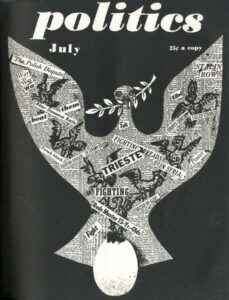
2. The Offending Article. In July 1945 Politics published Goodman’s essay “The Political Meaning of Some Recent Revisions of Freud”. He explained that there was much greater public interest in psychoanalysis because of the many draft rejections on psychiatric grounds; the problem of what we call post-traumatic stress disorder; American war propaganda particularly its analysis of the alleged Japanese character; and the desire to explain the psychological basis of Nazism.
Paul Goodman’s basic thesis in this article is that prominent psychoanalysts including Franz Alexander, Erich Fromm, and Karen Horney, in criticising or modifying Freudianism, were advocating that psychiatrists should adjust people to centralised societies and economies not vice versa. The article compares Nazism, Stalinist communism and New Deal reformed capitalism. Wilhelm Reich is mentioned as an honourable exception to this pattern.
Unlike Goodman, Orwell believed that the Beehive State was with us and what mattered was the spirit of how it is run. Orwell and Goodman detested totalitarianism but Orwell remained a democratic socialist.
3. Paul Goodman – Later Life. He continued writing, and was a left wing critic of Marxism. He was a libertarian. Some wiser heads in the American establishment saw his potential value. His novel The Dead of Spring was published in 1950 and another The Parents Day in 1951. That year he set himself up as a therapist in New York. The University of Chicago awarded him a doctorate in 1954 and published his thesis The Structure of Literature.
In the mid 1950’s Paul Goodman’s epic novel The Empire City was repeatedly rejected; stricter licensing laws meant that New York therapists had to be medically qualified; while his daughter Susan contracted polio. In 1958 he visited Europe and was impressed by Swiss society and its decentralised political structure. He returned to America determined to improve American society.
Paul Goodman’s book Growing Up Absurd (1960) was a study of alienated American youth. He was prominent in the 1960’s counter-culture. Disaffected students admired his integrity and defiance of Middle American values and saw him as a father figure. He often spoke on campuses and was involved with movements such as the Students for a Democratic Society.
Mainstream publishers began publishing Goodman’s social criticism such as his books The Community of Scholars (1962), Compulsory Miseducation (1964) and People or Personnel (1965). His earlier published works were reissued and his backlog of unfinished work found publishers. The counter-culture movement did much to undermine Kennedy and Lyndon Johnson’s reformist governments; and powerful vested interests knew this.
Paul Goodman opposed both the Vietnam War and violent protests, and he became unpopular with some allegedly revolutionary student leftists. They began to disrupt his meetings. His son Matthew Ready Goodman a Cornell University final year student helped organise draft dodging; was being investigated by the FBI; and died in a climbing accident in New Hampshire in 1967 aged twenty.
Paul Goodman became severely depressed. He died of a heart attack on 2 August 1972 aged sixty. Sally Duchsten died in 2013 aged ninety two. They were survived by his two daughters and four grandchildren.
4. Politics and Dwight Macdonald. The article by Paul Goodman from which Orwell quoted a passage as an example of bad English, appeared in Politics a journal that was founded in New York in 1944 by Dwight Macdonald who owned and edited it. It was at first a monthly and later a quarterly; and folded in 1949.
Dwight Macdonald was born in Manhattan on 24 March 1906 to prosperous Protestant parents. He studied at Yale and became a writer, editor, film critic, social critic, literary critic, philosopher and political activist. In 1934 he married Nancy Gardner Rodman. They had two sons. His wife’s inherited money helped finance his literary career although they divorced in 1954. He later remarried.
Dwight Macdonald, like Orwell, hated totalitarianism whether it be Nazi or Stalinist; but he was also a pacifist who opposed American involvement in World War Two. He criticised the dropping of the Atom Bombs on Hiroshima and Nagasaki, the bombing of Dresden and the Russian betrayal of the Warsaw uprising; and promoted the idea of moral equivalence between allied and axis atrocities.
Orwell’s work appeared in Politics three times. He and Macdonald hated totalitarianism but Orwell disliked Macdonald’s pacifism. Other authors’ work that was published in Politics, included eight articles by Paul Goodman; and works by Albert Camus, Simone de Beauvoir, Mary McCarthy, Jean Paul Sartre, Victor Serge, and many other notable names.
Dwight Macdonald viciously campaigned in Politics and elsewhere against former Vice President Henry Agard Wallace the Progressive Party third candidate in the 1948 American Presidential Election. This must have alienated many left wingers and contributed to the journal’s closure in 1949.
Dwight Macdonald remained a leftist critic of Soviet totalitarianism. In 1955 he became editor for a year of Encounter a magazine funded by the Congress for Cultural Freedom a CIA front. On learning he denounced such CIA involvement. He bitterly opposed American involvement in the Vietnam War. He died on 19 December 1982 aged seventy six.
Conclusion. George Orwell quoted five passages of alleged bad English by five authors in “Politics and the English Language”. He named Professors Laski and Hogben who were well known. He did not name Goodman or the other two authors. Paul Goodman’s name appeared at the head of the article from which the relevant quote was drawn so Orwell knew Goodman’s name.
Probably Orwell did not want to insult an author whose personal circumstances he did not know and that were, in fact, precarious. This may have been because Orwell was a gentleman; or because he did not want to offend Dwight Macdonald an ally in the fight against Stalinism as indeed was Paul Goodman himself.
*
This is a fascinating article that usefully puts the spotlight on the highly influential anarchist theorist Paul Goodman. You have, indeed, done very well, John, to delve into the British Library archives and highlight the author of the essay that Orwell critiques in his celebrated ‘Politics and the English Language’. (A more sympathetic reading of Goodman’s essay appeared here https://psypolitics.org/2020/11/02/paul-goodman-1945-the-political-meaning-of-some-recent-revisions-of-freud-2020/ in November 2020). It’s interesting to note that Orwell was clearly aware of Goodman’s other writings. For instance, he commented approvingly on his story, ‘A Ceremonial’ in a TLS review of ‘Experimental Writing in America’ (edited by James Laughlin) in April 1948. Orwell says the story was a ‘spirited attempt to describe happiness, a feat which no writer has ever quite accomplished’. Moreover, in his Last Literary Notebook that Peter Davison carries in Vol. XX of the Complete Works, Orwell copies a sentence Goodman writes in an article for the journal, Now, in 1945 as an example of the ‘American subjunctive’. Why was Orwell reading this edition of Now? Davison provides the answer: his essay ‘How the Poor Die’ appears in it.