
Beastly, Quid, Workhouse
George Orwell once said he had heard that the Gestapo employed literary analysts to identify the work of anonymous authors. The work itself he thought he might enjoy, he said, though his own attempts never came to much. Modern technology allowing texts to be collected, and computer systems which can collate and analyse language use have extended what was a manual exercise in Orwell’s day.
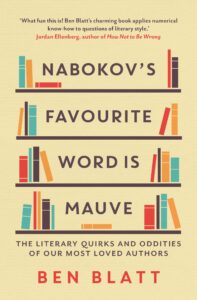
“Beastly, Quid, Workhouse” are the three words that Ben Blatt in his study of word-usage in literature, Nabokov’s Favourite Word Is Mauve, identifies as George Orwell’s cinnamon words. Using analyses of e-texts of classic and modern authors such as Orwell (that is, Orwell’s fiction), Blatt found Orwell used these three words most frequently in his writing. Blatt used the term cinnamon as Ray Bradbury had said he thought that was the word he used most (in fact Blatt found that he was wrong: Bradbury used spearmint more frequently). Vladimir Nabokov’s own three cinnamon words, Blatt found, were “mauve, banal, pun”.
Meanwhile, Blatt also looked for authors’ nod words, inspired by Michael Connolly’s thinking he used “nod” unusually frequently (a correct assumption, Blatt found). Nod words are in all of an author’s books, and used repeatedly. Blatt’s analysis found that Orwell’s three nod words are “round, kind, money”. Some surprising terms show themselves in Blatt’s analysis of seventy or so authors, but Orwell’s own analysis of D H Lawrence is perhaps proved right by Lawrence’s own nod words, “round, dark, sat”, and (not exactly the key words Orwell identified in his study “Charles Dickens”, but close) of Dickens’ “sit, dear, am”.
Earlier, Blatt’s analysis finds that Orwell use of “suddenly” puts him in the upper half of a table of usage, though it does put him with authors he admired such as Lawrence and Joseph Conrad. Blatt was inspired to look for “suddenly” by comments on writing by Chuck Palahniuk, and he followed Palahniuk’s guidance, going on to look for “thought” verbs. The use of “thought” and its synonyms imply that an author is telling, not showing, indicators of a weaker narrative skill. Here Blatt’s tabulated results show that Orwell is the lower reaches of usage, along with Charles Dickens and Joseph Conrad – all three considerably lower than Lawrence. Thus, the three are marked as show-ers, not tell-ers.
Finally, another section of Blatt’s book, looks as the use of “not”, inspired by a line from Strunk and White’s Elements of Style: “… it is better to express even a negative in positive form”. Orwell in his essay “Politics and the English Language” expressed his desire “to laugh the not un- formation out of existence”, and gave a helpful phrase in a footnote with which to learn how to do it. Perhaps it is, then, surprising that Blatt’s analysis of “not” in Orwell’s six novels shows him mid-table, and not lower, in his use of the negative, as he had the examples of Dickens and Conrad (who are considerably lower than him in Blatt’s table). We would have to remember, though, that four of those six novels were written before Orwell had perfected the thoughts expressed in “Politics and the English Language”, and that had he given us more his position might have been lower still.
Readers of Nabokov’s Favourite Word Is Mauve will find more of George Orwell’s idiopathies tabulated in other sections of the book, such as the frequencies of cliches in his work, or his use of “loud” and “soft” verbs in describing speech. Blatt lists all of these alongside his counts in other authors, allowing readers to identify similarities and differences between their styles. Unfortunately, the author he does not include in the book is Somerset Maugham, whom Orwell described as the one he most appreciated for style. It is clear, though, that another of Orwell’s favourites, Charles Dickens, frequently falls in the same standard deviation as him if Blatt’s figures are re-imagined as a bell curve.
This is a book which leaves one wanting more, but any student keen to research more about Orwell and language should be aware of it. Just following up that one section about not and negatives could provide several publishable and rewarding studies.
*
Nabokov’s Favourite Word Is Mauve: The Literary Quirks and Oddities of Our Most-Loved Authors, by Ben Blatt (Simon and Schuster, 2017)
Fascinating! Makes me want this book!
Intriguing, Les
What a fascinating piece, Les. It’s got me thinking. Some years ago the Orwell Facebook group ran a piece looking at Orwell and the semi-colon. https://www.facebook.com/TheOrwellSociety/posts/557863081050487. I wonder if a similar analysis/calculation could be done of Orwell’s use of other punctuation elements; for instance, brackets and exclamation marks (did Orwell; ever use the square bracket?). One could even move on to examine his spare use of notes (for instance, there are, unusually, six in The Road to Wigan Pier by Orwell while an unusual and equally rare one is provided the publisher, Secker & Warburg, in my 1980 edition: alongside Orwell calling Auden ‘a sort of gutless Kipling’ there is the note: ’Orwell somewhat retracted this remark later. See Inside the Whale.’) Perhaps the most striking/famous use of the note comes near the beginning of Nineteen Eighty-Four where Orwell writes: ‘Newspeak was the official language of Oceania. For an account of its structure and etymology see Appendix.’
Awesome post.