
George and the Hogben
Introduction. In Geoge Orwell’s article “Politics and the English Language” (Horizon, April 1946) the second passage of alleged bad English he quotes comes from Professor Lancelot Hogben’s book Interglossa. (Penguin Books, 1943). It reads:
Above all, we cannot play ducks and drakes with a native battery of idioms which prescribes such egregious collocations of vocables as the Basic put up with for tolerate or put at a loss for bewilder.
Horizon’s well educated readership would have known who Hogben was. Today things are very different.
1. Early Life. Lancelot Thomas Hogben was born in Southsea in Hampshire on 9 December 1895. His parents were Thomas Hogben a Methodist dry salter i.e. a chemical manufacturer; and Margaret Alice Hogben nee Prescott whose father was a Stoke Newington building contractor. They already had three daughters; an older son had died in infancy. They were to have three younger sons i.e. seven surviving children in all.
Lancelot Hogben studied at Middlesex County Secondary School in Tottenham, where he became interested in biology; and Trinity College, Cambridge where he studied natural science graduating in 1916. He had become a socialist and a Quaker. Although he had been a volunteer ambulance-man while still a student he refused to join the armed forces or do non-combatant service. He spent several months in Dartmoor as a result.
After his release Hogben made a precarious living as a lecturer at Birkbeck College. This is part of the University of London and specialises in part time and evening courses. He also lectured at the Plebs League a Marxist educational organisation that existed from 1908 to 1926.
On 21 June 1918 Lancelot Hogben married Dorothy Enid Charles aged twenty three the only daughter of the Reverend James Charles a Denbigh Congregationalist minister and theological writer. She was a mathematician and statistician and had studied at Newnham College, Cambridge. Lancelot and Enid Hogben produced sons and two daughters born between 1918 and 1929.
2. Between the Wars. In 1919 Hogben found a job as a Scientific Experiment Demonstrator at the Royal College of Science a college of Imperial College, London, where he researched chromosome cytology. He faced much hostility from returning soldier students. After they had, with his help, got their degrees, they clubbed together and gave him a white feather.
In 1922 Hogben moved to Edinburgh to work for Francis Albert Eley (Frank) Crew, the Director of the Edinburgh University Institute for Animal Breeding. Hogben lectured on experimental physiology and researched colour changes and metamorphosis in amphibians. In 1925 Hogben was appointed an Assistant Professor of Medical Zoology at McGill University in Montreal.
In 1927 Hogben was appointed Professor of Zoology at Cape Town University in South Africa. He reformed the biology curriculum and investigated the endocrine physiology of Xenopus a South African clawed frog. He detested South African racial policies and in 1930 returned to London.
Appointed Professor of Social Biology at the London School of Economics in 1930, Hogben stayed there until 1937 when the Rockefeller Foundation withdrew its support. This was probably because Hogben and most of his colleagues were left-wingers*, though he never joined the Communist Party. He continued to research the xenopus frog and this led to the development of the Hogben pregnancy test, the first practical such test.
In 1936 Hogben’s book Mathematics for the Million, a work popularising mathematics, was published, and he was elected to the Royal Society. In 1938 he was appointed Regius Professor of Natural History at Aberdeen University, and his book Science for the Citizen was published. The books were part of a series he edited, ‘Primers for the Age of Plenty’, aiming at self-educators. At Aberdeen he became interested in comparative linguistics and edited his Swiss friend Frederick Bodmer’s book The Loom of Language which was published in 1944. Professor Hogben also had published various more specialised scientific books and articles.
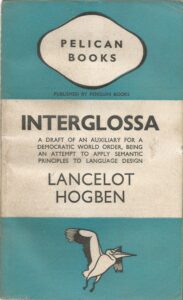
3. The Second World War and Interglossa. During the Second World War Hogben was a firewatcher. This meant spending the night in buildings that were normally kept locked in case they were bombed and fires started.
To use his brain while he was fire watching Hogben invented a new language called Interglossa. It was intended to be an international one. Many such would-be languages were invented in the late nineteenth and early twentieth centuries, the most well-known being Esperanto.: he identified and rejected six earlier artificial languages with “outstanding defects” (Page 10).
In January 1942 Hogben moved to Birmingham University to be Mason Professor of Zoology. In 1943 Penguin published his book Interglossa. He believed that the only alternative to barbarism was the abandonment of national sovereignty and much larger political units; and that this required a second universal language in addition to local ones. No one language or language developed from it, such as C.K. Ogden’s Basic English, would do, because this would arouse nationalist resentment from speakers of other languages. Hence, he sub-titled the book “A draft of an auxiliary for a democratic world order, being an attempt to apply semantic principles to language design”.
The passage that Orwell criticised, from Page 19 of Interglossa, was part of a longer one that insisted that any word in this new language must have a clear and precise meaning. Basic English has relatively few words but many of them have multiple meanings. Incidentally, egregious means disgraceful.
In 1944 Hogben was appointed Acting Director of Medical Statistics at the War Office a post which made him a Colonel despite him still being a Quaker. He reported to his old boss Frank Crew who had been made a Brigadier and appointed Director of Biological Research at the War Office.
4. Later Life. In 1947 Hogben returned to Birmingham University as Professor of Medical Statistics and Human Genetics; and was appointed the first editor of the British Medical Association’s Journal of Social Medicine.
Once her children were old enough Enid Hogben returned to research and administrative work. She was a Leverhulme Research Fellow in 1937-1939, Census Research Specialist at the Dominion Bureau of Statics in Ottawa from 1942 to 1947, and Chief Statistical Officer of Birmingham City Council from 1949 to 1952. From 1955 to 1964 she worked for the World Health Organisation in Southeast Asia. She had several books published.
Professor Hogben tried to keep his marriage alive but in 1957 he accepted reality and he and his wife divorced by mutual consent. Once he was divorced he married Sarah Jane Roberts nee Evans aged fifty four. She had been a schoolteacher but had retired in 1932 and married Arthur Cecil Roberts, a slate quarryman. They produced two children. Arthur Cecil Roberts had died in 1954 leaving his wife a widow.
In 1958 Hogben left the Quakers and declared himself a scientific humanist. He retired from Birmingham University in 1961 aged sixty five**. From 1963 to 1965 he was the first Vice Chancellor of the University of Guyana a former British colony in South America. He continued writing on linguistics and its relationship with science. His last book, The Vocabulary of Science, was published by Heinemann in 1969.
Enid Hogben née Charles died at Torbay in Devon on Sunday 26 March 1972 aged seventy seven. Sarah Jane Hogben died on 5 April 1974 aged seventy one at Ceirog, Llangollen in Denbighshire. Professor Hogben died in Wrexham War Memorial Hospital on 22 August 1975 aged seventy nine.
*
*See THE VISIBLE COLLEGE The Collective Biography of British Scientific Socialists of the 1930’s. By Gary Werskey (1979, and frequently reprinted)
** Hogben’s archive is held at the University of Birmingham in the UK. The Interglossa Dictionary he mentioned in his book was never published in his lifetime, but it has since been put online.
Leave a Reply