
A.D. Ultman Ploughs a Lonely Furrow
Politics is a dirty game, they say, and in Animal Town, a pastiche of George Orwell’s timeless barnyard fable Animal Farm, A.D. Ultman makes this abundantly clear. Unlike Orwell’s Manor Farm and its barnyard “beasts of England,” however, Ultman’s allegorical tale revolves around a community of animals living somewhere on the American prairie. A microcosm of present-day America, Animal Town is a deeply divided society in which prey and predators, called “preds” for short, jockey for position and power.
A political roman-à-clef (in many ways as reminiscent of Joe Klein’s Primary Colors as it is of Orwell’s Animal Farm), the fun part of reading the otherwise tragic Animal Town is identifying the real-life figures who have inspired the fictitious characters. Some are readily recognized while others, Ultman says, ‘are a mash-up of several elites or amalgams of certain ideological positions’, noting that his intention was ‘to ensure the story does not become dated by virtue of the actual people and events receding into history, not unlike [what] Orwell achieved with Animal Farm’. It should be noted, however, that Klein’s 1996 novel, featuring a character modeled on Bill Clinton, was originally published anonymously—for reasons that seem obvious—and A.D. Ultman (Adult Man), a former Staff Assistant to a Democratic senator, has opted to go a similar route with Animal Town.
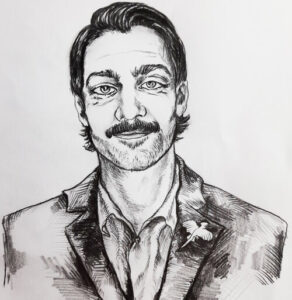
When asked why he had chosen to publish the book under a pen name, Ultman explained: ‘I have no desire for my name or face to be known. It’s not about me; it’s about the ideas. Further, A.D. Ultman is a metaphor for what I believe those ideas reflect: the “last man” [again reminiscent of Orwell] of the Anno Domini, an adult man of the future, (hopefully) not bound by the superstitions, dogmas, and tribalism of humankind’s childhood and adolescence, which are reflected in the identitarian ideologies ascendent in America today’. Fair enough, but I can’t help but think that in today’s highly polarized political climate, there may be more to it than that.
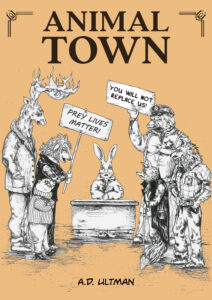
‘Things have never been better in Animal Town’, the tale begins (7), set in what Ultman describes as ‘a not too distant, semi-idealized future where dogma and specism are very nearly a thing of the past’. But change is in the air, ushered in with the arrival of a new schoolmaster, a gopher with a doctorate in ‘critical species theory’. Echoing the words Squealer painted on the barn wall in Animal Farm (and similar to the ideas of Georg Wilhelm Friedrich Hegel1), the new educator challenges the status quo when she scrawls a revised town credo on the blackboard: ‘All animals are free . . . But some animals are freer than others”. Catching wind of her teachings, including notions of ‘pred supremacy’ and ‘pred fragility’, the reactionary fox that leads the Great Predator Temple—no mere evangelist like Moses the raven in Animal Farm—seizes the opportunity to stoke the fires of specism still smoldering in fringe pockets. Spurred on by these rivalling leaders, the seeds of mistrust and resentment take root in both prey and preds, and the interspecial harmony of the town begins to fracture.
Tensions escalate when Officer Furman2 (!), a pred, is exonerated after killing a jackrabbit, and insult is added to injury when the jackrabbit is posthumously found guilty of ‘trespassing and larceny’. Labeling the system ‘pred justice’, prey protesters chant ‘Prey lives matter!’, while the ‘Animal Town Times’, eager to boost sales, goes to press with a string of sensationalized headlines. Similarities to the George Floyd case and the widespread protests it inspired abound, yet Ultman insists this was coincidence, pointing out that the jackrabbit who dies ‘by broken neck at the hands of a pred police officer was already in the book when George Floyd died/was killed, as were all the subsequent events in the story’. In fact, Ultman says that he first got the idea for Animal Town in early 2018 and completed an outline of the story in August 2019; ‘the plot’, he says, ‘has been unchanged since then’. Coincidence or not, the story is a jolting reminder of the case that came to define the zeitgeist of 2020 America.
But Animal Town has a more sinister secret: behind the scenes lurks a puppet master, a wealthy weasel, the very embodiment of corporate greed and the modern billionaire ownership class, who works solely to expand his own interests and profits. Well aware of the opportunity a divided population presents, he jumps at the chance to pull the strings of his Janus-faced minions. The ideological leaders of the embattled prey and preds—the gopher (more a ‘pawn’ or ‘dupe’ than a ‘gofer’) and the fox (connotations obvious)—are both in the pocket of the weasel, and so are the judge and the media. Even more alarming, the candidates in the upcoming mayoral election are stooges, too. A bighorn sheep (read: ‘follower’), who has long served the weasel as a rent enforcer, is running against the weasel’s own son, so regardless of the outcome, the Machiavellian mustelid is sure to win. Every bit as weasely as his father, the junior weasel evokes literary predecessors from yet another animal fable, Kenneth Grahame’s The Wind in the Willows, and seems a curious composite of that tale’s villainous weasels and hubristic Mr. Toad. The boastful Jr. promises to ‘build a great wall’ and make Animal Town great again, and when he wins the election by the narrowest of margins, the basest of animal instincts are exposed on both sides, but I’ll stop short of giving any spoilers.
I only hope worry over spoilers is a valid concern, for in a nation where people have lost the ability to laugh at themselves, Ultman’s razor sharp characterizations are sure to trigger many and, perhaps, even cause some to cast the book aside. And while the novel is in fact critical of both the left and the right, a good deal of the lampooning of the left occurs earlier in the novel than does the mockery of the right, making it more immediately apparent and perhaps opening the door to charges of bias. This, in fact, led me ask Ultman how he would respond to readers who might accuse him of telling a tale that is skewed to the right. Ultman replied:
‘I have had Republican readers suggest it is biased against them and Democrat-leaning readers suggest just the opposite. I hope, and believe, the book reveals more about readers’ biases than it does my own, for I believe the dogmas preached by the extremes of both parties are equally absurd. I am neither the narrator nor a character in the book, and none of them entirely represent my views; though, I admit, I am much closer to some than others, Marcus Prince [the character based on Martin Luther King, Jr.] being closest (if I may be allowed to compliment myself thus)’.
Wherever along the political spectrum readers may be, it would seem a shame to give up on this fable before arriving at its Aesop-like moral; it’s only a story, after all, and it’s a cautionary tale, one intended to provoke thought. And A.D. Ultman’s call for unity is based on convictions so strong they have even informed his choice of nom de plume:
‘Modern democracies have come closer than ever to establishing politics on ideas and policy platforms, but, I believe, our current political and ownership classes are out of ideas. As such, we are in the process of reverting to old, irrational loyalties that turn politics into a zero-sum game where one cannot choose one’s side. This kind of thinking, in my view, indicates we are still in our childhood, as a species. I believe the time has come to put aside childish things. To be adult, we must establish a polity dedicated to protecting and advancing scientific knowledge and human freedom, that is based on egalitarian democracy, and that rejects magical thinking in favor of acknowledging physical reality’.
Besides, the story is about more than just detestable powerbrokers. It is also about a deep friendship between a prey and a pred, both from humble backgrounds and the same economic class. These similarities are underscored by the shifting foundation upon which each friend’s home rests, a detail laden with nuance. Ultimately, though, not even their genuine affection for one another is strong enough to withstand the political upheaval of Animal Town, and while the ending may come as a surprise, the careful reader will likely recollect that their tragedy was indeed foreshadowed early in the story. And therein, perhaps, lies this fable’s real message, as appropriate today as it was in 1858, for any willing to hear it: a house divided against itself cannot stand. And when it falls, sadly, it always seems to be the those from the less privileged classes—like these two friends—who suffer the most.
A.D. Ultman, Animal Town (Houston: Outlier Books, 2021). ISBN13: 9781942549796
*
Works Cited
Hegel, Georg Wilhelm Friedrich. The Philosophy of History. New Dover editions, 1956, p. 104.
Ultman, A.D. Personal Correspondence. 8 Mar. 2021.
*
Carol Biederstadt extends her sincere thanks to A.D. Ultman. Images used by permission of Di Angelo Publications, Inc.
*
Footnotes
*1 Says Hegel: ‘The East knew and to the present day knows only that One is Free; the Greek and Roman world, that some are free; the German World knows that All are free. The first political form therefore which we observe in History, is Despotism, the second Democracy and Aristocracy, the third Monarchy’ (104).
*2 Officer Furman is reminiscent of Officer Mark Fuhrman, the former Los Angeles Police Department officer known for his role in the O.J. Simpson case. Fuhrman was later charged with perjury for his false statements regarding his use of racial epithets.
I had the pleasure of reading Animal Town and thought it was a well-balanced book that touched on sensitive subjects in a constructive way. It’s a great book I have been recommending to my friends and family on both sides of the political fence.