
A Night In, 1946
The son of a police officer opens his former home as social housing in the twenty-first century. A place that once offered shelter of a very different kind.
The Oban Times and its correspondent Hugh Smith recently reported that the former police station in Port Ellen has been brought back into use as social housing. Cutting the ribbon was former MP George Robertson, who lived there as the child of the station officer. That officer once welcomed a stranger without a bed in town: George Orwell.
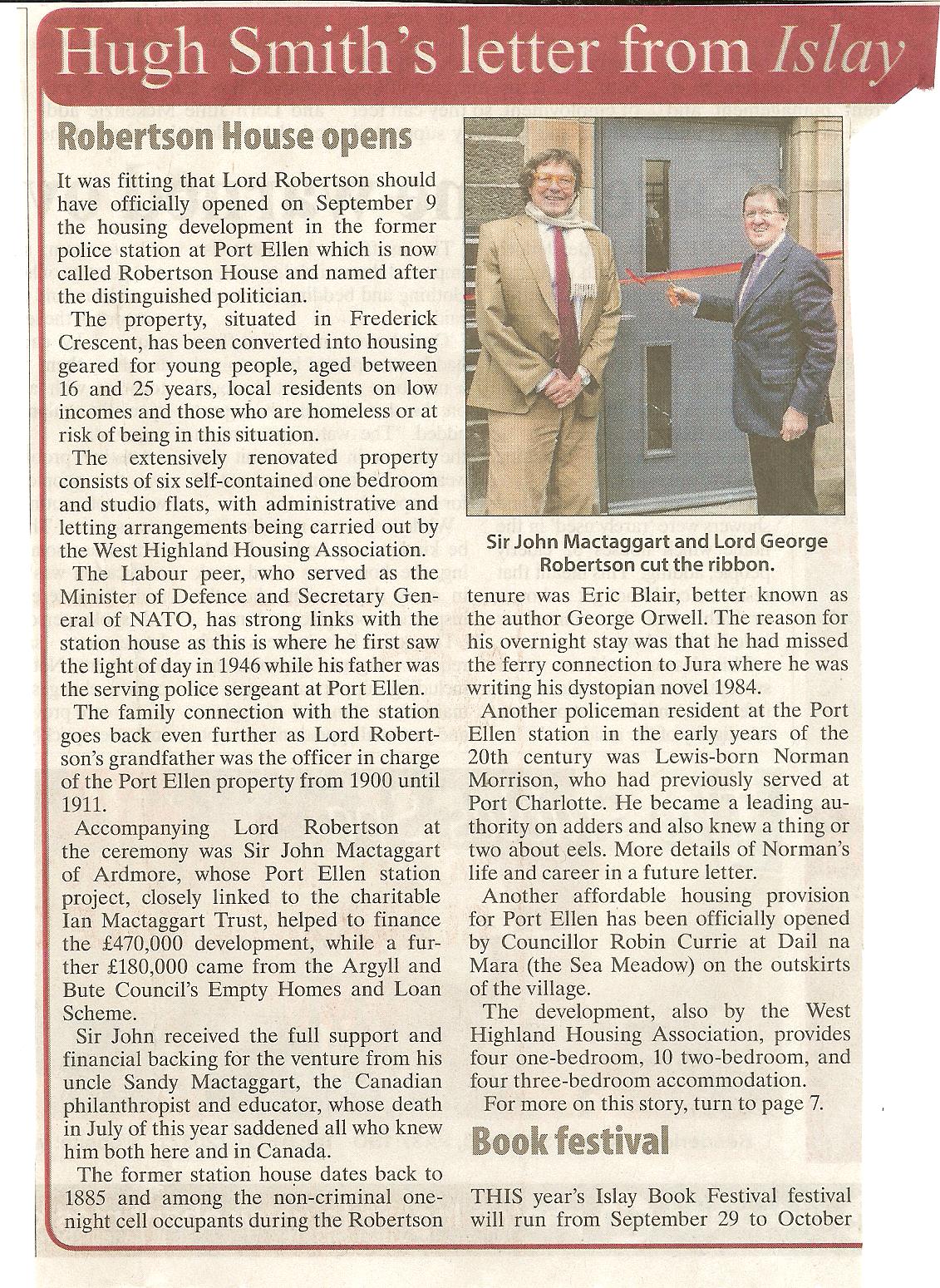
Richard Blair thanks the Oban Times for this clipping
George Orwell’s own account offers even more details. Here is what he wrote to his friend Celia Kirwan:
“I set out the day before yesterday morning, but punctured my motor bike on the way and thus missed the boat. I then got a lift first in a lorry, then in a car, and crossed the ferry to the next island in hopes there would be a plane to Glasgow, however the plan was full up, so I took a bus on to Port Ellen, where there would be a boat on Friday morning. Port Ellen was full to the brim owning to a cattle show, all the hotels were full up, so I slept in a cell in the police station along with a lot of other people including a married couple with a perambulator.”
(Letter to Celia Kirwan 17 August 1946)
So, although there was no storm as the newspaper report suggests, Police Sergeant Robertson’s action went far wider than putting up one stranger, there were a lot of other people, too, and that married couple and possibly a baby in the perambulator. Earlier in his letter Orwell reported that they had had “marvellous weather” for the last week or two, so a less sympathetic official could have told everyone to sleep in the streets, but Sergeant Robertson did not.
George Orwell was journeying because he had been sent to collect Sally, the daughter of his housekeeper, Susan Watson, who had moved with him from London to Barnhill on Jura. Sally’s journey to the house must have been nearly as exciting as Orwell’s the day before:
“In the morning I got the boat [to Glasgow], picked the child up and brought her back, then we hired a car for the first 20 miles and walked the last five home. This morning I got a lift in a motorboat to where my bike was, mended the puncture and rode home – all this in 3 days.”
Today, when the Scottish islands are fearing complete depopulation, we can read Orwell, look back, and in those accounts discover how many people were moving between the islands of the Scottish west coast, and equally how much shipping and traffic – marine and land – there must have been.
Our thanks to Hugh Smith and the Oban Times for letting us re-discover the life of seventy years ago. Who would have thought so much could be found in one police cell?
Why is this article called “A Night In, 1946″?
[…] Elli was followed by Denis Frize, who saw parallels in the lives of Orwell and Robert Louis Stevenson, both products of eminently Victorian parents who in youth threw off their advantages of upbringing and education only to come good as masters of the written word, particularly in social observation and insight into the dualism in the human condition. And finally Les Hurst reminded us of the night George Orwell spent in another Scottish location, the floor of a jail in Port Ellen. […]