
A woman, a man, and a machine gun
Only six months after they married, George Orwell (Eric Blair) and Eileen O’Shaughnessy found themselves in very different circumstances, but their love was just as strong, as Sylvia Topp describes.
Orwell had a beautiful wife… intelligent and self-confident
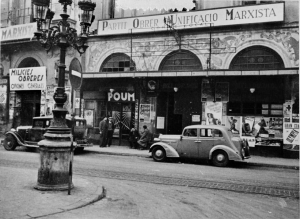
Eileen left for Spain in the middle of February, less than two months after Orwell had gone, travelling alone through France and needing John McNair’s assistance before she was allowed to cross the border into Spain. And when she climbed the long stairway to McNair’s fourth-floor office in Barcelona, bearing gifts for Orwell of his beloved Typhoo tea, chocolates, Havana cigars, and some of the strong black tobacco he enjoyed, she caused quite a stir. Charles Orr, McNair’s assistant, was quite shocked to discover that Orwell had a beautiful wife. He remembered Eileen as “a round-faced Irish girl, prim and pretty, with black hair and big dark eyes.” He thought she was “friendly, gregarious and unpretentious,” a complete opposite to her husband, whom Orr described as “tongue-tied,” a man who “stammered and seemed to be afraid of people.” Orr also found Eileen at first to be “very vaguish when she talks,” a quality others had noticed before. A lot of Eileen’s work would be as an assistant to Orr, and he found her to be “an excellent secretary … intelligent and self-confident. Everyone liked her, women as well as men.” He felt she stood out as “a superior person … not too proud to accept a job as secretary-typist.” Another office volunteer described her as “a remarkably even-tempered young Englishwoman … as she efficiently handled the affairs and finances of half a dozen members of the ILP contingent.”
The ILP was affiliated to the Spanish POUM
her hero husband
Orr was also impressed by Eileen’s open admiration for Orwell, saying, “At the office, Eileen just could not resist talking about Eric—her hero husband, whom she obviously loved and admired,” adding, perhaps ironically, “It was my privilege to hear about him day after day.” Orr decided that “[A] man who could win a woman of such quality must have some value.” Speculating on why Orwell, whom he saw as socially awkward, was “attracted to this outgoing gregarious Irish girl … apart from her natural beauty,” he concluded that Orwell needed “a socially extrovert wife as a window to the world. Eileen helped this inarticulate man to communicate with others”
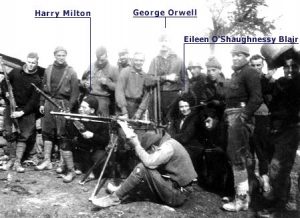
In mid-March, after Eileen had been in Barcelona only a few weeks, she talked Georges Kopp, Orwell’s commander, into taking her along when a trip was planned to the front-line trenches, since Orwell had not yet been given a leave. Eileen stayed at the front with Orwell for three days, getting her picture taken with the gang of volunteers, posing near a machine gun, then sleeping with Orwell at night in the outbuildings of a rambling farmhouse that served as a barracks. She described some of the scary details to Orwell’s agent, telling him, “I was allowed to stay in the front line dug-outs all day. The Fascists threw in a small bombardment and quite a lot of machine gun fire.” Then she added, “It was quite an interesting visit—indeed I never enjoyed anything more.
You really are a wonderful wife
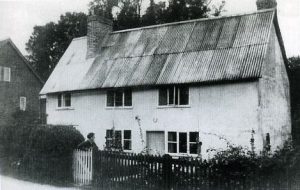
She left some greatly appreciated goodies for Orwell, and his only letter to her that has survived was one written after that visit: “Dearest, You really are a wonderful wife. When I saw the cigars my heart melted away. They will solve all tobacco problems for a long time to come … & you should have seen their faces when they saw the margarine.” Then he added, in a personal touch, “The weather is much better … & the look of the earth makes me think of our garden at home & wonder whether the wallflowers are coming out & whether old Hatchett is sowing the potatoes.” Orwell was looking forward to his leave, which he knew might still be weeks away, “& then what a rest we will have, & go fishing too if it is in any way possible.” He ended his letter, “Goodbye, love. I’ll write again soon. With all my love, Eric.”
our garden at home
*
Extracted from Eileen: The Making of George Orwell, by Sylvia Topp (Unbound, ISBN: 9781783527083), available from all booksellers.
Thank you so much for posting this excerpt from my book!
I have ordered your book which is not available from local library in Brisbane Australia to compare your impressions based on reading the letters with those of Funder in ‘Wifedom’.