
An Enduring, Uncomfortable Mirror
Keep the Aspidistra Flying at Ninety: An Enduring, Uncomfortable Mirror
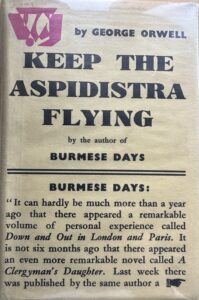
Réka Törzsök examines how, ninety years after its first appearance, Keep the Aspidistra Flying (1936) continues to challenge readers to reflect on their own relationship to such cornerstones of society as money and social status.
*
In recent years, readers of George Orwell have had no shortage of literary anniversaries to mark. The past half-decade has brought the 80th anniversary of Animal Farm (1945) and the 75th anniversary of Nineteen Eighty-Four (1949), followed by the 90th anniversaries of Burmese Days (1934) and A Clergyman’s Daughter (1935). In 2026, the sequence continues with the 90th anniversary of Keep the Aspidistra Flying (1936), a novel frequently overshadowed by Orwell’s better-known works, yet one that reveals key dimensions of his literary and social concerns. Orwell composed Aspidistra in 1934–35 while living around Hampstead, drawing on aspects of his own experience—most notably his time working in a bookshop—and writing under financial pressures that made the novel itself, at least in part, a practical attempt to earn money. The biographical context is revealing, because the novel is preoccupied not with dystopian totalitarianism but with the quieter although no less oppressive forces of class anxiety and economic insecurity, the backdrop to which is the relentless social power of money in interwar Britain. It also speaks with particular force to the clash between artistic ambition and what Orwell presents as the spiritually deadening (100; 102) logic of the advertising industry. Among Orwell’s novels, Aspidistra is perhaps the one most explicitly concerned with economics in both a broad social sense and a narrower cultural one. In light of this, it is hardly surprising that the questions raised by the novel remain strikingly relevant in the economic and cultural climate of the 2020s.
At the centre of the novel is Gordon Comstock, a frustrated middle-aged poet who has deliberately abandoned a promising career in advertising to wage what he sees as a moral rebellion against the “money-god”. Gordon’s rejection of the advertising world—a field Orwell would later know from another perspective through his wartime propaganda work for the BBC’s Eastern Service—initially appears admirable, even heroic. Although he recurrently doubts his own talent, he seeks to preserve his artistic integrity and escape a society where “one doesn’t feel a human being—unless one’s got money in one’s pocket” (162). Yet the narrative gradually exposes the contradictions of his revolt. Until his fateful night out on the town, after which his living conditions take a turn for the worse, Gordon idealises poverty as a romantic condition:
To get out of the money-world—that was what he wanted. Vaguely he looked forward to some kind of moneyless, anchorite existence. He had a feeling that if you genuinely despise money you can keep going somehow, like the birds of the air. He forgot that the birds of the air don’t pay room-rent. The poet starving in the garret—but starving, somehow, not uncomfortably—that was his vision of himself. (53)
The full reality of poverty as an exhausting and humiliating condition that permeates every aspect of daily life is revealed only after Gordon is saved from prison by his upper-class friend and editor, Philip Ravelston, who pays his fine. Gordon takes up lodgings at a “filthy kip” (231), also referred to by the even less flattering word “pigsty” (237). His lifestyle is described in vivid detail: Gordon eats “squalid meal[s]” (232) and “only wash[es] the parts that showed” (233). For entertainment, he reads thrillers or does logic puzzles and watches bugs “march across the ceiling” (233). Thus, one of the most remarkable aspects of Aspidistra is Orwell’s unsparing portrayal of poverty in 1930s London: Gordon’s humiliations are real, but the novel also suggests that his privation remains above (237; 249) the more brutal conditions of unemployment and working-class deprivation that Orwell would soon examine in The Road to Wigan Pier (1937). Writing during the lingering economic hardship of the Great Depression, Orwell captures the psychological toll of living with constant financial anxiety. In this respect, it is important that Gordon’s world is one of social embarrassment. When money is scarce, even simple pleasures—such as dining out, buying new clothes, taking a taxi, spending a day in the countryside, or maintaining a romantic relationship—become logistical challenges. As the narrator puts it: “Social life is so complicated when your income is two quid a week” (67; cf. 121), “[h]ow can you have any fun when you’ve got no money?” (124), and “[i]t is not easy to make love in a cold climate when you have no money” (135). Orwell shows how financial struggle infiltrates the mind, shaping how people perceive themselves and how they believe others perceive them. In this sense, the novel offers a powerful critique of class structures in interwar Britain. Gordon’s rebellion against the “money-god” is partly fuelled by resentment towards a society that equates financial success with moral worth. As he observes, “[g]ood and evil have no meaning any longer except failure and success. […] [M]oney is virtue and poverty is crime” (46–47).

Gordon’s prideful stubbornness and cynicism are, in fact, responsible for much of the humour in the novel. The nature of the text, in this respect, also sets Aspidistra apart from 1940s Orwell texts, which, although still satirical, adopt a much more sober and sombre tone. By contrast, the novels of the 1930s feature a more comic mode of characterisation: Orwell’s other protagonists—Flory (Burmese Days [1934]), Dorothy Hare (A Clergyman’s Daughter [1935]), and George Bowling (Coming Up for Air [1939])—also have their amusing moments. At the same time, these novels demonstrate Orwell’s acute attention to the social and psychological detail that makes his characters so vividly real. Staying on the firm ground of realism, he was yet to adopt the use of the fantastic that would later define works such as Animal Farm—with its anthropomorphised animals and the telling subtitle “A Fairy Story”—or the imagined future setting in which the events of Nineteen Eighty-Four unfold.
On the other hand, the comic elements in Aspidistra do not always counterbalance aspects of its content that are clearly meant to be taken seriously. Gordon’s refusal to compromise often harms the people around him, particularly his patient girlfriend Rosemary (124), who repeatedly tries to make him see the consequences of his obstinacy, remarking, for example, “[o]h, money! You let it worry you too much, Gordon” (134). By portraying Gordon’s flaws so clearly, Orwell avoids turning him into a heroic martyr of capitalism’s injustices. Rather, Gordon is a complex, often frustrating figure whose struggle reflects the messy reality of living according to one’s principles—principles which, as it is revealed at the end of the novel, go hand in hand with Gordon’s self-delusion.
Signifying this turn of events, the aspidistra plant of the title functions as the novel’s most memorable symbol. In middle-class British homes of the early twentieth century, the aspidistra was a hardy, somewhat unfashionable houseplant associated with respectability and domestic stability. In Orwell’s novel, it becomes shorthand for exactly those conventional aspirations that Gordon apparently despises: “good job[s]” (49), with their promise of steady income, comfortable housing, marriage, and children—that is, social conformity. To Gordon, whose “soul squirm[s]” (50) at the thought of such ideas, the aspidistra represents the suffocating values of bourgeois life. However, as the narrative unfolds, it also becomes clear that these arguably modest aspirations for material comfort, also shared by many people today, are deeply intertwined with the wish for security and dignity—things Gordon, in an epiphanic moment of self-awareness, also admits to craving (see 263; 265).
Although Aspidistra is firmly rooted in the social conditions of the 1930s, its themes resonate strongly with readers today. We might even chance saying that its concerns are universal. In the 2020s, people worldwide face economic insecurity, including financial instability driven by unemployment and rising living costs, alongside debates about the meaning of work in an era shaped by Artificial Intelligence. Gordon’s dilemma—whether to pursue artistic (importantly, for him, also moral) ideals at the expense of economic comfort—remains familiar to anyone who has grappled with the pressures of modern career choices: “He wanted to “write”, he told them sullenly. But how could he possibly make a living by ‘writing’? they demanded again. And of course he couldn’t answer” (50). Today, the novel speaks especially to freelancers and creative professionals, but it can also ring true for young people just entering the workforce, who are confronted with the trade-offs between passion and survival in an increasingly precarious economy. Consider, for example, some prominent online trends in recent years: the perceived “necessity” of launching a side hustle and the growing advocacy for both material and digital minimalism.
Orwell’s portrayal of advertising culture likewise feels remarkably prescient. Gordon’s distaste for the manipulative language of advertising reflects Orwell’s broader concern with the ways in which language can shape and distort thought—a theme he would later explore more explicitly in his essays and fiction, most notably through concepts such as Newspeak, doublethink, thoughtcrime, crimestop, and blackwhite. In the age of social media branding and algorithm-driven consumerism, the idea that economic systems shape not only behaviour but also language and identity seems more relevant than ever. Gordon’s refusal to participate in this system may be impractical, but his unease about its influence resonates strongly in today’s advertising-saturated world. This is, naturally, also tied up with the origin of the content itself. In the past year, the widespread integration of AI has led to what has been called the “slopification” of content shared on the Internet—perhaps unsurprisingly, Merriam-Webster’s editors chose “slop” as the 2025 Word of the Year. In this light, we might also be reminded of the novel-writing machines tended to by Julia in Nineteen Eighty-Four.
Another enduring aspect of the novel’s psychological dimension is its exploration of masculinity. Firstly, Gordon’s identity is reliant on his sense of independence; in several scenes, his pride prevents him from accepting help. The exception to this is when he borrows from his sister Julia. As the narrator comments, “[w]hy is it that one can’t borrow from a rich friend and can from a half-starved relative? But one’s family, of course, ‘don’t count’” (138). Secondly, considerable attention is given to Gordon’s lack of success with women. It is these sections of the text which the contemporary reader might feel have not aged well. While the narrator appears to be critical, or at least mildly ironic, towards the Comstock family’s gendered approach to educating their children, as a result of which Julia left school at sixteen for Gordon’s benefit (see 44), Gordon’s musings on women—“The only thing a woman ever wants is money […] No woman ever judges a man by anything except his income” (103)—read as ambiguous, even when readers are aware of the satirical undertone. The character of Rosemary counterbalances this outlook: she is less interested in money and confesses that she “can’t help loving [Gordon], scrubby jaw and all” (128).
Without revealing too much for new readers, the ending suggests a quiet reconciliation between idealism and reality. Propelled by an event that could hardly be more down-to-earth, Gordon comes to recognise that rejecting society entirely may be less meaningful than finding ways to live within it—a conclusion echoing A Clergyman’s Daughter. Orwell’s protagonists, as has often been noted, rarely emerge victorious. In Aspidistra, too, like in the case of Big Brother, the revolutionary overthrow of the “money-god” is inconceivable, and most of the turns taken by the narrative are defined by the often bleak subject matter and the focaliser Gordon’s despairing attitude. The difference concerning Gordon and Winston Smith’s fate is that, in Gordon’s case—partly due to the non-totalitarian lifeworld being depicted—Orwell could still imagine a modest, humanistic acceptance of life’s compromises.
This resolution also reflects Orwell’s broader intellectual trajectory. Throughout his career, he remained deeply concerned with the ways social and economic systems shape human freedom—be it the Empire, England, or a completely fictional setting. At the same time, he was also wary of ideological purity and abstract theories that ignored the simple complexities of everyday life. In Aspidistra, this tension plays out on a personal scale: Gordon’s rebellion ultimately reveals both the necessity and the limits of individual resistance in a world structured by unavoidable economic realities.
Looking back from the vantage point of the novel’s 90th anniversary, it is clear that Aspidistra deserves a more prominent place within Orwell’s body of work. Contrary to, but perhaps because of, Orwell’s own low opinion of the novel—he did not want it reprinted in his own lifetime. While it lacks the dramatic political stakes of his later novels, it offers something equally valuable: a nuanced portrait of the quiet struggles that define ordinary lives. In doing so, it reminds us that Orwell was not only a prophetic political writer but also a keen observer and chronicler of the everyday life of his contemporary society. The combination of witty social insight and psychological realism ensures that the novel remains not just product of the 1930s, but a living work that still speaks to these dilemmas of the modern world. Indeed, in a cultural landscape increasingly interested in questions of inequality and precarity, Orwell’s novel feels contemporary. The aspidistra itself—once a symbol of stifling middle-class respectability—can now perhaps also be seen as representing something more universal: the human desire for stability and belonging, but also for dignity and purpose.
References
Orwell, George (2014) Keep the Aspidistra Flying, London: Penguin Books (Originally: 1936, London: Victor Gollancz Ltd)
*
Réka Törzsök is a first-year PhD student in the British Literature and Culture subprogramme of the Doctoral School of Linguistics, Literary, and Cultural Studies at the University of Debrecen, Hungary. She has published on Orwell’s work and related topics in Brno Studies in English and Brolly: Journal of Social Sciences, with articles forthcoming in Atlantis and Journal of English Studies.
*
Our thanks to Richard Young for the cover images from his library.
*
Click here to access an index to our series of articles written for the 80th Anniversary.
*
Thanks Réka
Thanks for your thoughtful article.
There is a publisher of romantic Novels in the UK called Mills & Boon. I once visited the Printers and they showed me the machine which went from rolls of paper to pallets of printed and bound books. They said the machine was rumoured to wtite the stories as well!
Thank you, Quentin, I’m glad you enjoyed the article. That story about the Mills & Boon printers is quite fitting!
Thanks for sharing this, very helpful. I particularly liked the insightful approach.
Thank you, John, I appreciate your kind words.