
Battles and Struggles in Orwell’s Writing to Inspire
Richard Hallmark reviews
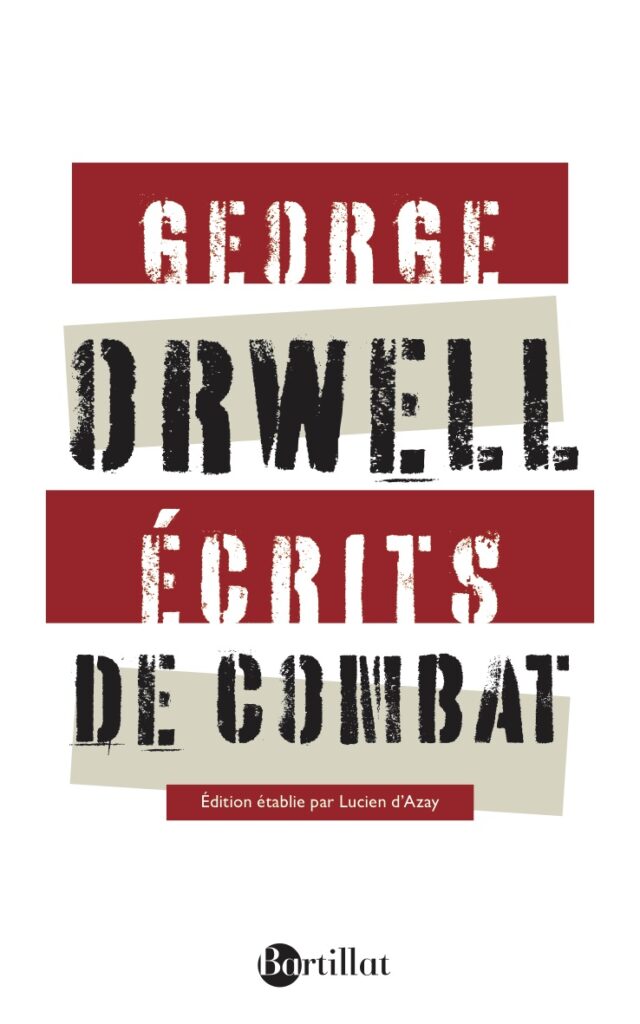
George Orwell, Ecrits de Combat
*
Lucien d’Azay is an established, and prize-winning author, and translator of literature into French. In this new volume of Orwell essays he presents works that are not so familiar from an author whose name is daily used in a way that is often far from what that writer was striving to tell us. This edition will be a revelation to many people.
The words and ideas of George Orwell have been plundered from all sides since even before he died prematurely of tuberculosis in 1950. He had said that in one of his essays, that “Dickens is one of those writers who are well worth stealing.” So some might suppose that there should be no objection to Orwell’s work being treated as a free quarry for anyone to dig out and carry away as they will. Thus the bones of the saint are scattered as relics around the world. (“Saints”, he wrote in opening an essay on Gandhi elsewhere, “should always be judged guilty until they are proved innocent”. Presumably that applies to Francis of Assisi to whom the translator and commentator Lucien d’Azay compares Orwell, if not also Orwell himself whom d’Azay describes as a saint.)
The relics include a plethora of new words, which have been transported around the world and into many languages, and many quotations that refer to acute perceptions of totalitarianism and control by state and corporations. With this is an increased awareness of Orwell’s role in warning of these developments.
By 2007 Orwell’s two most famous books had together sold more than any other English-language author of the 20th century, and that was before the Edward Snowden revelations about US government surveillance and the election of Donald Trump to the US presidency which led to massive sales.
But what we have seen is not just quoting in all the plundering, but misquoting, quoting out of context, twisted application of quotations and even invented quotes, made to sound like something Orwell might have written. He has become something we all want a part of. He is presented as a useful or vital ally. Battle has been joined over what his heritage amounts to.
Lucien d’Azay, the translator and author of the preface of this book, says that exposing himself to attack is one of the features that draws the cachet of saintliness, the notion of “St. George Orwell.” In fact one might think from the attacks on Orwell’s reputation from certain quarters, particularly those associated with the old Stalinist view of the world, that the saintliness is an ironic slur, lent credence by the supposed discovery of the “Orwell list”, some names of communist sympathisers and fellow-travellers given to a friend in the Information Research Department (IRD) of the UK Foreign Office as people not to be trusted. That complaint of his being complicit with the enemy has receded as the Stalinist influence (outside Russia, China and a very few other places )has diminished. It has been replaced by a claim from right-wing quarters to appropriate the Orwell name without either loyalty or understanding. In the USA this has mainly been far right “libertarian conservatives” (an Orwellian description they give themselves, one might say). In France a classic example has been the far-right-wing French journalist Natacha Polony who set up a Comité Orwellienne (Orwellian committee) of mostly like-minded individuals who represented only themselves. She tried to establish a television channel to be called OrwellTV, until she was warned off by legal threats and changed the name to PolonyTV. This journalist is facing trial for (a crime in France) denying the genocide in Rwanda and the complicity of the then French government. D’Azay explains several words that permeate Orwell’s thinking, such as humbug, that her antics illustrate nicely.
The associations of saintliness and Orwell are not new or derived from with that old Stalinist counter-offensive. It goes back to his contemporaries, and some friends: V. S. Pritchett called him “a kind of saint”. Anthony Powell said of him that he was “in his way, a sort of saint”. Evelyn Waugh visited him the year before he died, and judged him “very near to God”. While Orwell was not in any conventional sense of the word ‘religious’, he was moral and understood how values underpinned the kind of world that is to be fought for, and how the lack of values evidently leads in the opposite direction.
D’Azay’s short introduction fairly covers some of the issues which have developed around Orwell. It refers to some of the French commentators of note, such as Jean-Claude Michéa, he opens with a quote from Simon Leys. He makes a clear and strong link to the work of Orwell’s near contemporary Albert Camus. But perhaps most importantly the clear-sightedness and pervasive honesty in Orwell is what appeals to d’Azay and he wants to share his enthusiasm for these works of the English writer and his experience of how he found them.
It is refreshing to find a freshly minted collection of Orwell’s work aimed at an audience that may not have read the works in this volume. He tells the story of how he came by his copy of a 1958 edition (in English) of Orwell’s work with the almost anonymous title Selected Writings prepared by its editor, one George Bott, for adolescent school students. The editor of that earlier edition wrote: “they are notoriously difficult to cater for and Orwell offers a base for the exploration of so many fields: politics, social problems, foreign affairs, prose style, for example.” D’Azay had chanced upon it at a second-hand bookseller at the edge of a jungle area in South Africa. He says that he was so inspired that he carried it with him everywhere on his travels.
It should be recognised nevertheless that this is not just a reissue in translation, as there are some changes in the essays or extracts chosen. He has a replaced an extract from Homage to Catalonia with “Looking back on the Spanish War”, chosen to include “How the Poor Die” and “A Hanging”, and not an extract from Nineteen Eighty-Four (which Bott called The Re-writing of history).
This is as creditable a reason for producing this particular collection as could be imagined. Lucien d’Azay does not burden the book or his readers with a lengthy polemic or academic introduction to justify his view of the writer or the essays. He leaves the work to speak for itself. That is to say for Orwell to speak for himself. It covers the range of Orwell’s life and the very different situations which he found himself in, from Imperial Burma where he served in the Imperial Police, to the poverty and degradation of people in London and the South East of England and in Paris, to investigating the social conditions of working-class people in the Midlands and North of England, to revolutionary Spain in a time of war, as well as England and Europe suffering from the struggles against poverty, injustice, inequality and fascism. He does not invent the dire circumstances he tells us that people have to endure.
What is fascinating about reading Orwell’s essays is that he can make it seem like we are listening to the man explaining his idea or telling us what he has seen or what he understands about something, and why he is passionate about it, and so why it is significant to us the reader. It is better to let him do that without being burdened with explanation, commentary and footnotes. He writes as one might imagine him speaking on the radio to listeners across the world, clearly, precisely, making a point, drawing deductions, explaining how things are. These essays are good examples of his technique.
Notes that d’Azay makes in his brief introduction are helpful, especially for newer Orwell readers. D’Azay’s reference to the supposed saintliness is explained in a context that will appeal to French readers. He compares Orwell being attacked from both sides of a political divide like Michel de Montaigne in Florence being attacked by each of two factions in that city called the Guelphs and Ghibellines, who supported the Pope and the Holy Roman Emperor respectively. They each attacked Montaigne for belonging to the other faction. d’Azay is also clear that while Orwell can be called a democratic socialist, he is not distracted by the fuss about what that might mean even as he stood apart from the militants of camps who would appropriate him to their cause. As with Swift’s lampooning of religious bigotry in Lilliput’s “Big-Enders” and “Little-Enders” in Gulliver’s Travels. Orwell knew when to stand apart.
In his essays and other journalism Orwell does not just write “objectively” about what he observes and reports, but he tells us how it affects him too, how what he experiences changes him. What makes Orwell important, memorable, interesting and enjoyable, qualities rarely combined in a writer or even a book, is derived from the unity to his work, what might be called his constancy to his purpose and direction, driven by his character and moral sense. Experiences enrich the man and clarify the point and the urgency of what he has to say and he may change his mind at various points, but fundamentally he is still aiming the same way.
The essay on Charles Dickens is a fine piece of literary criticism, but not only. As a fine piece of Orwell’s approach to such a subject it shows the breadth of his reading and the depth of his knowledge of one of greats of English literature. He conveys his sympathy to the approach of that author while at the same time being critical. There is a personal measure of Orwell himself in his appreciation of Dickens. The essay goes beyond mere discussion of one author and his books. It becomes a discussion of literature, with the emblematic lines: “every writer, especially every novelist, has a ‘message’, whether he admits it or not, and the minutest details of his work are influenced by it. All art is propaganda.”
And he continues: “Progress is not an illusion, it happens, but it is slow and invariably disappointing…. The central problem — how to prevent power from being abused — remains unsolved. Dickens, who had not the vision to see that private property is an obstructive nuisance, had the vision to see that. ‘If men would behave decently the world would be decent’ is not such a platitude as it sounds.”
Orwell’s essay on Dickens ends on a note which combines the themes he has touched on: “When one reads any strongly individual piece of writing, one has the impression of seeing a face somewhere behind the page. It is not necessarily the actual face of the writer. I feel this very strongly with Swift, with Defoe, with Fielding, Stendhal, Thackeray, Flaubert, though in several cases I do not know what these people looked like and do not want to know. What one sees is the face that the writer ought to have. Well, in the case of Dickens I see a face that is not quite the face of Dickens’s photographs, though it resembles it. It is the face of a man of about forty, with a small beard and a high colour. He is laughing, with a touch of anger in his laughter, but no triumph, no malignity. It is the face of a man who is always fighting against something, but who fights in the open and is not frightened, the face of a man who is generously angry — in other words, of a nineteenth-century liberal, a free intelligence, a type hated with equal hatred by all the smelly little orthodoxies which are now contending for our souls.”
So what makes it right to be call this collection of Orwell’s writing “Écrits de combat”, when there is so little fighting involved? Surely the point is clear that Orwell is addressing the struggles, his and ours, about values such as common decency and the efforts required to change things, the struggles of ordinary people at the individual level and as groups and nations, and how to prevent injustice and misery, how to make people treat each other better in a fairer society. Summarising his aim like that in a few words of course does him no justice, as what he put himself through, and what he reports seeing many others suffering, may seem trite. He deals in real pain and suffering, from the violence in colonial Burma, in which he participated as a policeman on the side of the oppressors; in industrial England, seeing, as a journalist, the misery of working-class people on the edge of survival; in colonial Marrakech (then part of the French empire); as well as reflecting on his part, as a combatant, in the brutal war brought on the Spanish people by the fascist military in a coup d’état aided by the Nazis of Germany and Fascists of Italy while the liberal democracies of France, Britain and the US stood by; and not least the corrupt and murderous treachery of the Soviet-backed communists. After all they nearly had him “liquidated” too.
But the point of Orwell’s criticism not to make us feel depressed that nothing can be done but is to enlighten us, so that by getting us to see things as they are, as he called one of his journalistic columns, we are armed and the better to defend ourselves against abuse, lies and dictatorship. He shares his experiences in his autobiographical writing and his essays, and shows how things work out in his novels. He explains how to avoid to be taken in by the traps of deception and lies that are cleverly woven into patterns of thinking and writing. Forewarned, we can avoid them. If we choose to.
This is writing to be inspired by, in any language.
*
About the editor and translator
Lucien d’Azay is an author in his own right as well as a translator. Both these qualities must chime well with his appreciation of Orwell, both in the telling of stories and the manner of the telling. Books have covered the message of Francis of Assisi, Keats, G.K.Chesterton.
*
Chapters:
Part 1
- Une pendaison (A Hanging)
- Comment j’ai tué un éléphant (Shooting an Elephant)
- Au fond de la mine (The Road to Wigan Pier, Chapter 2; Down The Mine)
- Marrakech (Marrakesh)
- Souvenirs de la guerre d’Espagne (Looking Back on the Spanish War)
- L’Esprit de sport (The Sporting Spirit)
- Pourquoi j’écris (Why I Write)
- Comment meurent les pauvres (How the Poor Die)
Part 2
- Charles Dickens (Charles Dickens)
*
George Orwell, Ecrits de Combat (with « Charles Dickens »)
translated from the English and with a preface by Lucien d’Azay
(Bartillat, Paris 2021
ISBN : 978-2-84100-702-8
Publication date : 07/01/2021
Price : 20 €
264 pages, Format : 12,5 x 20)
*
Excellent review Richard
Thanks.
Yes, I agree – a super review, Richard. Just one tiny follow-up point – isn’t it interesting in his essay on Dickens Orwell nowhere mentions the fact that he was a journalist…