
Becoming George Orwell
Reviewed by Norman Bissell
*
John Rodden is widely regarded as the world’s leading authority on the legacy of George Orwell. Beginning with The Politics of Literary Reputation: The Making and Claiming of ‘St George’ Orwell in 1989, Every Intellectual’s Big Brother in 2006, and continuing with editing The Cambridge Companion to George Orwell in 2007 and The Cambridge Introduction to George Orwell in 2012, The Unexamined Orwell in 2011 and more, he has established himself as the foremost expert on the cultural and political impact of Orwell on the world. His latest book, Becoming George Orwell: Life and Letters, Legend and Legacy more than justifies that reputation.

Rodden draws a distinction between Orwell the man and his work and “Orwell” the legend he has become in everyday discourse which often distorts and misconstrues who he really was and what he stood for. He makes this point frequently throughout this book when examining the “afterlife” of the author and his writings. He is refreshingly honest in describing Orwell as his “intellectual big brother” to whom he feels a special affinity and reveals the personal debt he owes Orwell in enabling him to resolve his own issues of personal identity as a writer and aspiring intellectual.
His overview of Eric Blair’s life and work is brief but informative and at the end of it he raises some interesting “what if” questions such as “What if he had delayed completing Nineteen Eighty-Four until he found a London secretary?” “What if his health had not broken down from the exertion and exhaustion of pushing himself to type Nineteen Eighty-Four?” He suggests that perhaps Orwell and the novel might never have become so famous and controversial, but we shall never know.
Despite the ever-expanding Orwell industry, Rodden manages to come up with several original angles on the Orwell story. He makes a convincing case for the publication of the essay “A Hanging” in the Adelphi magazine in September 1931 as representing Eric Blair’s literary, political and intellectual breakthrough when he became a masterly writer. He argues that Christopher Hollis’s A Study of George Orwell: The Man and his Works in 1956 was the first full critical assessment and biographical portrait of Orwell and that it played a major role in defining Orwell as a man of “common decency”. It was generally accepted as revealing much about Eric Blair’s time at St Cyprian’s, Eton and Burma, albeit they drew entirely different conclusions from their time spent in each.
The Conservative MP Hollis tried to draw Orwell into his own Catholic intellectual camp despite the latter’s atheism, and Rodden, a Catholic himself, has a fascinating chapter on the favourable reception of Orwell from the 1930s onward by the influential American Catholic magazine Commonweal which helped to secure his reputation among not only American Catholics but the wider public. Despite Orwell’s hostility towards the Catholic Church, Commonweal saw him as a man with a clear moral compass whose writings exemplified decency and fair play, an essentially Christian ethic.
Rodden also emphasises the importance of Orwell’s French connections by drawing comparisons with the now forgotten French novelist Jean Malaquais and the much better known Algerian writer Albert Camus. Malaquais was a fierce anti-Stalinist who fought in the POUM militia in Spain just before Orwell did and his first novel Les Javanais (Men from Nowhere) published in 1939 won lavish praise from French reviewers and Leon Trotsky. Malaquais became a mentor to Norman Mailer and his final novel Le Gaffeur (The Joker), 1953 portrayed a totalitarian society similar to Airstrip One with a rebel protagonist and an interrogator. Lauded in the 1940s, he disappeared down the memory hole of literature and became, as Rodden has it, ‘a Nowhere Man’ — unlike Orwell. He also likens Orwell to Camus in that they both became persona non grata on the Left for their critique of Stalinism and both valued the spiritual dimension of life despite their hostility to religious institutions. The French Communist Party was the largest party in the post-war Constituent Assembly and hugely influential with over half a million members, so it took real courage for Camus to go against the Stalinist grain, unlike Jean Paul Sartre, Maurice Merleau-Ponty (Sonia Brownell’s lover before she married Orwell) and others. Interestingly, Camus’ novel La Peste (The Plague) has become a best seller again as a result of the Covid-19 pandemic. Rodden sums them up as “Intellectual integrity, moral courage, and literary excellence: George Orwell and Albert Camus” — virtues we have much need of today and in the years to come.
 John Rodden
Rodden is suitably perceptive about the role of what he calls the twin masterpieces of Animal Farm and Nineteen Eighty-Four in cementing Orwell’s reputation but he also makes a compelling case for a definitive edition to be published of the “dystopian classic” with an Introduction which puts it in context, and for Orwell to be considered England’s prose laureate based on the quality of his literary essays and articles on popular culture. He says that the American Book-of-the-Month Club’s selection of Animal Farm in September 1946 is the key to understanding Orwell’s worldwide fame today. It sold 460,000 copies between 1946 and 1949. He also restates the convincing argument he made in The Politics of Literary Reputation that it was BBC Television’s adaptation of 1984 broadcast on Sunday 12 December 1954, repeated on 16 December, which created a ‘perfect storm’ of controversy which led ‘Big Brother’ and other Orwell neologisms to enter common parlance where they have remained ever since.
Surprisingly for someone who has spent most of the last three decades studying the work of the avowed democratic Socialist Orwell, he reveals late in the book that he is not a socialist himself — rather, a social democrat and follower of the liberal utilitarian philosophy of John Stuart Mill. He regards socialism as utopian and unrealistic, a vision created by people which is ‘far beyond their moral reach’. One imagines Orwell having a lively debate on such matters with his critical admirer! No matter, the range and depth of Rodden’s knowledge and understanding of post-World War II literature and worldwide responses to Orwell are unparalleled and inform whatever aspects of Orwell and his legacy he analyses. One feels in safe hands whichever literary journey he takes us on with Orwell.
The timing of Orwell’s death in January 1950 was crucial to his legacy, Rodden argues, because it came at a time when his condemnation of totalitarian dictatorship could be embraced by both left and right, especially in the USA. After his death, “ideological grave robbers and political body snatchers could now ransack his legacy at will.” Orwell’s late novels were weaponised by anti-Communists during the Cold War, exemplified by the CIA’s involvement in the production of the animated version of Animal Farm released in 1954. Orwell was aware of this danger before he died and tried to make clear his own political position as a democratic Socialist, but Rodden rightly makes the point that, had he lived longer, one of the sides who lionised him, the American right, would have had to confront the author’s socialist views.
His concluding chapters examine the intriguing questions of Orwell’s relevance today and what importance his work will have in the future. The Cold War has been replaced by cyber-wars and Edward Snowden’s revelations of the extent of surveillance by the National Security Agency in the USA and GCHQ in the UK, together with the long reach of data collection by Facebook and Amazon, have taken Orwell’s warnings about the dangers of Big Brother to new levels. Interest in Orwell and his work continues to grow. Rodden believes that whilst Orwell’s life and work have been exhaustively studied, new perspectives on the legend and legacy of his doppelganger “Orwell” will continue to emerge because of the ongoing tendencies towards surveillance and authoritarian power throughout the world which will provide new examples of Newspeak, Big Brother and Doublethink. He also sees China and India as offering new theatres for the deployment of Orwell scholarship.
Two other features of Becoming George Orwell are worthy of note. One is the American cartoon drawings and other images it contains which vividly illustrate how Orwell’s creation Big Brother has been used to portray the surveillance society of Robert Kennedy, Barack Obama and, especially pertinent today, Donald Trump’s America. The other is the forty pages of Notes at the end of the book which are extremely informative extensions and reinforcements of Rodden’s arguments and an excellent resource for further study of Orwell and his legacy. This is particularly the case with regard to both Rodden’s condemnation of the notorious John Birch Society’s attempt to hijack Orwell and his contention that Orwell is the most influential writer of all time. The Notes consider alternative famous literary quotations to “Big Brother is Watching You” and conclude that none come close in the popular imagination. The Notes are chock-full of fascinating literary insights into the likes of Anthony Burgess, E.P. Thompson, Raymond Williams, Norman Mailer, Christopher Hitchens and even the compartmentalised friendships and secret love lives which Charles Dickens and Orwell both had.
The timing of the publication of Rodden’s book in February 2020 was unfortunate in that, like many other books in this year of Covid-19 pandemic, it hasn’t received the attention it deserves and he hasn’t been able to promote it in the normal way by means of actual book launches, talks and participation in conferences. I hope the Orwell Society will consider inviting him to talk about his book both online and in person next year, pandemic restrictions permitting. I feel sure this would be well worthwhile were it to prove possible. In the meantime, Becoming George Orwell makes for an engrossing and illuminating read.
*
Norman Bissell is the author of Barnhill A Novel about George Orwell’s last years.
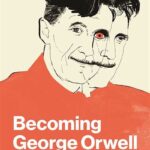 Becoming George Orwell: Life and Letters, Legend and Legacy by John Rodden (Princeton University Press, 2020 [Announced 2019], ISBN: 9780691182742)
*
Congratulations to The Orwell Society, John Rodden and Norman Bissell ! I shall certainly buy Becoming George Orwell later today. Can I take this opportunity to mention Norman Bissell’s own Barnhill, a novel about Orwell’s last years in London and Jura. It is brilliant because through careful research and an empathic imagination, Norman manages to craft a sympathetic portrait of George/Eric, without idealising him. Socialism in Britain is in the mire because it is still thirled to the notion that socialism can only be created through the centralised state. And because socialists still think in binary opposites. I regard myself as a democratic socialist (because otherwise socialism becomes totalitarianism) and a social democrat (because the demos are not isolated individuals but persons in relation).
Okay: I am happy add more if you wish. Another astonishing connection is that between George Orwell/Eric Blair on the one hand, and Karl Popper (The Open Society and its Enemies) on the other. Popper’s analysis of Plato’s authoritarianism, and Orwell’s imaginative creation of Animal Farm and 1984. These great critiques of totalitarianism happened broadly over the same period.
Thank you. I hope that you’ll join the Society.
https://orwellsociety.com/how-to-join/
Thank you for your recommendation of my review and my novel Barnhill, Colin. It would be interesting to hear your thoughts on the Orwell and Popper connections. Popper had a doctorate in psychology and his most famous book Open Society and its Enemies came out in 1945 but I’m not aware that Orwell wrote about it. Popper influenced Bernard Crick at LSE and continues to influence George Soros and his Open Society Foundations.
non credo che Orwell avrebbe apprezzato una interpretazione simile a quella per cui la socilademocrazia ideale superi quella reale; e la speranza di un mondo nuovo non totalitario non appartiene ai conservatori.