
Can We Truly Rebel?
Can We Truly Rebel? – Fisher and Orwell
by Patrick Homes
*
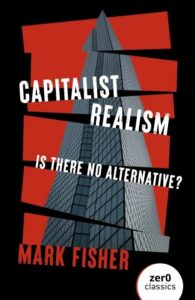
Mark Fisher was a Marxist philosopher and writer who taught at Goldsmiths’ College at the University of London. His 2008 book Capitalist Realism: Is there no alternative? dissects how, after the defeat of communism in the Cold War, it is easier to imagine the end of the world than the end of capitalism. In other words, it is impossible to imagine a modern world without capitalism.
That does not mean that anti-capitalism, or criticism of the capitalist system is impossible, but that it never seriously proposes a viable alternative.
In such a system, in which only the small improvement of present conditions is imaginable, and not any systemic change in the fundamental intellectual and ideological basis of that system, Fisher states, ‘Action is pointless; only senseless hope makes sense’. In essence, the only course a dissident can take is one of futile hope, of being a dissident, and not a true rebel.
This intellectual framework offers an insightful method of understanding and analysis of George Orwell’s work, particularly Nineteen Eighty-Four for the same idea is evident in the ultimate futility of the protagonist Winston Smith’s dissidence, and the effect this analysis has on the dystopian warning Orwell presents in his novel.
Winston’s sure sense of fatalism, of his final defeat, ‘The end was contained in the beginning’ demonstrates a similar idea to Fisher’s ‘senseless hope,’ for Winston cannot believe that his rebellion might succeed, and he internalises this defeat, creating, as Fisher notes ‘a self-fulfilling prophecy.’ In a society where every traitor is exposed and destroyed, it is understandable that Winston simply cannot, beyond mere vagaries, imagine a scenario of victory, only of delaying the inevitable
Yet the true limiter of thought in this sense, the thing that truly makes it, in the words of Mark Fisher, ‘impossible to even imagine a coherent alternative,’ is the existing resistance to the Party.
This might sound, on its surface, a paradox. How can the opposition to the Party be that which makes true opposition impossible? But the real genius of Fisher’s, and, as I contend, Orwell’s analysis, is how they exhibit the in-built futility of such oppositions.
Fisher argues that there are ‘settled ‘alternative’ or ‘independent’ cultural zones which endlessly repeat older gestures of rebellion … as if for the first time.’
This is precisely what Goldstein’s Brotherhood is. In the modern day, Fisher describes these zones as a mostly informal configuration dictated by the need to feel rebellious when true rebellion is impossible. I would argue Goldstein functions in a similar way in the society of Nineteen Eighty-Four, except more officially and formally.
The construction and maintenance of such ‘cultural zones’ is evidently O’Brien’s job. Take, for example, the supposedly revelatory work of Goldstein The Theory and Practice of Oligarchical Collectivism. It offers an accurate critique and exposition of truly how the Party, and INGSOC, is structured. It exposes war as merely the means by which the ‘products of human labour’ may be destroyed, to ensure the poor remain poor, and the deliberate institution of ‘chronic shortage[s]’ to promote a siege mentality. It exposes every category of lie ever told by Oceania.
And yet, it is an analysis, not a political programme. Its one idea of progress, which Winston naïvely holds to as an article of faith, that, in a society where everyone is wealthy the lower classes would finally, somehow, realise the futility of the ruling class ‘and they would sweep it away’. This is, evidently, a hope, not a viable alternative.
In fact, its portrayal of history much in the way Marx described it, as ‘The history of all hitherto existing society is the history of class struggles’, that three classes, the high, the middle, and the low, have existed, and will always exist, and that society is eternally hierarchical, does not truly offer an opportunity to imagine an alternative. If history is merely the cyclical churning of power, then how can one escape that cycle? The inescapability of history lies at the heart of Capitalist, and INGSOC, realism. For the first, the seemingly inevitable and almost scientific progress of society to liberal democracy and market capitalism as, if not the perfect, then the best available system of government, and for the latter, the eternally hierarchical nature of human society.
This is what truly makes Winston’s actions mere dissidence, and not rebellion. Not just because the scale of his actions is always personal, but because he cannot truly articulate a future without INGSOC. He hopes for one, he might even believe in one, but he can’t envision one.
Thus Fisher’s analysis of our modern Capitalist system, and its suppression of any viable alternative, bears some striking similarities with the world Orwell imagined, helping us to both better understand the intricacies of Nineteen Eighty-Four, but also showing, more broadly, the role our intellectual environments play in forming the outer bounds of intellectual expression.
A first-class example of two and two making five…
TBM
Very interesting article. My only problem with your analysis (and Fisher’s) is that the Appendix of Nineteen Eighty-Four shows that the regime of Big Brother was effectively defeated by around 2050.Two questions should be asked about the Appendix: how come the date of 1984 is mentioned twice, and how was it that Winston’s diary was found when it should have been vapourised? The secret brotherhood must have done its job i.e. there is hope – Winston was remembered.
The other point I would make is that no mention in the article has been made of Winston’s belief in “The spirit of Man”
I have written several peer review essays in the George Orwell Studies book which you might like to read. Another essay is coming out shortly in which I will address the very questions your article raises.
Thank you for the stimulating thoughts.
Sorry Patrick,
Should have said 1984 mentioned 3 times in Appendix.
Incidentally, Margaret Atwood was one of the first to see the significance of the Appendix, but not even she has taken its implications for interpreting the rest of the novel to its logical conclusion. Hope to have a discussion with her soon since I will be quoting from her in a forthcoming paper.