
Churchill and the “Remarkable” Book
Published a day apart, George Orwell’s last articles concerned the two figures who had played a large part in his thinking. In The New York Times Book Review of May 15th 1949 was his review of Dickens: His Character, Comedy and Career by Hesketh Pearson, but a day before in The New Leader, also published in New York, was his review of Their Finest Hour by Winston Churchill (the second volume of Churchill’s history of the Second World War). According to his editors, Sonia Orwell and Ian Angus, in their note accompanying the Churchill review in the Collected Essays, Journalism and Letters, this was the last work that Orwell completed. He died seven months later in January 1950.
In his review Orwell wrote:
Churchill is among other things a journalist, with a real if not very discriminating feeling for literature, and he also has a restless, enquiring mind, interested both in concrete facts and in the analysis of motives, sometimes including his own motives.
This short piece looks at Churchill on Orwell, and how that account is used by three authors, two of them Americans, and one British.
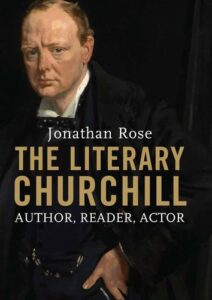
First, Jonathan Rose, in The Literary Churchill: Author, Reader, Actor (2014):
How would the British people have conducted themselves if they had been persecuted by some kind of Gestapo? George Orwell was already working on that thought experiment, and Churchill would read Nineteen Eighty-Four twice. Throughout the 1950s he was enthralled by novels of totalitarianism: Spark of Life (Erich Maria Remarque’s account of a German concentration camp), Brave New World, One Day In The Life of Ivan Denisovitch, Doctor Zhivago. With Orwell and many other intellectuals of that decade, he wondered whether a new technology would abolish the individual even in the Western democracies… (p. 419)
Jonathan Rose’s “1950s” has to be read very widely: the Gestapo reference came from an election broadcast made by Churchill on June 4th 1945:
No Socialist Government conducting the entire life and industry of the country could afford to allow free, sharp, or violently-worded expressions of public discontent. They would have to fall back on some form of Gestapo, no doubt very humanely directed in the first instance.
Spark of Life was published in 1952, while Dr Zhivago first appeared in Italy in 1957 with a Russian emigré edition and an English translation a year later, but Ivan Denisovitch did not appear until 1962 in Russian, and a year later in English.
*
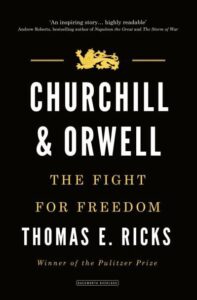
Now to our second author: Thomas E Ricks in Churchill & Orwell: The Fight For Freedom (2017):
Their paths never crossed, but they admired each other from a distance, and when it came time for George Orwell to write 1984, he named his hero “Winston”. Churchill is on record as having enjoyed the novel so much he read it twice. (p. 2)
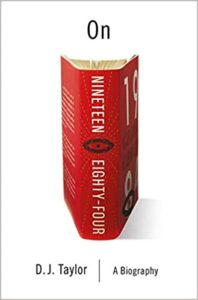
And finally, the British author, D J Taylor in On Nineteen Eighty-Four: A Biography (2019):
Calling at 10 Downing Street in February 1953, Churchill’s doctor Lord Moran “found the P.M. absorbed in George Orwell’s book 1984.” Had he read it? Churchill straight away inquired. “I’m reading it for a second time. It’s a very remarkable book”.
There is so much in Nineteen Eighty-Four that it is little wonder that Churchill had read it twice by 1953; perhaps he read it again before he died in 1965. Did he ever stop and consider what Winston Smith thought he had discovered in Goldstein’s Theory and Practice of Oligarchical Collectivism:
The book fascinated him, or more exactly it reassured him. In a sense it told him nothing that was new, but that was part of the attraction. It said what he would have said, if it had been possible for him to set his scattered thoughts in order. It was the product of a mind similar to his own, but enormously more powerful, more systematic, less fear-ridden. The best books, he perceived, are those that tell you what you know already.
“It was the product of a mind similar to his own”: perhaps that is why Churchill found Nineteen Eighty-Four remarkable. Regardless, though, “remarkable”, at least, as Churchill’s description of the novel, is one that should be better known.
*
Thomas E Ricks, Churchill & Orwell: The Fight For Freedom (2017: Duckworth Overlook)
Jonathan Rose, The Literary Churchill: Author, Reader, Actor (2014: Yale University Press)
D J Taylor, On Nineteen Eighty-Four: A Biography (2019: Abrams)
*
Leave a Reply