
Clogs and the Cotton Mills Conundrum
*
One of the most interesting sentences in George Orwell’s The Road to Wigan Pier (1937) is the very first one.*i Much criticism of Orwell’s account of his researches into the plight of the poor, unemployed and miners in the north of England has focused on his failure to acknowledge women. For instance, Beatrix Campbell writes (1984: 131):
‘Part of the problem is that Orwell’s eye never comes to rest on the culture of women, their concerns, their history, their movements. He only holds women to the filter of his own desire – or distaste.’
She says Orwell ignored the fact that there were as many cotton workers in Wigan as miners – many of them women. And Deirdre Beddoe (1984: 139-154) also argues that Orwell chose to focus on mining rather than cotton factories where women predominated because it confirmed his conception of the working class as male.
Yet The Road to Wigan Pier begins: ‘The first sound in the mornings was the clumping of the mill girls’ clogs down the cobbled street.’
I thought of this when recently visiting the Manchester Art Museum which displays Eyre Crowe’s remarkable ‘The Dinner Hour, Wigan’ (1874). The painting shows a group of mill girls chatting outside Thomas Taylor’s factory looking relaxed in their aprons and shawls. One girl is barefoot: all the others are wearing clogs.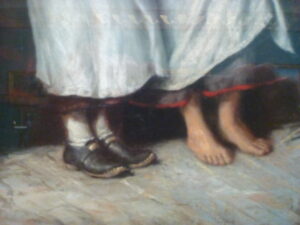
A detail from the Wikipedia article on British clogs.
Dianne Sachko Macleod, in Art and the Victorian Middle Class (1996), suggests that by painting a ‘happy workers’ scene outside the factory walls, Crowe, who probably visited Wigan during one of his tours of the country in his role as Inspector of Schools of Art, thereby avoided portraying the terrible working conditions inside.
But the painting was the first illustration of contemporary working class life to appear at the Royal Academy. Not surprisingly, it attracted a lot of hostile comments. Critics damned it as ‘unpictorial’ and ‘vulgar’. One said it was ‘a pity Mr Crowe wasted his time on such unattractive materials’ while The Times described it as a ‘praiseworthy attempt to find paintable material in the rude life of some of the most unlovely areas of Lancashire’.*ii
Why then did Orwell begin The Road with the reference to the mill girls? According to Ben Clarke (2016), Orwell may have started out with the intention to concentrate on the cotton factories and their women workers. But before travelling north, Orwell had corresponded with Jack Hilton (having praised his first book, Caliban Shrieks, in an Adelphi review) who recommended concentrating on miners rather than cotton workers. Frank Meade and his wife, with whom Orwell stayed in Manchester, may also have encouraged him to focus on the colliers: it was Meade who suggested Orwell travel to Wigan and he introduced him to Joe Kennan who fixed his first trip down a mine.
Hilton may then have played an important role in the making of The Road to Wigan Pier. But, once published, he had a dim view of it: although Orwell had travelled to Wigan, Hilton later said, he may as well have stayed away since he ‘wasted money, energy and wrote piffle’ (Clarke op cit). According to Hilton, the book’s failings were the result of class differences with the old Etonian Orwell unable to get to ‘the tap-roots’ of what he later termed, in Nineteen Eighty-Four, the proles.
Notes
i. I would like to thank Les Hurst for pointing this out to me
ii. For a copy of the painting, and a detailed account, see https://eyrecrowe.com/pictures/1870s/the-dinner-hour-wigan/
References
Beddoe, Deirdre (1984) Hindrance and help-meets: Women in the writings of George Orwell, in Norris, Christopher (ed.) Inside the Myth: Orwell – Views from the Left, London, Lawrence & Wishart pp 139-154
Campbell, Beatrix (1984) Orwell: Paterfamilias or Big Brother? in Norris, Christopher (ed.) Inside the Myth: Orwell – Views from the Left, London, Lawrence & Wishart pp 128-136
Clarke, Ben (2016) George Orwell, Jack Hilton and the working class, Review of English Studies, Vol. 67, No. 281 pp 764-785
Macleod, Dianne Sachko (1996) Art and the Victorian Middle Class, New York: Cambridge University Press
Richard Lance Keeble, joint editor of George Orwell Studies, was chair of The Orwell Society (2013-2020). He is currently editing with Tim Crook a 320,000-word Routledge Orwell Companion.
In an interview in yesterday’s Observer, Stephen Fry commented, “I happen to be of that generation when almost every institution I belonged to has been all-male.” For Orwell, born 50 years earlier, this was even more so. At his prep school, at Eton, in the Burmese police, when he was teaching and tramping etc he was in all-male company. Perhaps in consequence of this, he showed little curiosity about women workers, and I suspect would anyway not have felt comfortable investigating the lives of the mill girls.
A most interesting reflection, John. But by 1936 he had already known quite a few women including: Jacintha Buddicom, Eleanor Jaques, Brenda Salkeld, Kay Ekevall, Ruth Graves, Ruth Pitter, Mabel Fierz, Eileen O’Shaughnessy, Lydia Jackson, Myfanwy Westrope (not to mention his two sisters, mother, Aunt Nellie and Aunt Norah and various female relatives in Burma). Women feature quite prominently in his early novels. And women are observed and interviewed closely in his Wigan Pier Diary…D.J. Taylor even talks of the ‘genuine imaginative sympathy that Orwell brought to the plight of the Wigan women’.