
Don’t Dell On It
*
Or A Savage in Disguise
In “Inside the Whale” published in 1940 George Orwell discusses the three highbrow literary generations that had existed in Britain since he was old enough to read allegedly serious literature: the three being,. the Houseman era Nature Poets, the Joyce-Eliot Despair of Life writers, and the Stalinist pro-Russian era.
Orwell and Dell. George Orwell wrote in “Inside the Whale” (1940) that at any given moment of course there is a huge tribe of Barries and Deepings and Dells who simply don’t notice what is happening. These were Sir James Matthew Barrie of Peter Pan fame, (George) Warwick Deeping and Ethel Mary Savage née Dell who wrote under her maiden name. Here I look at her.
George Orwell made several other references to Ethel M. Dell. In the 26 September 1935 New English Review reviewing several books he wrote that If one is reviewing a novel by say Dell or Deeping it will not do to write it off snootily and unhelpfully as a piece of tripe.
Keep the Aspidistra Flying. Gordon Comstock a bookshop assistant the hero of Orwell’s novel Keep the Aspidistra Flying (Gollancz, 1936) regards Dell scornfully. Although this was a novel some of it is autobiographical. In chapter one Orwell writes first:
‘Good afternoon, Mrs Weaver. Good afternoon, Mrs Penn. What terrible weather!’
‘Shocking!’ said Mrs Penn.
He stood aside to let them pass. Mrs Weaver upset her rush basket and spilled onto the floor a much-thumbed copy of Ethel M. Dell’s Silver Wedding. Mrs Penn’s bright bird-eye lighted upon it. Behind Mrs Weaver’s back she smiled up to Gordon, archly, as highbrow to highbrow. Dell! The lowness of it! The books these lower classes read! Understandingly, he smiled back. They passed into the library, highbrow to highbrow smiling.
And then
Mrs Weaver pursed her lips. Behind them were three isolated yellow teeth.
‘I think p’raps I can’t do better’n ‘ave another Dell’ she said. ‘You ‘ave got some more Dells ‘aven’t you? I do enjoy a good read of Dell, I must say. I says to my daughter, I says ‘You can keep your Deepings and your Burroughes. Give me Dell’ I says’.
Ding Dong Dell! Dukes and dogwhips! Mrs Penn’s eye signalled highbrow irony. Gordon returned her signal. Keep in with Mrs Penn! A good, steady customer.
‘Oh certainly, Mrs Weaver. We’ve a whole shelf by Ethel M. Dell. Would you like The Desire of his Life? Or perhaps you’ve read that. Then what about The Altar of Honour?
‘I wonder whether you have Hugh Walpole’s latest book?’ said Mrs Penn. ‘I feel in the mood for something epic, something big. Now Walpole, you know, I consider a really great writer. I put him second only to Galsworthy. There’s something so big about him. And yet he’s so human with it.
‘And so essentially English’ said Gordon’.
‘Oh of course! So essentially English’.
I b’lieve I’ll jest ‘ave The Way of an Eagle over again’ said Mrs Weaver finally. ‘You don’t never seem to get tired of The Way of an Eagle, do you now?
‘It’s certainly astonishingly popular’ said Gordon, diplomatically his eye on Mrs Penn.
‘Oh astonishingly’ echoed Mrs Penn, ironically’ her eye on Gordon.
He took their two-pences and sent them happy away. Mrs Penn with Walpole’s Rogue Herries and Mrs Weaver with The Way of an Eagle.
In his first draft Orwell described Ethel M. Dell and Warwick Deeping’s work as garbage. Victor Gollancz ever cautious of libel-threats cut this remark but the editor of the twenty volume Orwell Collected Works, Professor Peter Davison, stated that he had re-instated it. The novels named by Mrs Weaver were published in 1911 (The Way of an Eagle), 1920 (The Desire of His Life), 1929 (The Alter of Honour) and 1932 ([The] Silver Wedding) : the approximately decade-long gap between each title may have been of significance in Orwell’s satire contemporaneously, but has been lost along with Dell’s reputation generally.
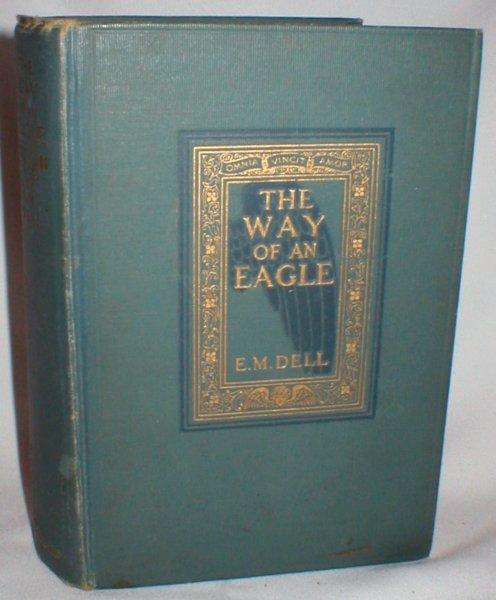
A 1912 copy of The Way of an Eagle, a US edition already on its fifth printing, offered by sale by Canadian bookseller Dave Shoots.
Other References. George Orwell’s factual article “Bookshop Memories” was published in the Fortnightly Magazine in November 1936. He wrote that Ethel M. Dell was the most issued book in the circulating library the bookshop (Booklovers’ Corner, in Hampstead) maintained. Warwick Deeping came second, and Jeffery Farnol third.
The 12 and 19 November 1936 New English Weekly published Orwell’s article “In Defence of the Novel”. He discusses the dilemma reviewers faced and says that this means sinking his standards to a depth at which say Ethel M. Dell’s “Way of an Eagle” is a fairly good book.
The 19 October 1940 New Statesman published Orwell’s review of four novels including one by Angela Thirkell. He called Edgar Wallace and Ethel M. Dell natural writers.
Horizon (September 1946) published Orwell’s essay The Cost of Letters. He wrote
… that at most a few hundred people in Great Britain make their living solely by writing books, and most of these are probably writers of detective stories etc. In a way it is easier for people like Ethel M. Dell to avoid prostitution than it is for a serious writer. By prostitution he meant composing propaganda for bodies such as the British Council.
Ethel Mary Dell was born on 2 August 1881 in Brixton the third and last child of John Vincent Dell an Equitable Life Assurance Company official and Irene Dell nee Parrott a solicitor’s daughter. Ethel and her older sister Ella were educated at home by their mother and then at Streatham College for Girls.
Ethel M. Dell began writing stories at school to amuse her friends. Her father had some privately printed. Her family moved to Knockholt in Kent and in 1912 to Ashford, Surrey. She became an obsessive writer. Magazines such as the Universal and Ludgate and the Red Magazine accepted some of her stories but she received many receptions.
The Way of an Eagle which Orwell briefly referred to was Dell’s first novel. In it a Colonel’s daughter marries the officer who has saved a British legation from a siege. She received eight rejections and redrafted it several times before Thomas Fisher Unwin, of the Unwin publishing dynasty, accepted it for his First Novel Library in 1912. It was an instant best seller.
Ethel M. Dell had thirty two more novels, eight volumes of short stories and a volume of poems published. They inspired twenty three films. The Way of the Eagle inspired two films with this title. One was directed by George Berthold Samuelson in Britain in 1918 and the second was a 1921 Hungarian film. The Safety Curtain (1918), Her Own Free Will (1924), and The Top of the World (1925) were Hollywood productions. The others were British ones.
Ethel M. Dell’s readers got melodrama, romance, purity, happy endings usually genteel settings, spirited and virtuous heroines, faithful, chivalrous and steely though often insignificant looking heroes, villainous villains, tense situations, sudden twists, banal language, and stereotyped plots.
Many of Ethel M. Dell’s novels were set in British India or other British colonies. She had never visited India and disliked foreign travel but she read extensively about it and the other places where her stories were set. She had a sadistic streak for instance killing off in freak accidents children produced by villainy.
Marriage. On 7 June 1922 at Holy Trinity Church, Guildford, Surrey, Ethel Mary Dell married Lieutenant Colonel Gerald Tahourdin Savage Distinguished Service Order of the Royal Army Service Corps. He was born in Glasgow on 6 September 1883 the fifth of six children and won the DSO in France in 1916. He was two years younger than his wife.
Lieutenant Colonel Savage was a short insignificant looking man like many of his wife’s fictional heroes. After their marriage he resigned his commission and devoted himself to her. Their marriage was childless and she put her maternal instinct into looking after their dogs. The Savages lived privately and avoided publicity as much as possible. She was kind hearted and generous to her relatives and servants.
The End. Ethel M. Dell was operated on for breast cancer in 1929. It returned in 1939 and she died at Hertfordshire County Hospital on 17 September 1939 aged fifty eight. She left £32,937 5s 10d. Her husband as a reserve officer re-joined the army. In 1940 he married Edith Louise Savage. He died on 11 February 1958 aged seventy four. His second wife died in 1986 aged eighty seven and left £442,088.
Reputation. Many other writers apart from Orwell mentioned Ethel M. Dell. They included Noel Coward, Winifred Watson, Richard Hughes, P. G. Wodehouse, D. H. Lawrence, Cornelia Otis Skinner, the science fiction writer Martin (M.) John Harrison, Gladys Mitchell, and Dorothy L. Sayers.
Ethel M. Dell resented the patronising reviews she received but she sometimes mocked her own reputation. For instance in The Juice of the Pomegranate (1938) she has her heroine say Now we really shall see what the brainy Blanche reads in her leisure moments; and Great Scott! It’s an Ethel M Dell.
Most of Ethel M. Dell’s readers were women. To quote Orwell’s Bookshop Memories, her works were read by women of all kinds and ages, and not, as one might expect, merely by wistful spinsters and the fat wives of tobacconists. Moralists sometimes criticised her for being too passionate and sensationalist. Their criticisms did not hurt her sales.
In literary terms Ethel M. Dell was the successor to Victorian sensationalist women writers such as Mary Elizabeth Maxwell nee Braddon and Rhoda Broughton. Ethel M. Dell’s modern equivalents include Georgette Heyer and Catherine Cookson. All were or are looked down and/or envied by allegedly serious novelists. They could or can though cry all the way to the bank.
*
Leave a Reply