
Down (But Not Out) In London, September 2022
OS member Tom Chesshyre describes our September Orwell Walk through London
In his witty essay “Bookshop Memories” George Orwell describes his time in 1934-35 working as a part-time assistant at Booklovers’ Corner, a bookshop facing South End Green on the edge of Hampstead Heath in north London, bemoaning the various oddball customers (though clearly enjoying them very much).
One “dear old lady” would drop by and tell him she “read such a nice book in 1897 and wonders whether you can find her a copy. Unfortunately, she doesn’t remember the title or the author’s name or what the book was about, but she does remember it had a red cover.” Others would order books with no intention of collecting and paying for them: “It gave them, I suppose, the illusion that they were spending real money.”
Bookshops, Orwell drily notes, are “one of the few places where you can hang around for a long time without spending any money”. Meanwhile, one of his most regular such characters is the “decayed person smelling of old breadcrumbs who comes every day, sometimes several times a day, and tries to sell you worthless books”.
Perhaps the ghost of Orwell’s breadcrumb-y former customer, lives on: Booklovers’ Corner is now a Gail’s bakery, selling sour-dough loaves, smoked salmon bagels and chocolate-and-almond croissants to the rather better-heeled North Londoners of today, parking up in their enormous SUV vehicles and queuing while flicking through social media on their iPhones. Not so down-and-out in London round these parts anymore.
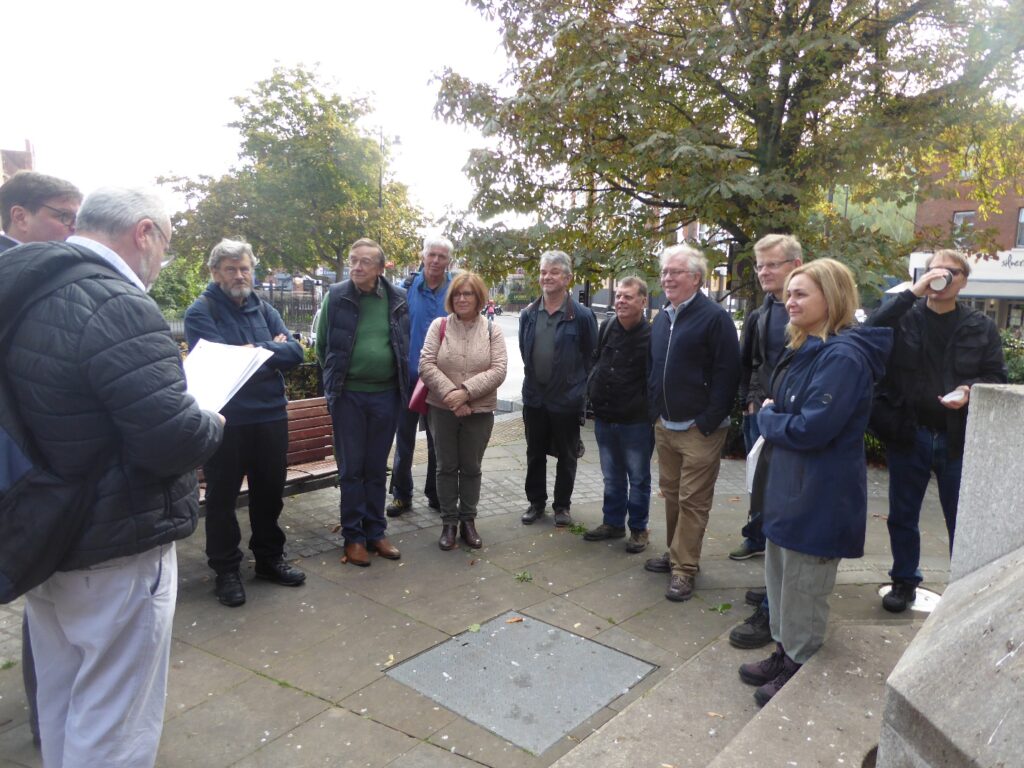 Meeting at the Monument in South End Green
Last weekend, the ornate Victorian fountain at South End Green facing Gail’s made an appropriate meeting point for the London leg of the Orwell Society’s Down and Out in Paris and London weekend in the two cities. Crowded round, we (about 20 of us) listened to our knowledgeable guide/leader Michael King as he read from “Bookshop Memories” and explained how Orwell had taken lodgings above the bookshop, working in the afternoons, and devoting the remainder of his time to writing.
Orwell, aged 32 when he came, was negotiating with his publisher, Victor Gollancz, over potentially libellous aspects of the yet to be published A Clergyman’s Daughter. Many tiresome alterations were required. On the plus side, he began seeing a bookish customer named Kay Welton, with whom he had a close relationship and went on walks around Hampstead Heath discussing poetry in 1934-35 (ahead of meeting his future wife Eileen Maud O’Shaughnessy later in 1935).
We inspected a quote from Animal Farm engraved by the fountain: “All animals are created equal, but some are more equal than others,” which you do indeed get quite a sense of in some parts of north London, nowadays.
Then Quentin Kopp, Chair of the Orwell Society, who was in attendance wearing a flat cap, pointed out that the site of the bookshop had also once been a Perfect Pizza. “So perfect it was closed down,” he quipped, as we went to inspect the little plaque on the edge of Gail’s with its curious sculpted visage of Orwell.
At the back of the redbrick building, another plaque was to be found, which Michael pointed out. This one was in honour of the writer John Wyndham, who had lived in the same block as Orwell, although there is no evidence they ever met. The plaque is marked “Triffid Alley” as it featured as such in Wyndham’s post-apocalyptic novel The Day of the Triffids (1951): “The door, I could see, gave into a narrow alley running the full length of the block…”
Up a hill the Orwell Society went, crossing the road and passing by the bathing ponds of Hampstead Heath, soon reaching Parliament Hill, a street where Orwell was to move to in 1935 as his lodgings above the bookshop were no longer available and for the benefit of clearer air.
Orwell had lived at number 77, where he shared a spacious flat for six months with a friend of a friend, Rosalind Obermeyer as well as Janet Gimson; a psychology student at University College and a medical student, respectively. It was to be an auspicious lodging as he met his future wife Eileen, another psychology student from University College, at a party he held at number 77, declaring rather hastily, (but presciently), to Rosalind after the guests left that Eileen was “the sort of girl I’d like to marry”.
The building is part of a redbrick terrace with a wide black double-door, high sash windows and an Orwell plaque, of course. A worker was repaving the front garden, scraping at the ground and banging, but Michael raised his voice, and all information was imparted with perfect clarity.
Down the hill we passed the sites of two tragic events. The first was number 63 Parliament Hill, where the poet Anna Wickham hung herself in 1947. Orwell had laid eyes on her during his time in London, Michael said, and considered her “ferocious looking”.
Then at the foot of the hill we came to the Magdala pub, where Michael paused to tell us that this was where Ruth Ellis had shot and killed her abusive lover David Blakely in 1955, going on to become the last woman to be hanged in the UK. The “bullet marks” previously in the pub wall were fakes, Michael said. Perhaps if Orwell had not died so young, a follow-up to his Decline of the English Murder would have been in order.
On this note, the Orwell Society took the North London Line from Hampstead Heath Station to Highbury & Islington Station. Beyond the Garage nightclub, a gathering of supporters of Arsenal’s women’s football team, a Wetherspoon’s and a McDonald’s, the Society soon arrived at Canonbury Square.
Michael stopped by number 17 to tell us that Evelyn Waugh had once lived there with his with his wife Evelyn Gardner (“the two Evelyns”) and written his novels Decline and Fall and Vile Bodies. He said that Orwell believed Waugh was about as good a novelist as it was possible to be with “untenable” beliefs, and that Waugh had enjoyed Animal Farm, writing to tell Orwell so in 1949.
The Society shuffled onwards to number 27A, where Orwell had lived in a top-floor flat intermittently from 1944 to 1950, passing the leafy public gardens and arriving at a six-storey Georgian terrace with arched windows and scaffolding obscuring yet another Orwell plaque.
“It was not by any stretch of imagination the smart fashionable place it is now when Orwell was here,” Michael said of Canonbury. “It was very, very working class at that time.”
Ian Bloom, a Society member who used to do the Christmas Post Office run in Canonbury in the 1960s, concurred: “It was a dodgy derelict area, and it hadn’t changed much in the intervening 20 years.”
Orwell had come to Canonbury Square in October 1946 having written the first 50 pages of a manuscript that was then tentatively titled “The Last Man in Europe”, later to become Nineteen Eighty-Four, at Barnhill, his remote rented house on the Isle of Jura in the Inner Hebrides. He had gone to Barnhill to escape the “journalistic treadmill” of London and was planning to return in the spring. He had with him his sister Avril and his adopted son Richard (now patron of the Society, of course).
During the harsh winter of 1946-1947 a fuel crisis had hit Britain and Orwell had been forced to burn peat instead of coal. He “kept [himself] going on a blitzed bedstead,” on one occasion, writing an article by its “grateful warmth”. This would most likely have been one of his “As I Please” columns for the Tribune, the socialist weekly.
Michael showed us a picture of Orwell pushing a pram along the road behind his Canonbury Square flat, featured in the book George Orwell at Home (and among the Anarchists) published by Freedom Press. Then the highlight of the London leg of the Down and Out in Paris and London tour saw the Society enter the Orwell’s back garden to see his old home from another perspective.
This “first” for the Society had been arranged courtesy of David Armitage, who joined the Society 18 months ago and who lives on the ground floor of Orwell’s old flat. “The Orwell plaque is on the outside of my bedroom wall,” he commented. Armitage is a historian of political ideas working at Harvard University, living between London and Massachusetts. He bought in Canonbury Square quite recently and admitted that Orwell’s connection had “kind of sealed the deal” when he signed on the dotted line.
A light was on in Orwell’s top-floor abode and various curtains and blinds twitched in the block as the Society inspected the small garden with it old plane trees, shed and rusting barbecue. It must have been quite a job for Orwell, as unwell as he had been, climbing up and down the towering building with a child and a pram, a few of the Society members agreed.
We exited the garden, saw the homes of the architect Basil Spence, the novelist George Diary of a Nobody Grossmith, and the poet Louis McNeice in the streets behind Orwell’s flat. And all that was left was for those only on the London leg of the trip (myself included), was to repair to the nearby Canonbury Tavern, possible inspiration for Orwell’s famous “The Moon Under Water” essay on what makes a perfect pub. The rest were off to the Eurostar to France.
Sipping ales in the back garden, we all agreed it had been an interesting Orwellian morning.
Tom Chesshyre
Photograph: Quentin Kopp
*
Read about our September walk through Paris here.
Great piece Tom. A pleasure to be quoted accurately, too. Ever thought of taking up this travel writing lark seriously!?