
Flying in Formation
Symmetry in a building may appeal to the eye but it is variations in symmetry that interest the architectural historian. The same is true of literature: George Orwell’s The Lion and the Unicorn: Socialism and the English Genius is one such case.
The book is in three parts and part one begins with a paragraph of a single sentence.
As I write, highly civilized human beings are flying overhead, trying to kill me.
Part I: England, Your England
The second part ends with the sentence:
The lady in the Rolls-Royce car is more damaging to morale than a fleet of Göring’s bombing-planes.
Part II: Shopkeepers At War
That is to say, that if Orwell’s short book had consisted of only two parts it would have begun with an aerial reference and end ended with another, both about Luftwaffe bombers. It would have been symmetrical.
But there is a third section. Why? Eileen, his wife, explained to a friend:
George has written a little book, no 1 in the Searchlight Books (Secker & Warburg 2/-), out next month, which please note. Explaining how to be a Socialist though Tory. It was going to cost 1/-, which would have been better, but Warburg changed at the last minute & the book had to have another 10,000 words inserted to give value for twice the money.
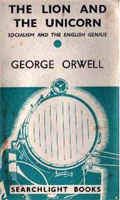
Professor Peter Davison explains some background details to The Lion and the Unicorn, in his head-note in the Complete Works:
Orwell was persuaded, rather against his will, to write the first book— in effect, a sixty-four-page pamphlet.
The work as printed suggests that Eileen’s letter with its detail provides by its contraries the true situation: the whole work in three parts is 118 pages long: as printed it begins on page 9 and ends on page 127 with a definitive “THE END”. The work is closer, though, to sixty-four pages if we take only the (symmetrical) first two parts. It then begins on page 9 and ends 74 pages later on page 83.
The reference in the title, however, does not appear in either the first or second part. It is only in the final section of Part III that Orwell refers to the lion and the unicorn when he writes of the English Revolution:
An English Socialist government will transform the nation from top to bottom, but it will still bear all over it the unmistakable marks of our own civilization, the peculiar civilization which I discussed earlier in this book.
It will not be doctrinaire, nor even logical. It will abolish the House of Lords, but quite probably will not abolish the Monarchy. It will leave anachronisms and loose ends everywhere, the judge in his ridiculous horsehair wig and the lion and the unicorn on the soldier’s cap-buttons.
Part III: The English Revolution
In fact, The English Revolution has a symmetry of imagery of its own: the symmetry of imagery in the first two parts was aerial (German bombers). The English Revolution begins at ground level:
The English revolution started several years ago, and it began to gather momentum when the troops came back from Dunkirk.
And it ends with a vision of re-taking that ground:
I believe in England, and I believe that we shall go forward.
Part III: The English Revolution
As the London Blitz followed the evacuation from Dunkirk, Orwell could not have been responding to contemporary activity for inspiration as he wrote each section. What we do have, though, thanks to Eileen’s note is an insight into Orwell’s construction of his work. The first two parts were units of a complete work, headed and tailed in symmetry, but Orwell then responded to drive for a Socialist revolution, adding the third part. And in adding the third part he used a new image. He started with coming back, but he ended going forward. Perfect symmetry.
*
Leave a Reply