
From Manor Farm to Contemporary Britain

*
Réka Törzsök examines
Adam Biles’s Sharp-Eyed Return to Orwell’s Animal Farm
*
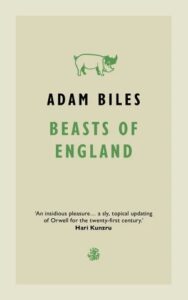
As the world marks the 80th anniversary of Animal Farm (1945), George Orwell’s searing allegory remains frighteningly relevant: its tale of the subtle and gradual descent into authoritarianism provides a perennial example of the susceptibility of democracy. In this commemorative moment, Adam Biles’s Beasts of England (2023) arrives not just as homage, but as resuscitation. It is a fierce, satirical, dark-humour-infused sequel that adapts Orwell’s anthropomorphic parable into the turbulent heart of 21st-century Britain, all the while referencing the worldwide context.
Following in the footsteps of Animal Farm rewritings such as the American author John Reed’s Snowball’s Chance (2002) and the Zimbabwean author NoViolet Bulawayo’s Glory (2022), Biles’s Beasts of England is the latest, British title contributing to the rich afterlife of Orwell’s classic. With incisive wit and unnerving accuracy, Biles fuses Orwellian allegory with the anxieties of the 2010s and the first half of the 2020s—populism, economic struggles, the COVID-19 pandemic, Brexit, the refugee crisis and xenophobia, technological developments, and the spread of fake news—to remind us that the pigs and the dogs are still in power, the farm is still easily divided, and some of the animals are still dreaming of an easier and more comfortable life.
Set decades after the events of Animal Farm, Beasts of England imagines Manor Farm as a place that is gradually decaying, initially under political strife. On the surface, the farm has transformed into a successful petting zoo, with a Council of Animals at the wheel. However, after the departure of the current First Beast, Buttercup—echoing how Snowball was driven away in Orwell’s original—the election called the “Choozin” is to be held. Most animals have their own motives for taking either the Animalist or the Jonesist side, or for staying away: “Why bother? […] Whoever you Chooz, you get a pig” (174). The animals—many of whom are disillusioned, indoctrinated, or simply unable to think for themselves—are soon divided, due to changes like the sudden invasion of starlings, who take to whispering into animals’ ears, and the reintroduction of the deceptive foxes to the farm.
Biles introduces an array of new characters, such as Martha the goose, one of the only animals to notice that something is wrong, and her unlikely friend (167), Cassie the mule, who has personal reasons for looking into the farm’s past. Nods to Orwell’s characters, such as Old Major and Boxer, can be found throughout the text, while one beloved animal, Benjamin the donkey, also makes a bittersweet appearance. In accordance with Orwell’s work, every impulse to resist oppressive regimes seems destined to be swallowed by the machinery of power. Yet, Biles goes even further: in his rise to power, Jumbo, the Napoleon figure of the novel, surpasses his predecessor in cruelty; while at the height of his power he appears to be downright sadist, resorting even to the exploitation of his fellow animals (246). Biles’s take is undoubtedly grimmer than Orwell’s: violence and deception take various forms and become especially pronounced between the animals of different species, underscoring the satirical edge of the farm’s final state, “Unity in Division” (264; 270). Under Jumbo’s leadership, Manor Farm becomes a species-ist place where animals have to face the question: “Are you Manor Beast enough?” (267; cf. 187). Overall, Biles handles his characters with care, giving them a unique personality and role in the farm’s life, through which he ensures the reader’s emotional involvement in the narrative.
Orwell’s influence can also be felt in various motifs. A meta-moment occurs when Cassie reads Napoleon’s copy of Animal Farm, discovering that Napoleon was dissatisfied with Orwell’s version of the events (to the extent of writing “crooked Bore-well” in the margins, see 117). Other references to Orwell include the farm’s current motto—“all animals are more equal than others” (16)—, and the scene in which Benjamin remarks upon the difficulty in telling apart pigs and humans (247; one of the main plotlines sees the detrimental collaboration of the two species). There is a reference to 1984 (1949) in the form of the Two-Minute Huzzah (260), and the farm’s famous windmill also appears, playing an integral role in wrapping up the narrative.
Biles’s masterstroke, however, lies in his ability to entwine the bones of Orwell’s allegory with the flesh of today’s political and social upheavals. The result is not simply a sequel—as suggested by the back cover, the work is a “state-of-the-farmyard” novel. The legacy of Brexit looms large in the plotline concerning the Jonesist effort to leave the Wealden Union of Farms (WUF), recast under the slogan “Manor Farm for Manor Beasts” to the farm animals (232), but, in reality, only serving to enrich a corrupt elite and give them unsupervised control over life and death on the farm. The prion-plague—unmistakably invoking the COVID-19 pandemic—spreads through the land, with quarantine, misinformation, and futile efforts at care all making an appearance, coupled with absurd, discriminative, and propagandistic explanations, such as only “non-Manor Beasts” like alpacas being capable of catching it (149; 163). However, once “real Manor Beasts” also fall ill, the explanation is revised to suggest that they were not true manor beasts after all (222; cf. 131–32). A memorable, recurring element is the adding of species names to the two columns designating who is a Manor Beast and who is not, which ultimately also influences the outcome of the election (see 232–34), while for much of the narrative, outsider animals are unwelcome on Manor Farm.
Meanwhile, a faction led by the pig Pearl within the Animalists insists on reinstating old doctrines like the effort to locate Sugarcandy Mountain, after which the farm would be supposedly transformed into “a True Animalist paradise” (170; cf. 79; 147; 186). Others, like Balmoral the roe deer insist on digging a moat (131), which recalls Trump’s idea about building a wall. Biles does not shy away from making direct allusions, exposing the populist discourse and general political buffoonery that defines much of contemporary society. When it is revealed that many of the starlings are mechanical (who are meant to be an allegory for the ease with which fake news has been known to spread on Twitter/X), the scope of satire is expanded to not only ridiculing individuals, but also exposing the ecosystem of enablers, media sycophants, and disenfranchised citizens that allow demagogues to flourish. Lines such as “[w]hen you have nothing […] why not vote for everything?” (146), “it’s so much easier to unite the animals against something than for it” (191—italics in the original), and “[d]o you really think Manor Farm is ready to have an owl as First Beast?” (146—italics in the original) are clearly meant to comment on prevalent tendencies which define the contemporary political landscape.
Biles’s prose is agile, vivid, and darkly humorous. He borrows Orwell’s economy of style yet adds lyrical flourishes that evoke the exhaustion and confusion of a post-truth age. For instance, the recurring inclusion of the modified lyrics of the “Beasts of England” song highlights the way in which what we often conceive of as “truth” is not set in stone—the “ancient melody” (247) can just as easily be reduced to a mantra of Jumbo’s name (253). Mirroring how the animals cannot be expected to act “reasonably” (231; cf. 191; 145) and every individual animal and species has their own perspective, the narrative structure switches between an omniscient point of view and following either Martha, Cassie, Benjamin, or Cosmo the owl—perhaps the clearest voice of reason but the candidate who has no chance of winning the election—as the focaliser. Additionally, while Orwell’s original employed a stark moral clarity to get its message across, Beasts of England thrives in ambivalence, as several details are left unresolved by the end of the narrative. A key question, for instance, is whether Jumbo’s only motive is the wielding of power for its own sake, like the Party’s in 1984, or whether he has other reasons for his actions. Biles refuses to provide easy answers, but perhaps the missing details have been intentionally left out, because they are meant to echo the contemporary tendency that sees various morally ambiguous actions justified under the banner of “progress”.
What makes Beasts of England so compelling, particularly in the context of the anniversary, is its deep understanding of what Animal Farm was truly about. Beyond its Cold War symbolism, Animal Farm was a fable about power, memory, and the corrosion of ideals. Biles extends this vision to portray a world where facts are just as fungible and where—as the ending makes clear—it is explicitly ensured that yesterday’s slaughter becomes today’s security measure.
The reader would perhaps like to hear that for all its bleakness, Beasts of England is not without hope. The animals’ small acts of solidarity—Martha and Cassie’s collaborative detective work, and the touching scene in which animals remember the ancient melody—appear to glimmer as signs that the spirit of resistance and compassion, however embattled, survives, only for the final scene to dispel any hope of rebellion. Orwell’s Benjamin said, “Donkeys live a long time. None of you has ever seen a dead donkey” (Orwell 27). In Biles’s hands, this enduring creature becomes a symbol of historical memory: stubborn, weary, but unbroken until the end.
In celebrating the 80th anniversary of Animal Farm, it is tempting to locate Orwell’s novel first of all in the literary museum—revered, quoted, occasionally assigned in schools. What Beasts of England does so brilliantly is reanimate Orwell’s legacy, prying it out of its glass case and thrusting it back into the muck and manure of the real world. Biles does not rewrite Orwell so much as reboot him for a digital, divided, and disoriented age. If Animal Farm warned the reader of how easy it is for authoritarian systems to develop, Beasts of England presents an unbridled vision of how democracies die. By the end of the novel, the question still remains: “But would the animals ever come together again, as they had done in the past? Not as Manor Beasts, or even beasts of England. But as beasts, as animals, plain and simple” (269). As readers turn the final page, they may find themselves humming along with Benjamin to that old tune, wondering whether we, like the animals of Manor Farm, stand any chance of making sense of the tumult we call the 2020s.
References
Biles, Adam (2023) Beasts of England, Norwich: Galley Beggar Press
Orwell, George (2021) Animal Farm, London: Constable (Originally: 1945, London: Secker and Warburg)
Leave a Reply