
Interview with Mr Giles Jones, formerly of Manor Farm

*
Mr Jones is an elderly gentleman with impaired hearing and an uncertain temper. He has recently been ill, but reports of his death were, it turns out, greatly exaggerated. Our reporter recorded her interview with him, and what follows is a transcription of what Mr Jones had to say. It has been thoroughly edited to remove ramblings, repetitions and expletives.
THE EDITOR*
*
Animal Farm? Don’t talk to me about Animal Farm. It’s always been Manor Farm to me, and I’m glad to see the name has been changed back to what it was. Animal Farm? Don’t make me laugh. You might as well call my prize bull the Fleas’ Playground.
I truly loved those animals. Made sure they were fed every day, got the vet to them when they were sick, or else put them out of their misery. Watched over them like a big brother, I did. They were far better off working for me.
The ingratitude! For once in a while—Midsummer’s Day it was—I got home late from seeing my friends and wasn’t feeling very well, and the bastards took advantage, smashing property, making a hullabaloo, attacking my workers. I couldn’t believe it—after all I’d done for them. Of course I could have taken my shotgun and put down the riot then and there, but what can you do? I’ve a soft heart, I didn’t want to hurt them. So we left the farm to them, thinking they’d be begging us to come back after a day or two. I should have known better.
Of course I kept an eye on the place from the outside, and from the start I had spies on the inside too, because not all of them were in favour of their so-called revolution, not by a long chalk. Plenty of informers would come to me and tell me what was going on at the farm. At first there was a lot of nonsense about democratic meetings and endlessly singing some stupid song, and devising new laws. Well, anyone could have told you how that would work out.
Sure enough, before long the news was coming to me that that Napoleon had put a stop to voting. Then the laws were being changed. From old Pilkington’s top field I could read them on the barn wall with my binoculars. Soon there was only one law, and it made no sense. ‘All animals are equal but some animals are more equal than others.’ How I laughed.
This is my point, see. Write this down, my girl. A cow is not equal to a rabbit. A strong horse is not equal to a weak horse. Never has been, never will be. I’m a farmer, I see it every moment of the day. It’s nature, isn’t it. Creatures are different from each other. Every one has its place. That’s why men are in the fields and women are in the kitchen. A woman Prime Minister—don’t make me laugh! It’s the order of nature, you can’t change it. That’s what the animals didn’t understand. Well, perhaps they understand it now.
It’s like in the army. I know. I did my National Service in the Catering Corps. The officers give the orders, and the rest obey them. Imagine what would happen if the ordinary soldiers kicked out the officers. Who would give the orders? Who would swear at you and tell you where to stand? Who could tell you what the regulations said? Who would know what was going on? In next to no time it’s mutiny, and anarchy, and chaos. And foreigners pouring over the border and everything gone to hell.
Why? Democracies are weak, that’s why. In a democracy everyone thinks their voice should be heard. So democracies are always confused about everything and they take forever to come to a decision. That’s what I tell my kids. You listen to me and stop whingeing. Don’t waste my time. Father knows best. My wife agrees.
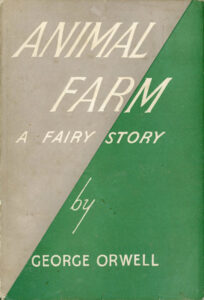
The first edition of Animal Farm
My spies told me the Animal Farm trouble started a while back, with Willingdon Beauty, the old boar they called Major. Cost me a fortune at market, that beast, and then went on to make trouble after he was dead. Seems he filled up the minds of the animals with talk about liberation. Minds! Most of them couldn’t count up to two. But they all started squawking and bleating about freedom and equality. I ask you! If they got rid of me, did they honestly think they would be free?
Animals are for working. Most of ’em only exist because we breed them to work. We’re an agricultural country, for God’s sake. The ones we can’t put to work, we shoot them for sport, if we can reach them, or fish them out of the water and eat them. Did the Animal Farm lot think wild animals have a better life than the ones in farms or zoos? In zoos they’re in cages, but they’re fed every day. In farms they’re looked after by their owners. And if you drive away the owners, there’s work to do every day just the same, only it’s harder work, because the men have taken their skills with them. Stands to reason. Freedom is slavery, in a manner of speaking.
So guess what happened. Liberation turned out to be difficult. The clever ones started to quarrel, the others had to work harder and harder. I always knew that Napoleon was a troublemaker. And Snowball, he was a clever pig, but he was no match for Napoleon. It didn’t even occur to the poor sod to get himself a bodyguard! So the inevitable happened. You know what they say, about how the revolution eats its children.
Well, Snowball got the chop, no pun intended. He was lucky to get away with his life. Afterwards, you used to see him mooching around these parts, cadging drinks at the Chestnut Tree Café, looking shabby and hopeless, always trying to recruit passing animals for his ANRA, his Anti-Napoleon Resistance Army. Funny, I haven’t seen him recently. He seems to have disappeared. Good riddance.
Now, some people criticize me for joining the Consortium of Neighbouring Farmers, who were invited to dinner by Napoleon the other day. If I hate Animal Farm so much, some people say, why make friends with the pigs? Why didn’t I just get some bulldozers and a few unemployed bruisers, and mount a special military operation? It would have been over in a day or two, a week at most.
But those people don’t understand. There would have been a humanitarian outcry—round here, you can’t throw a brick without hitting the niece of a bishop. And besides, why would I want to wreck the farm? I want to profit from it again!
So there I was the other night, sitting in the farmhouse that used to be mine, drinking a toast to that scoundrel Napoleon. (Looking across the table at him, he reminded me of someone, I couldn’t think who.) I’d worked out some time ago that we could do business together. And as he becomes more corrupt and lazy, bit by bit I’ll get my hands on his property, and soon I’ll be back where I started, Farmer Giles of Manor Farm. No bloodshed, and no hurry, and a full workforce.
But I won’t be making the same mistake again. Next time, no more Mr Nice Guy. Still, at first, I’ll go step by step, and I’ll be careful not to be too greedy.
I’m not a pig, after all.
*
* Our interviewer, Douglas Kerr, is the author of Orwell and Empire (Oxford University Press)
Lovely, Douglas, cheers Quentin
Brilliant Dougles!
Much food for thought!