
International volunteers of the POUM
(Intervention by Juan Manuel Vera of the Fundación Andreu Nin during the presentation of Andy Durgan’s new book Voluntarios por la revoución. La milicia internacional del POUM en la Guerra Civil española in Traficantes de Suenños, Madrid 25 May 2022.)
*
Andy Durgan’s long career as a historian is full of contributions of great rigour on the period of the Spanish Civil War and its background, with a special focus on the POUM and its forerunners in Catalonia and Spain during the 1930s. He has done this in books like El Bloque Obrero y Campesino (1930-1936), The Spanish Civil War and Comunismo, revolución y movimiento obrero en Cataluña (1920-1936). Los orígenes del POUM; and also, in numerous articles and monographs. To all this work is now added, in 2022, a long-awaited book, Voluntarios por la revolución. La milicia internacional del POUM en la Guerra Civil española.

Voluntarios por la revolución is not just another book about the Spanish Civil War given that it fills an important gap in the historiography of the war and the revolution. This is the first work to deal systematically with the international militia of the POUM and the origin and fate of hundreds of internationalist volunteers. In contrast to the abundant bibliography on the International Brigades, the POUM volunteers have suffered a historiographical silence, sometimes accompanied by malicious and insidious commentaries by prestigious historians inclined to defend the communist interpretation of the Spanish war. These distortions refer both to the POUM itself, to its military policy and to the trajectory of its own national and international militants. In the pages of this book, and also in precise and perfectly documented notes, Durgan refutes various imputations or considerations that have no historiographical basis whatsoever.
What Andy Durgan uncovers expands considerably on what we already know. Some individual stories are famous, in particular, that of a British independent socialist called Eric Blair, better known as George Orwell, who, in his universally known Homage to Catalonia, recreated a part of this story; or the trajectory of the Argentinian Trotskyist Mika Etchebehere, author of a splendid memoir (Mi guerra de España)) and protagonist of La capitana, the novel by Elsa Osorio. Now, with Durgan’s book, these individual stories are joined by many other equally exciting, richly contextualised, nuanced accounts, which are brough to life full of additional information.
Around five hundred foreign fighters joined the POUM militias. Durgan identifies 367 of them. A significant proportion were exiled Italian and German anti-fascists, although he identifies volunteers from up to 28 different nationalities. Andy has made an exhaustive study of the available sources to provide an accurate picture of what we know today about these activists, their participation in the fighting and the repression they suffered from May 1937 onwards. But he also pays due attention to their subsequent fate: in French concentration camps, in Italian prisons, in German concentration camps, in the anti-Nazi resistance or fighting with Allied troops.
Durgan has succeeded in putting together a book with an a priori complex structure and making it an engaging read where the numerous individual cases come together to provide a powerful overall picture. He does this with vivid descriptions of the military actions, including, for example, the actions of the Rovira Shock Battalion or the dramatic assault on the Loma de las Mártires (Huesca, June 1937) by the POUM-controlled 29th Division. But there are many other remarkable accounts in a book that, in the best traditions of Anglo-Saxon historiography, never forgoes the narrative thread.
This book tells us about hundreds of militants who were not only anti-fascists, which they were of course, but also, for the most part, militants of different internationalist socialist currents in a particularly complex period. The trajectory of internationalist socialism in the 1930s is a little-known story, but it is full of interesting elements. Particularly relevant were the independent left socialist groupings, like the Italian Maximalist Socialist Party, the German Socialist Workers Party (SAPD), the British Independent Labour Party, the French Gauche Révolutionnaire of Marceau Pivert, which later gave rise to the Parti Socialiste Ouvrier et Paysan (PSOP), or the Dutch RSAP of Henk Snevliet, etc. Most of these organisations were linked to the International Bureau of Revolutionary Socialist Unity, the so-called London Bureau, which had also included among its founder members the Bloc Obrer i Camperol (BOC), forerunners of the POUM.
But we are also talking about militants of the International Left Opposition belonging to diverse small Trotskyist groups in various countries, and the Italian Bordigist Left Communists. In addition, there was the current of German oppositionists, followers of Brandler and Thalheimer, the KPD (O).
These internationalist currents were influenced by the experiences of the Russian revolution of 1917, which brought about the end of the tsarist empire and the seizure of power by the Bolsheviks, and the failure of the German revolution of November 1918, which overthrew the German empire. These two events had originally determined the course taken by socialist internationalists opposed to the First World War.
But the 1930s were the epoch which the Russian-Belgian writer and revolutionary Victor Serge would describe as “midnight in the century”. Thus, the internationalists of the 1930s lived under the impact of both the triumph of Stalinism, with the consolidation of a totalitarian, bureaucratic system in the USSR, and the defeat of the German proletariat without Europe’s most powerful workers movement having posed a real fight against Nazism. It was the moment of the collapse of many liberal democracies, with the spread of totalitarian, dictatorial, authoritarian or Bonapartist regimes throughout Europe; from the victory of fascism in Italy and Germany through to the establishment of dictatorships in Portugal (Salazar) and Greece (Metaxas).
For the internationalist socialists who came to Spain, whatever their political tendency, the resistance of the Spanish people to the military coup and the beginnings of a social revolution, which was both spontaneous and the product of radical workers’ organization and culture nurtured over decades, of which Chris Ealham has written so memorably in his book Anarchism and the City, was bound to make a strong impression. Thus, Spain was in 1936 the first and, also, the last existing frontier of internationalist socialism.
These internationalist militants were going to find themselves in Spain, as later, in the Second World War, with conflicts of a more complex nature than which the Bolsheviks had faced in relation to imperialist war or the defence of revolutionary defeatism.
Spain was not only a focal point of the confrontation between the declining democracies and fascism, but also a laboratory of social revolution. It was also the place where Stalinism was to show, beyond doubt, outside the USSR, that its methods had a far-reaching and international nature. For all these reasons, the Spanish war prefigured many of the contradictions and complexities of the World War that was to unfold a few years later.
Contrary to the expectations of the internationalist socialists, the Spanish resistance was not the first chapter of a revolutionary wave in Europe. Similarly, the Second World War ended without the regeneration of revolutionary socialism in the West and with the terrible consequence of the expansion of totalitarian methods and oppression in Eastern Europe. Victor Serge’s prediction became reality when he wrote in 1944: “If socialism does not vigorously maintain its democratic and libertarian physiognomy (in the etymological and not anarchist sense of the word) it will be torn apart and crushed”. His omen came true.
Durgan’s book is an enlightening work which arouses even further interest in the international volunteers of the POUM. When I finished reading it, I wanted to know more, more about these internationalist militants, more about where they came from and their subsequent trajectories. Because the snippets of their lives that Andy shows are evocative enough to know that he is telling us an important story, a story that is part of the genealogy of a left that could not be.
Reading Andy Durgan’s book some considerations that Jean-François Lyotard made about the historian’s craft came to mind. “The adversary against whom the historian fights with all his might is not easy to defeat, it is death, it is the oblivion that is the death of death itself. And if he expends so much energy to make us hear of his heroes it is to preserve, in the life of our memories, what has disappeared from the other life.” All of that, Andy Durgan has fully achieved and deserves our thanks. Those lives, having overcome a long-standing neglect, are from now on part of the construction of memory.
*
A talk given by Juan Manuel Vera at the book launch on the 25th May in Madrid.
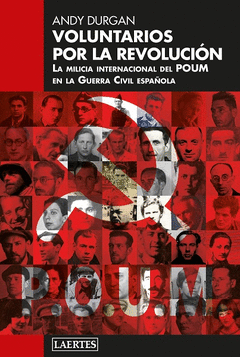
Voluntarios por la revoución. La milicia internacional del POUM en la Guerra Civil española, by Andy Durgan (Laertes, ISBN13: 9788418292682)
English language version??
As of May 2022 we have to wait for an English version to be acquired and published. A pity.
Very interesting. Although written in Spanish, quite easy to read. A real history.
Any update on the English version please ?
Good News – out in English in late November! Bad News is that at an Amazon discount £146.49!
Thank you for the information. That might be the hardback. We believe the paperback will come eventually at a lower price.