
Kallocain by Karin Boye
Reviewed by Steve Foulger
Penguin Classics’ recent publication of a new translation of Kallocain by Karin Boye, gives us a significant, if not that well known in the English speaking world, dystopian novel that can be ranked alongside works such as Zamyatin’s We, Huxley’s Brave New World and, of course, Nineteen Eighty-Four.
Karin Boye (1900 – 1941) was a modernist poet and writer, a translator of T S Eliot and the author of five novels. Written in neutral Sweden in 1940 amid fears that anything too provocative might provoke German aggression Kallocain draws upon both Nazi Germany’s and the Soviet Union’s totalitarian systems and projects them into the 21st Century. Boye had been an active member of the socialist/pacifist movement Clarté but a three week study tour of Russia in 1928 was sufficient to disillusion her about communism and she turned towards a more liberal position. Fluent in German and having spent time in Berlin in 1932/3 Boye was also very well aware of the horrors of the Nazi regime and the threat posed by the Nazi-Soviet pact. As she was writing Kallocain Norway was invaded and Sweden was left surrounded by aggressive totalitarian powers acting in concert against the democratic states.
The story is this: Leo Kall (his surname suggesting both cold and professional) is a middle-ranking chemist working at Chemistry City Four. Like all World-State cities this is mainly underground and there are suggestions that a chemical/biological catastrophe in the past has made surface life untenable. The World-State is a rigidly hierarchical and militarised police state. All movement and association is regulated, permission is needed to move out of your sector or visit the surface and everybody is under constant observation by ubiquitous ‘police eyes and ears’. In addition to their jobs every ‘fellow soldier’ has a military and/or police function and consequently little spare time. Women work and also have additional police/military roles but their primary function is to produce children, ideally male, who are removed to children’s camps at seven where they can be better inculcated with the military values of the World-State. The World-State leadership is paranoid about secrecy and the perceived threat of espionage, so virtually every aspect of life is an official secret and ‘fellow soldiers’ are conditioned not to display any curiosity. As both the Gestapo and the KGB were aware, the population under control can display a generous propensity towards denouncing their colleagues, friends and families and the World-State was no exception. Denunciation was considered an essential and laudable action so every ‘fellow soldier’ went in fear of being denounced at any time.
During the course of the novel Leo Kall is both denounced (to the Seventh Bureau of the Ministry of Propaganda) and in turn denounces a colleague. He has made a discovery, however, that will be of immense utility to the World-State: a drug, Kallocain, that forces people to tell the truth when questioned. For the first time it will be possible to see inside a person’s mind, lay bare their thoughts and circumvent the time and resource hungry methods hitherto used to establish guilt. It will now possible to prove beyond any doubt if a ‘fellow soldier’ is guilty of treasonable thinking. The drug was tested using members of the ‘Voluntary Sacrifice Service’, ‘fellow soldiers’ who loyally served the World-State by acting as guinea pigs in often dangerous, indeed potentially lethal, experiments and found to be one hundred percent effective. What may be even worse is that the subject remembers clearly what they said however damaging it might have been.
It is clearly obvious that Boye was indebted to Yevgeny Zamyatin’s We and to a lesser extent Huxley’s Brave New World but she brings to the genre a feminist’s sensibility: Linda, Leo Kall’s wife and the mother of three children, is an important protagonist in the novel which, to be honest, is not strong on characterisation. Her story is equally as important as Leo Kall’s. Kall and Zamyatin’s D-503 are both scientists, both have produced something of great use to the State, both start as true believers and both feel threatened by the mere possibility of the unplanned and the spontaneous, the survival of sparks of humanity amid the crushing machinery of the state. Neither novel gives away the geographical location of the World/One State and many of the characters in Kallocain are given oriental sounding names, possibly to try and convince readers that the World State was not in fact the German Reich. Boye describes a rigidly authoritarian police state but is fairly quiet about any ideological underpinning, Society before the institution of the World State is depicted as being akin to the original Hobbesian state of nature (where the life of man is ‘solitary, poor, nasty, brutish, and short.’). The World State had developed from a ‘Planless herd to the most highly organised and differentiated of all forms…from individualism to collectivism, from aloneness to communion, such had been the course of this giant and holy organism, in which the individual was only a cell with no other significance than that it served the organism as a whole.’
Was Karin Boye being overly pessimistic? In April 1941 she walked out into the night and took her own life. The German émigré film maker Peter Weiss who befriended Boye shortly before her death wrote that ‘the guilt that she carried within her was less about sexual conflicts than about being party to the inability of people to stop the development of the state into an instrument of murder’. In May 1941 Orwell had written in his BBC broadcast ‘Literature and Totalitarianism’ that ‘this is the age of the totalitarian state, which does not and probably cannot allow the individual any freedom whatever…the totalitarian state tries, at any rate, to control the thoughts and emotions of its subjects at least as completely as it controls their actions’. What a boon a real version of Kallocain would have been to the totalitarians.
*
Two English editions are available –
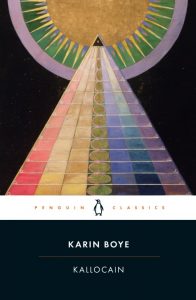
- Boye, Karin Kallocain: a novel from the 21st century translated and with an introduction by David McDuff. Penguin Classics 2019
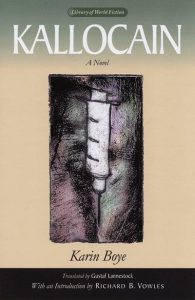
- Boye, Karin Kallocain. Translated from the Swedish by Gustav Lannestock with an introduction by Richard R.Voles. University of Wisconsin Press 1966
Uploaded: 23 February 2020
The French Wikipédia claims that this was a strong influence on Orwell, although if so he must have read it in French as the English translation wasn’t until 1966, and not in French until 1947!
“Kallocaïne a fortement influencé 1984 d’Orwell, notamment dans les détails matériels : baisse de la qualité de vie, mais aussi dans le recours à un journal intime, la dénonciation au sein des couples, la surveillance policière de l’espace privé, l’idée du crime de la pensée, puni de mort, l’enrôlement des citoyens dans des célébrations d’État sur leur temps de loisirs, les enfants soldats redoutables adjuvants du régime, le rôle de la guerre, le rôle de la femme comme propulsant la force de vie, l’importance de l’amour dans le déclenchement de la prise de conscience.”