
Orwell and Max Miller
Introduction. When the Second World War broke out George Orwell was at a loss both financially and morally. While he struggled to find a contribution he could make to the war effort he took a job as theatrical reviewer for Time and Tide magazine. His September 7th, 1940 review of Applesauce, a variety show, gave him the opportunity to express his interests and favours.
Anyone wanting to see something really vulgar should visit the Holborn Empire, where you can get quite a good matinée seat for three shillings. Max Miller, of course, is the main attraction, but there is a good supporting programme with some brilliant sketches.
After comparing Miller with the earlier Little Tich, Orwell went on:
… it is important that such comedians should exist. They express something which is valuable in our civilization and which might drop out of it in certain circumstances. To begin with, their genius is entirely masculine. A woman cannot be low without being disgusting, whereas a good male comedian can give the impression of something irredeemable and yet innocent, like a sparrow. Again, they are intensely national. They remind one how closely-knit the civilization of England is, and how much it resembles a family, in spite of its out-of-date class distinctions.
One can read in this many of the points that Orwell made in his explicitly political work of the same period, The Lion and the Unicorn.
Soon afterwards in his article “The Art of Donald McGill” (Horizon, September 1941) Orwell mentioned Max Miller again. He wrote that a few seaside postcards are genuinely witty, in a Max Millerish style; and asked readers to compare Max Miller’s stage patter with his weekly column in the Sunday Dispatch to understand the difference between written and stage censorship.
Orwell could safely assume that anyone educated enough to read a magazine such as Horizon would know who Max Miller was; and that so would most other people. For him to have explained this would have insulted his readers’ intelligence, but as with many former celebrities this is no longer so.
Early Life. Max Miller’s real name was Thomas Henry Sargent. He was born on 21 November 1894, at 43 Hereford Street in Brighton; and was the second of six children (one of whom died in infancy) of James Sargent, a builder’s labourer, and Alice Sargent nee West. He was raised in poverty and left school aged twelve, semi-literate. He worked as a milk rounds-man, tailor and golf caddy in Brighton and briefly as a motor mechanic in London. He was then inspired by George Henry Elliott (1882-1962). This Mr Elliott would blacken his face and do a music hall minstrel act. This was then considered acceptable.
Thomas Henry Sargent began performing in Brighton pubs with his father playing the piano; joined a small local concert party; and in 1910 joined the Territorial Army. It was recruited for home service but when the First World War started in August 1914 he volunteered to serve abroad. There was some confusion when the recruiting sergeant asked Thomas Henry Sargent what his surname was.
Thomas Henry Sargent served in the Royal Sussex Regiment in France; in India, where he joined a concert party as a comic, singer and dancer; and in Mesopotamia (Iraq) where he was blinded by shellfire. With medical help he recovered his sight after three days. He was discharged from the army in 1919.
The Entertainer. After being demobilized Thomas Henry Sargent joined Jack Sheppard’s Brighton Concert Party as a comedian and singer. He initially used the stage name Harry Sargent. Another member of Jack Sheppard’s concert party was Frances Kathleen Marsh a contralto and child impersonator. She was born on 29 October 1896 in Brighton the daughter of Charles Marsh a blacksmith who became a motor mechanic; and Bessie Marsh nee Edwards. They married on 17 February 1921.
On his wife’s advice Harry Sheppard adopted the stage name Max Miller. She became his business manager and answered his fan mail. His main forte was stand-up comedy specialising in double entendre. A classic quoted by the Dictionary of National Biography was I once knew a girl who when she was eighteen swallowed a pin. She didn’t feel a prick until she was twenty one. His first London appearance was at Shoreditch Town Hall in the East End in 1922.
In 1924 Max Miller adopted the persona of the Cheeky Chappie on his wife’s advice. He dressed flamboyantly to the point of appearing camp about which he often joked, Well what if I am? He would ask audiences if they wanted jokes from his blue book or his white book. They invariably asked for jokes from his blue book. He would sing sentimental or comic songs as part of his twenty to thirty minutes stage act. He never swore in his act and detested performers who did.
In 1929 Max Miller appeared at the London Palladium, a theatre built in 1910 and still open. He performed at Royal Variety Shows in 1931, 1937 and 1950. He toned his act down for the King and Queen but not completely. He toured abroad including to South Africa. A friend warned him off appearing in Nazi Germany saying that Miller looked so Jewish the Nazis would probably send him to a concentration camp.
The biggest success of his fourteen film career was a cameo as a song plugger in the 1933 film of J. B. Priestley’s novel The Good Companions. It was directed by Victor Myer Saville (formerly Salberg) a film director and producer of Polish Jewish descent, who used a dummy camera to stop Miller from distracting the film audience’s attention from other actors. Stealing the show was one of Miller’s faults.
Max Miller played in revues such as Applesauce. It opened at the Holborn Empire in August 1940. It was here that Orwell saw Miller on stage, writing in his review that,
Applesauce* is a first-rate variety show, with only the minimum of “glamorous” songs between the comic acts.
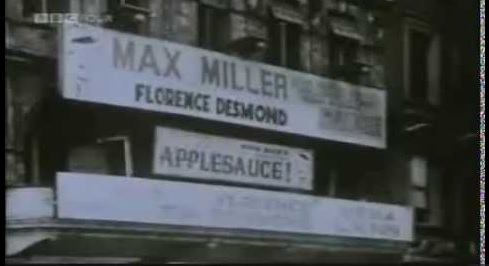
Applesauce at The Palladium – still from the BBC documentary
The Holborn Empire was bombed in November 1940 but Apple Sauce reopened at the London Palladium in March 1941 where it ran until November 1941. This sort of long run suited Miller and many other artistes admirably. They could use the same act many times reducing the amount of preparation they had to do. Unlike some artistes he and his wife prepared all his material themselves.
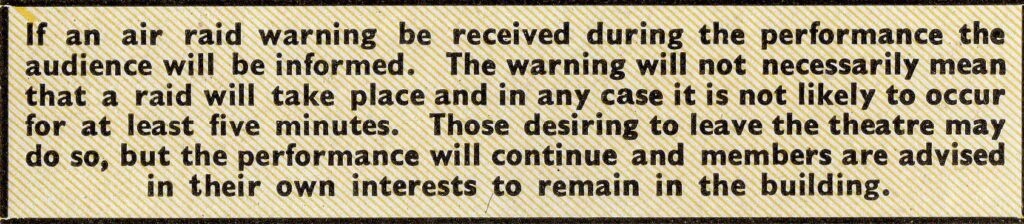 An air-raid warning from the Palladium programme. Orwell mentions these in his Holborn Empire review.
Miller’s co-stars included Vera Lynn (who seems to have slipped into Orwell’s “minimum of ‘glamorous’ songs”; Lynn’s place at the Palladium was taken by ITMA star Lynd Joyce). Appearing at the London Palladium as well was Jack Stanford known as the Dancing Fool (1806-1968), who played in the Home Guard sketch with Miller that Orwell said was the best of “some brilliant sketches”. Orwell, however, names stars who do not appear on the later billing, including acrobatics by the Dolinoffs and Raya Sisters. “Doris Hare does a skit on a strip-tease act”, he says, which may have become “The Folies Bergère comes to Oxford Circus” in the later programme, performed by Florence Desmond.
Max Miller did well on radio but was banned by the BBC in 1944 after he began to tell a off-colour joke. The producer cut him off from completing it and the ban lasted until 1949. Radio Luxembourg, though, welcomed his talents.
The Sunday Dispatch ran a column of Miller’s jokes from December 1939 to July 1940. Examples included I could tell you the joke about the red hot poker, but you probably couldn’t grasp it. Whether Orwell realised that Miller’s newspaper career was so brief, when he mentioned it in “The Art of Donald McGill”, is unclear.
He made several TV appearances, firstly on ITV in January 1956 and later that year on the BBC. He disliked TV, though, because he ran through material too quickly. In September 1959 Max Miller suffered a heart attack. His last stage performance was at Folkestone in December 1960.
Private Life. The Millers’ marriage was childless. He enjoyed fishing, golf, gardening and horse riding and kept parrots. He was sometimes considered cautious with money to the point of meanness but was quietly generous to what he considered were deserving individuals and causes and was especially generous to charities for blind people. During the Second World War he let St Dunstan’s Institute for Blinded Armed Forces men and women (now the St Dunstan’s Institute for Visually Impaired Armed Services Personnel) use his large house at Ovingdean near Brighton for the many war blinded veterans.
Thomas Henry Sargent aka Max Miller died at his Brighton home on Tuesday 7 May 1963 aged sixty eight of complications from influenza. He left £28,091 10s 9d of which £7,000 and the rights from his songs went to his organisational secretary and long standing friend Miss Ann Graham.
Max Miller’s funeral was held on 11 May 1963 and his body was cremated at the Downs Crematorium near Brighton. His wife was a keen member of the British Israelites a religious group which has nothing to do with Israel (whose pamphlets Orwell followed, as his review of “Pamphlet Literature” shows)! She died on 24 January 1979 aged eighty three and left £27,731.
George Orwell and Max Miller. The only one of Orwell’s theatre reviews included by Sonia Orwell and Ian Angus in the Collected Essays, Journalism and Letters (1968) is his review of Applesauce. It takes the form of a long footnote, occupying almost a page, to the name of Max Miller in the essay on Donald McGill. Coincidence? Perhaps, but perhaps evidence, too, of Sonia Orwell remembering her husband talking about Max Miller and what he stood for, and ensuring that it persisted.
*
The memory of Max Miller and music hall was already fading in 1963. He was given a 9 May 1963 Times obituary and an 11 May 1963 Brighton Herald one. On 14 May 1963 Stage and Television News published an obituary of him by the drama critic Raymond Bowler Marriott (1911-1992). The Dictionary of National Biography has an entry for Miller and lists two biographies of him. The most recent is John Marlborough East’s book Max Miller – The Cheeky Chappie, (W. H. Allen, 1977).
The core of this article is based on David Dave Russell’s well written Dictionary of National Biography entry for Miller. It is supplemented with information from John Marlborough East’s life of Miller; and information from the Brighton Keep, an archives and history centre, about Miller and Thomas Francis Frank Gomm of Jack Sheppard’s Concert Party.
*
* Orwell’s Complete Works print the show name as Applesauce (one word rather than two), as does the Palladium programme.
The Jack Sheppard, of Jack Sheppard’s Brighton Concert Party, was actually Thomas Francis (Frank) Gomm (1873-1968) who a Brighton local newspaper called Brighton’s Mister Fun.
The real Jack Sheppard was an eighteenth-century English robber and serial gaol breaker; although Sheppard is a common surname, and Jack is not always a nickname for John.
A footnote to Max Miller: a work colleague who was in the RAF in the last war told me that he and a pal were walking in uniform along the Brighton prom when they saw Max Miller. ‘Coming to the show tonight?’, he asked, but they didn’t have tickets as they’d sold out. He gave them a couple of tickets and asked them for the names of the senior officers at their RAF base. They told him, and he worked the names into his act. There were many airmen from the base at the theatre, and they loved it when the names were mentioned. A neat move on Miller’s part; I wonder if he did that elsewhere?