
Orwell and Solidarity
George Orwell ascended to cult-like prominence during the 1980’s Polish Solidarity (Solidarność) Movement. His distrust of Soviet-style communism, incubated by his experience in the Spanish Civil War, birthed what would sadly be his final political works. Three plus decades after their publication, Solidarity embraced the English author and elevated Animal Farm and Nineteen Eighty-Four to North Star status in their courageous resistance to all things communist in Jaruzelski’s Poland. The extent of and evidence for Solidarity’s adoption of Orwell in their struggle is found in the many printed and fabricated items that deliberately, but surreptitiously, found their way into the daily lives of members of the outlawed trade union. Exactly how and to what degree Orwell influenced Solidarity is a matter of historical record and significance that merits close examination. What follows details, differentiates, and describes various artifacts that were Solidarity’s paper currency of resistance during their heroic anti-communist efforts.
Ephemera dominate Orwell memorabilia from the Solidarity era. Items in this group include a Nineteen Eighty-Four calendar, Orwell Solidarity postal stamps, and a variety of forbidden samizdat (“self-published”) editions of Animal Farm and Nineteen Eighty-Four. Although the movement manufactured metal 1984 lapel pins and played cassettes of the 1955 film version of Nineteen Eighty-Four at private fund-raising gatherings, the publication of paper items was pervasive.
With the notable exception of the 1947 Ukrainian translation of Animal Farm, these items are unique to Poland and share a common peril. Possession of anything Orwell-related under Premier Wojciech Jaruzelski’s watch resulted in certain arrest and a likely lengthy jail sentence. For all of the items described in this essay, as well as their associated historical information, I am indebted to a decades-long friend and former Solidarity member who wishes to remain anonymous for political reasons.
Perhaps Solidarity’s boldest underground venture was its illegal printing and distribution of its Rok 1984 (“ Year 1984”) calendar in 1984. Printed, ironically, in a state-owned Warsaw printing office by Solidarity members after work hours, best estimates are that nearly 5,000 copies appeared for sale. The proceeds were used to help fund Solidarity’s activities as well as to assist the families of activists who were incarcerated. For purposes of safety and security, no sales records were kept, so it is impossible to say exactly how many copies were actually sold. Today, however, this calendar is extremely rare and nearly impossible to find.
Unlike the majority of Solidarity’s Orwell ephemera that was printed on low-grade pulp paper, the calendar appears to have been printed on commercial grade, cardstock glossy paper that lends it a magazine appearance. The calendar, printed entirely in Polish, measures 12 ¼ x 8 ¾ inches (31 cm x 22 cm). This combination of size and quality of material suggests a newer and riskier aesthetic distinct from their other publications that will be introduced later in this article.
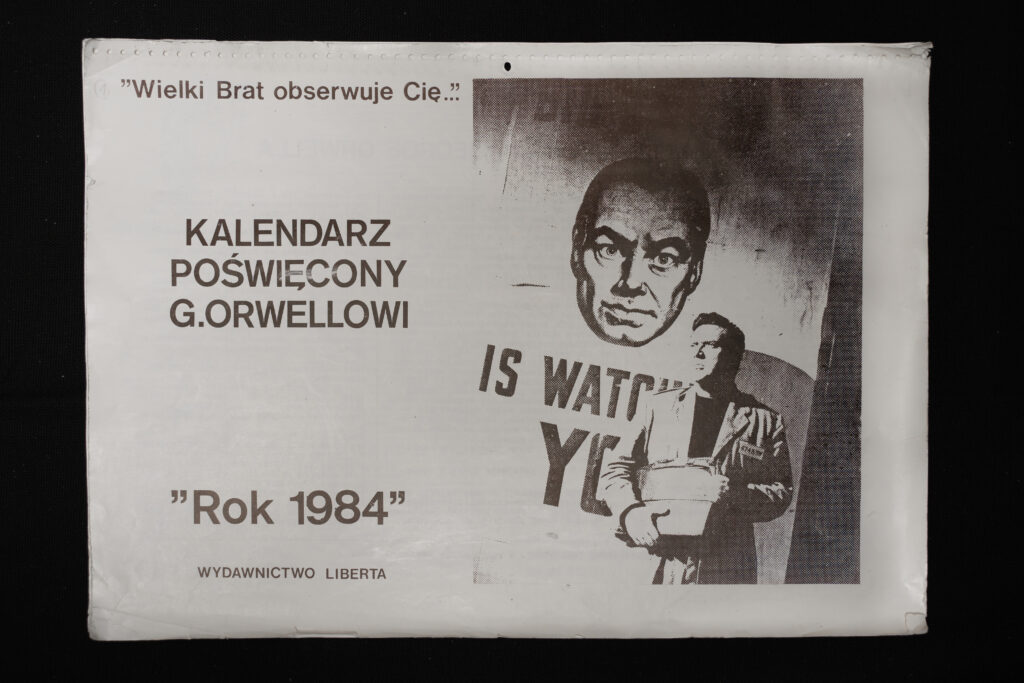
The calendar’s front is divided in half along the Y-axis. An all-cap, large font dedication to “G. ORWELLOWI” dominates the middle space left of center. Above and below the dedication respectively appears the Polish for “Big Brother is watching You” and “Rok 1984” (Year 1984). The final piece of printed information on the front reveals that “Wydawnictwo Liberta,” or Liberty Publishing House, published the calendar. Before martial law in late 1981, there had been only one underground publishing house, the Library of History and Literature, operated by Solidarity. Arrests of its members led to attempts to mislead the secret police by establishing “new” houses operated by “new” people whose names the authorities did not know. The Liberty Publishing House was one such “new” house. Right of center features a still frame from the 1956 film version of Nineteen Eighty-Four. The actor Edmund O’Brien (Winston Smith) stands in front of a poster “… of a man of about forty-five, with a heavy black mustache and ruggedly handsome features.” The reverse of the calendar’s front page highlights Orwell’s literary career, with the occasional reference to select essays and his broadcasting stint at the BBC.
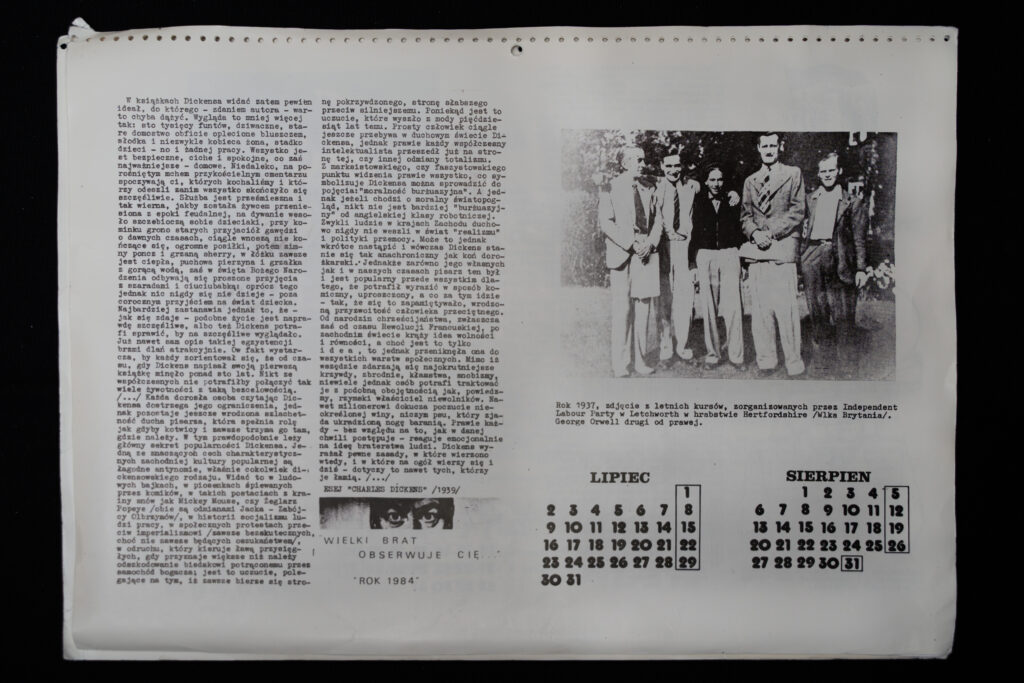
The calendar’s remaining three double-sided pages are structurally similar. Each side of a page is devoted to two months. To the left of center are Polish translations of various works by Orwell. Excerpts from Animal Farm and Nineteen Eighty-Four dominate this area with the occasional essay (see below) also featured. Photocopied photographs of the author with a still frame of the Two Minutes Hate from the 1956 film are displayed to the right of center on these double-sided pages. Each page is devoted to two months that appear side-by-side below the photographs/frame.
Possession of a Rok 1984 calendar, as well as the possession of anything devoted to or written by Orwell, was a serious offense in communist Poland. The typical jail sentence for such crimes was up to six years in prison, and it was this climate of fear that drove Solidarity to take extraordinary precautions and creative safety measures. Members correctly assumed that posted letters and parcels were subject to government scrutiny, so to avoid this surveillance Solidarity established its own courier system. This alternative courier system gave rise to yet another form of Orwell ephemera.
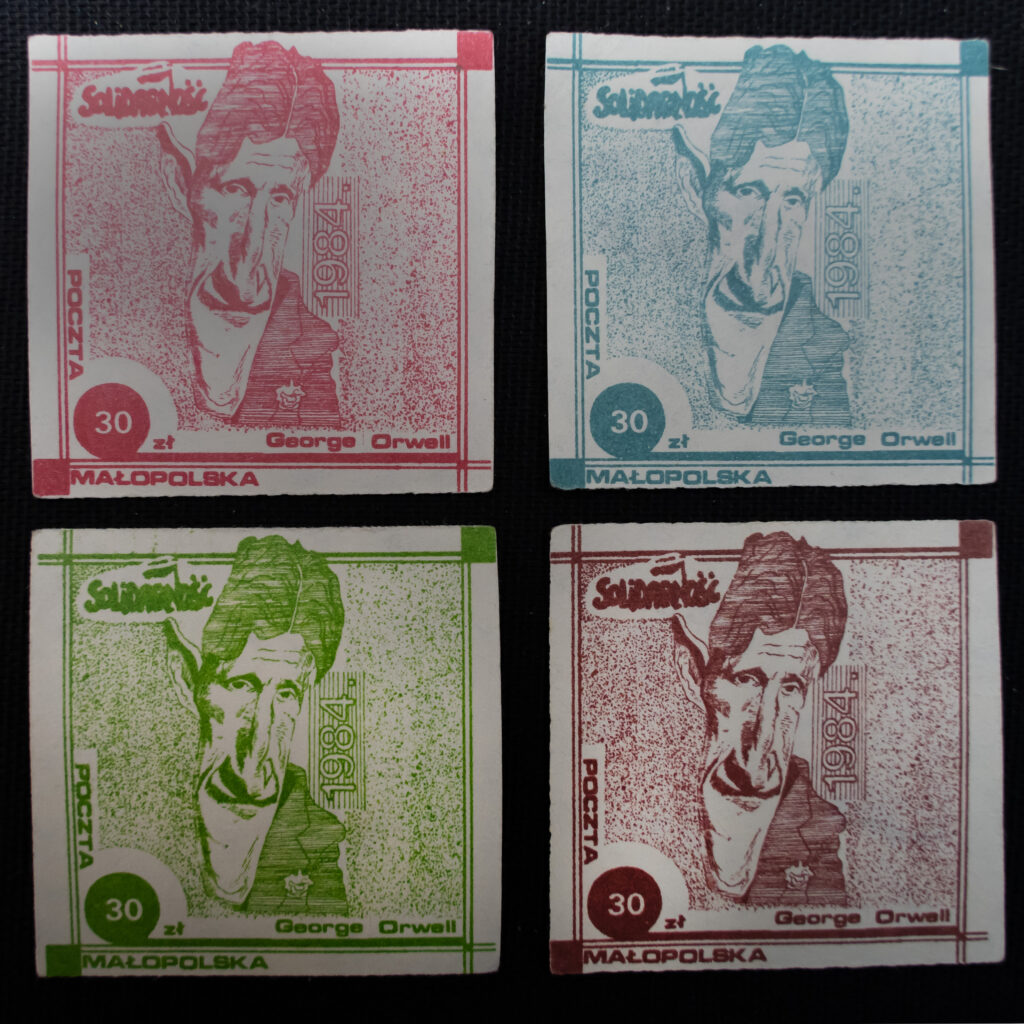
As a Solidarity activist, one would use this alternative postal system to help ensure both the privacy and eventual delivery of a letter addressed to another Solidarity member. To fund and conduct this operation, special Orwell stamps were printed and sold. As a Solidarity member living in Warsaw who wanted to post a letter to my Solidarity friend in Gdansk, I would affix a 30 zloty Orwell stamp to the addressed envelope. I would then give the envelope to a trusted union member who I knew was travelling out of town, who would do likewise until the envelope found its way to my friend in Gdansk. Although the possession of these stamps carried the same incarceration risk as the possession of a Rok 1984 calendar, this method of delivery was considered a much safer alternative to the Polish Post.
Appropriately, the Orwell stamp was issued in 1984. The stamp measures 1 ¾ inches square (4 ½ cm) and is dominated by an elongated caricature of Orwell, whose full name appears in the lower right corner. The stamps were available in one of four colours: red, green, blue, and brown. The year 1984 is placed vertically next to Orwell’s caricature, and Solidarity’s banner is exhibited in the upper left. The only remaining features on the stamp are its price (30 zt), the words poczta (post) and Malopolska (the southern territory of Poland the capital of which is Cracow). Best estimates are that 50,000 of each stamp were in circulation.
Unsurprisingly, Solidarity’s use of Orwell as an instrument of widespread resistance also appeared in the form of multiple editions of Animal Farm and Nineteen Eighty-Four. His final two pieces of literature dominate the final category of ephemera from the Polish Solidarity Movement. The volume and variety of Animal Farm publications suggest that it was more widely printed and circulated than its dystopian counterpart.
Without a doubt, the 1985 Jan Lebenstein-illustrated version of Animal Farm ranks as the Holy Grail of samizdat editions. He created the ten extraordinary surreal coloured sketches in 1974 during his exile in Paris. Published by the Literary Publishing House, it uses Teresa Jelenska’s highly regarded 1945 London translation. Covered in artificial leather dyed burgundy, this publication measures 11 ¾ x 8 ¼ inches (30 x 22 cm). Interestingly, this edition was reprinted in 1990 with the exact dimensions as the original, but unlike the original it included a dedication “To the memory of George Orwell” on the edition notice page.
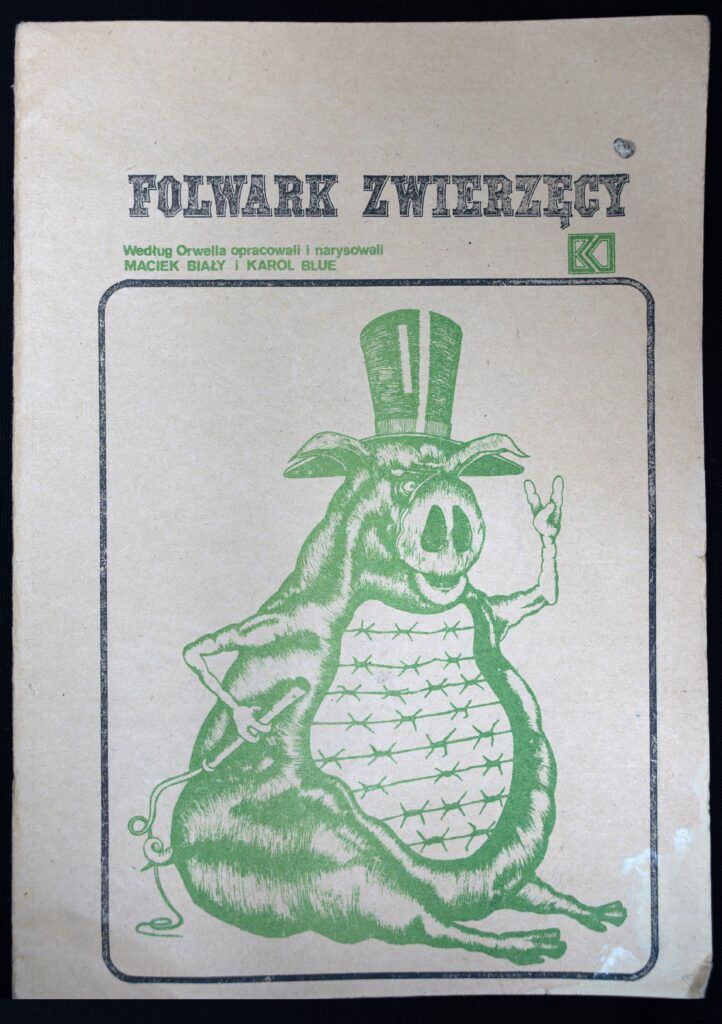
Another 1985 printing of Animal Farm is a rare samizdat edition in the style of what we would classify today as a graphic novel. Printed and illustrated pseudonymously in Warsaw, this oversized, black and white version of the fable is a visual treat. The satirically illustrated version of the story is accompanied by a translation from the early 1950’s, and it is evident immediately that its illustrators are launching a full frontal attack on Soviet-style communism. For example, Major reads his Seven Commandments from a book decorated with the Red Star, a motif that recurs throughout the comic’s forty pages. Unlike the aforementioned calendar, this text is printed on pulp paper. What is remarkable about this copy, though, is its remarkable size. Unlike the many smaller versions of both Animal Farm and Nineteen Eighty-Four that were miniaturized for purposes of concealment, this edition is significantly oversized. It measures 8 ¼ x 11 ½ inches (21 x 29 cm), which makes it slightly four times larger than any other samizdat edition with the exception of Lebenstein’s version.
The earlier mentioned Library of History and Literature, Solidarity’s underground press, printed one of those smaller editions of Animal Farm in 1981. In particular there was a 3 ¾ x 6 inch (9 ½ x 15 ¼ cm) version, a pulp copy of the 1974 copy of the aforementioned Teresa Jelenska’s original 1945 translation. Unlike other illicit printings, this one includes a foreword written by “H. Lewis Allways,” a pseudonym that Eric Arthur Blair considered before he became George Orwell. A Solidarity activist whose post-communist translation of the work exceeded 200,000 by the mid-1990’s in fact, wrote this foreword:
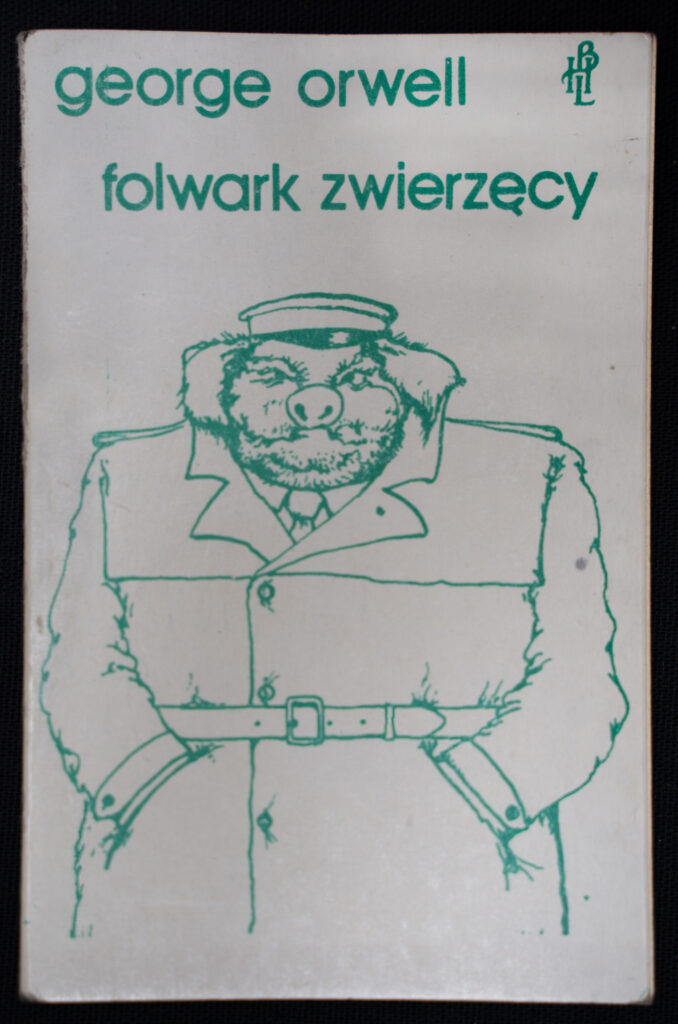
Solidarity distributed other copies of Jelenska’s 1974 Animal Farm, copies that were in circulation long before the labor union’s existence. The “Freedom Publishing House” published an unsigned translation of the work, another pulp edition whose size exactly duplicates the dimensions of the copy published by the Library of History and Literature.
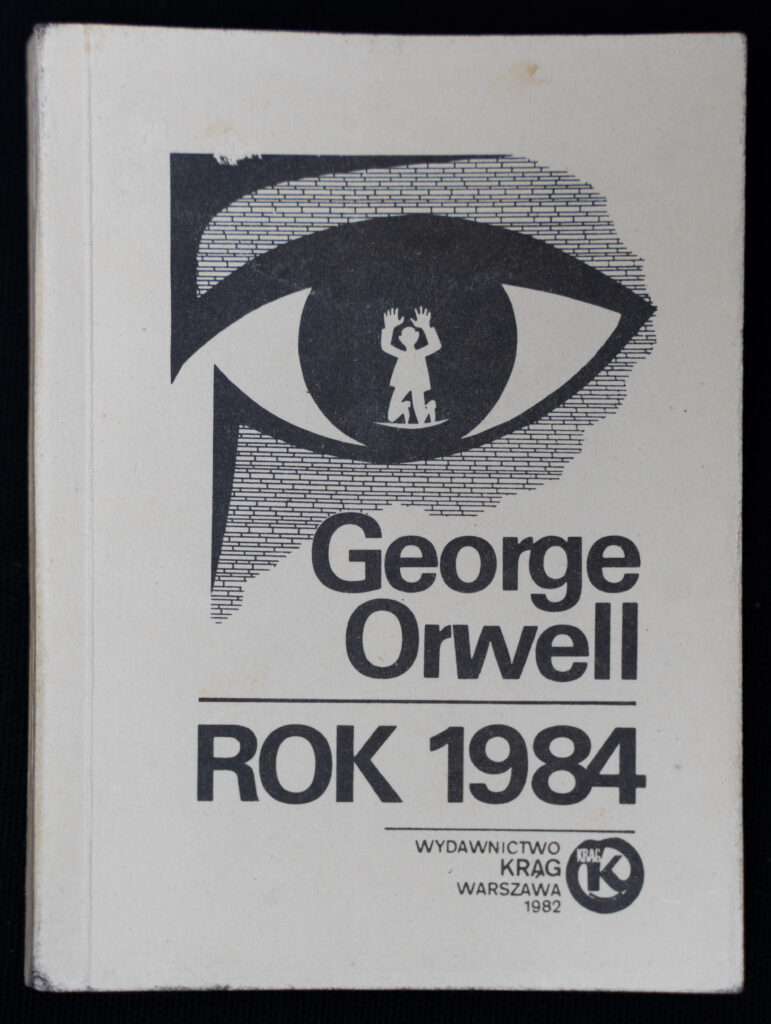
Even more compact than the previously discussed editions of Animal Farm is the 1982 edition of Nineteen Eighty-Four by Krag Publishing House, the largest underground publisher at that time. This edition measures 4 x 5 ¼ inches (10 ¼ x 13 ½ cm) and is printed on offset paper, a quality of paper superior to that used on the previously discussed Animal Fam editions. This publication borrows from Juliusz Mieroszewski’s 1953 Paris edition. Set in 5.5 point type, this 255 page production was available for the sales price of 200 zlotys, which was in the middle of the price range of various Animal Farm translations.
Perhaps nowhere in the communist world was the influence of a non-native writer as profound and widespread as Orwell’s was in Poland. That so many thousands of Poles adopted him as their inspiration during their struggle against Soviet influence was unique in the 20th century. How fitting, then, that spray painted on the Berlin Wall directly below a video-equipped watch town appeared the message: “Idiots – Big Brother is watching you”.
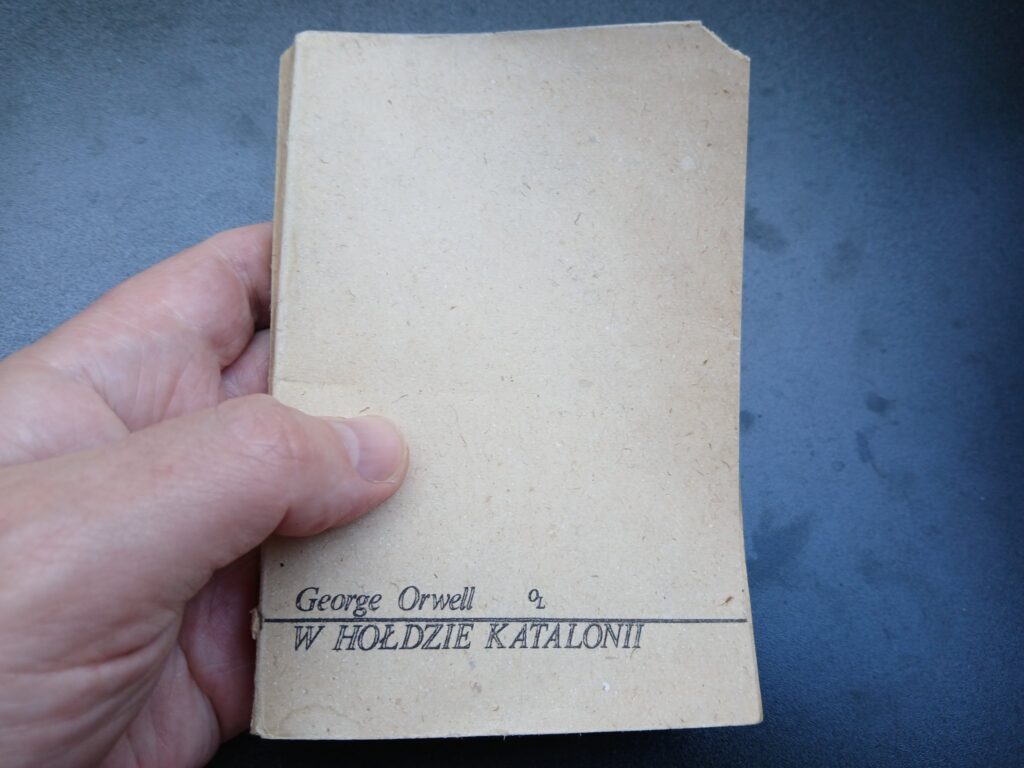
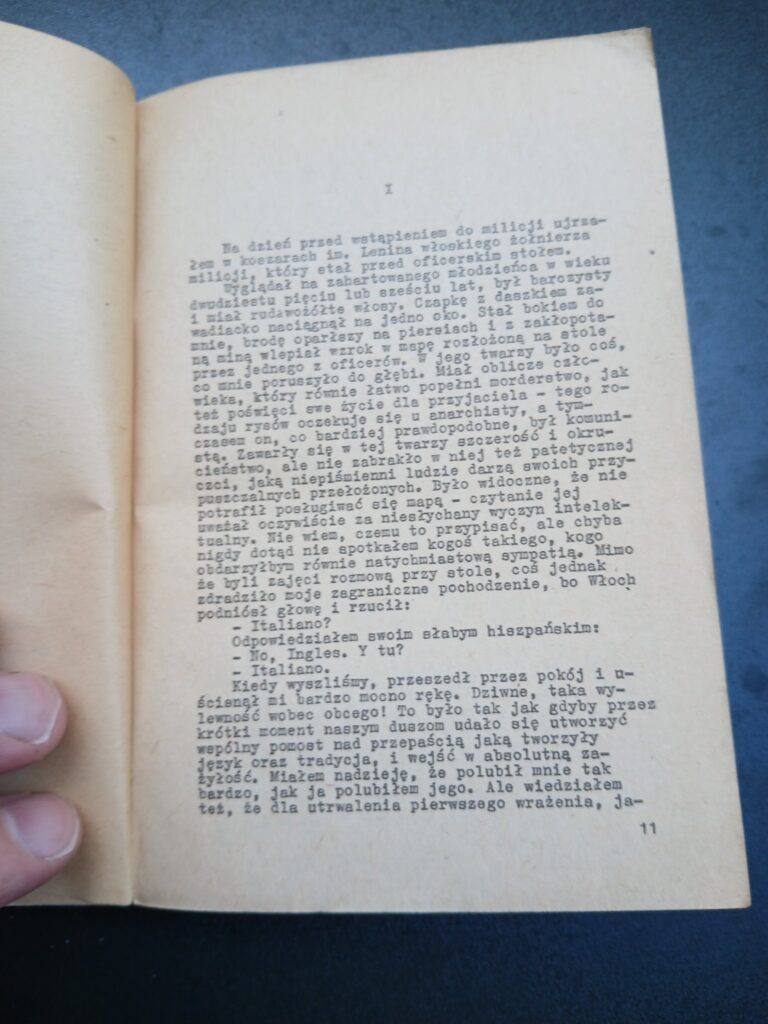
Thanks to Nick Lloyd, of Civil War Spain Tours, Barcelona, for these images of a samizdat Homage to Catalonia published in Warsaw.
Leave a Reply