
Orwell and the Gollancz Archive
A couple of articles have recently appeared concerning the sale of files of correspondence relating to the publication of some of George Orwell’s early works. The material in question originated in the archive of the Gollancz publishing house, through which many of Orwell’s early works appeared.
How these files came to be up for sale is actually a story which goes back more than 10 years to when the then owners of Gollancz decided to sell the archive.
Gollancz was founded in 1928 by Victor Gollancz, and very quickly became a power house of publishing, with a distinctive approach to marketing. It became known for the uniform yellow dust-jackets on most of its books, which helped them stand out on the railway bookstalls of the 1930s. Gollancz was perhaps the first truly mass market publishing house, and the commercial success of the company enabled Victor Gollancz to pursue his interest in left wing political publishing. This was most famously manifested in the Left Book Club, which Gollancz operated from 1936 to 1948. Anyone interested in the history of Gollancz and the Left Book Club is strongly advised to seek out second hand copies of Gollancz – The Story of a Publishing House by Sheila Hodges (Gollancz 1978) and The Left Book Club by John Lewis (Gollancz 1970).
Gollancz continued as an independent publishing house even after the death of Victor Gollancz in 1967, under the guidance of his daughter Livia. In the late 1980s, however, the business was sold to new owners, and went through several changes of ownership in the 1990s, ending up under the Orion Group. In 2012 Orion were faced with a problem, in that the archive of Gollancz was by then housed in a warehouse on the south coast, along with archives from several other publishing houses. The warehouse provider planned to close the facility in the coming years, and so faced with this Orion took the opportunity to put the archive up for sale.
So what exactly is a publishing house archive? Essentially it consists of two main elements, so-called file or archive copies of the books published by the firm, and secondly the correspondence or publishing files relating to each of the published works.
In the case of Gollancz there were many thousands of books on rows of shelves in the warehouse and a considerable number of filing cabinets full of the publishing files.
Orion decided to work with the well-known book dealer Rick Gekoski to manage the sale. Gekoski has written his own account of this project in a chapter of his book Guarded by Dragons published by Constable in 2021.
As well as needing to free up space, Orion wanted to earn revenue from the sale. In many ways selling the file copies of the books was the easiest bit, and that was done first. The leading booksellers Peter Harrington agreed to buy all the file copies of books published by Gollancz between 1928 and 1944 – generally the most collectible of the volumes. Books from later years were sold separately to other booksellers.
That left the archive of correspondence. Each book published by Gollancz had a file which often contained the signed authorial contract for the book, together in some cases with copies of correspondence between Gollancz and the author and other documents.
Gekoski did his best to place the entire correspondence archive with an institution. Those tapped included the British Library, as well as Universities in the UK and in the US. The price tag of £1 million pounds which Orion was seeking proved to be a stumbling block however, and all negotiations to sell the archive (which included significant George Orwell correspondence) in its entirety fell through.
So in the end the archive was broken up, and offered for sale largely initially on an author by author basis to booksellers and private buyers over the following years.
The files relating to George Orwell were undoubtedly the jewel in the crown of the archive, and there was much interest in that set of files. The Orwell set consisted of separate correspondence files for: Down and Out in Paris and London, Burmese Days, A Clergyman’s Daughter, Keep the Aspidistra Flying, The Road to Wigan Pier, Inside the Whale and a separate file of more general correspondence with Orwell unrelated to a specific Gollancz publication. It will be noted that there is no file mentioned relating to Coming Up For Air, as this file was apparently lost (or maybe stolen?) from the archive many years ago.
The idea with the Orwell files was originally also to keep all of them together, and they were eventually bought as a set by Peter Harrington booksellers.
Eventually though economic reality reared its head again and the files were offered for sale separately through Harrington’s and also through another dealer – Jonkers. Some of the files have sold, but a number still remain unsold at the time of writing, at the quite substantial prices they are being offered at. The most valuable single item amongst the Orwell correspondence was the original of the letter in which Orwell offered Gollancz Animal Farm, which of course Gollancz famously declined to publish. This letter, and associated correspondence, was sold by Jonkers for £100,000 a few years ago now.
In my view it is a great shame that neither the Gollancz archive as a whole, nor even just the set of Orwell related files were kept together and re-homed appropriately in a respected institution. The price not withstanding I think this was a major missed opportunity, and a serious indictment of the paucity of funding underpinning the protection of our literary heritage.
Certainly the booksellers who have sold, or are selling, Gollancz Orwell material should not be blamed for this situation. Strenuous efforts were made to keep these files together.
In the end though it all has to go somewhere.
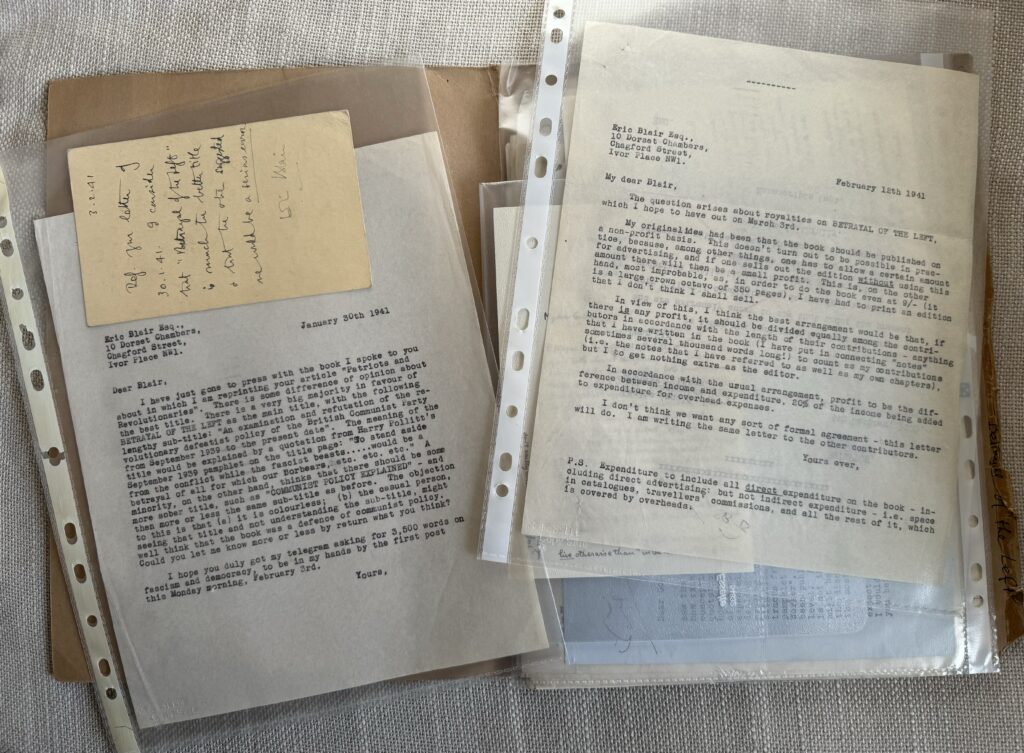
A silver lining for me was that the archive breakup did enable me to add a small piece of Gollancz Orwelliana to my own collection, in the shape of the publishing file for the book Gollancz issued in 1941 called The Betrayal of the Left. This book contained two essays by Orwell, and the publishing file does feature a small amount of Gollancz/Orwell correspondence. As I said it all has to go somewhere!
Update: May 2025
The Gollancz Orwell Archive has been acquired by the Orwell Archive at University College London.
Press Release by UCL. 9 May 2025
This acquisition does not include Animal Farm correspondence, nor the files for Down and Out in Paris and London and Burmese Days, as these were disposed of separately. Perhaps the purchaser might place them, too, in the Orwell Archive?
The remaining files of the Gollancz archive are now housed in the library of Princeton University.
Thanks for this accurate and balanced account.
Many thanks Rick
Sad that the government would not have obtained the material. I thought that British law required national treasures to belong to the state in some way. In the manner of The Detectorists, no?
You’re thinking of Treasure Trove, which has a very specific legal meaning. Unfortunately not relevant here (but perhaps should be).