
Orwell on the 2025 Fringe
*
Charlie Ellis Reports
*
Orwell’s continuing significance has been expressed vividly at this year’s Edinburgh Festival Fringe, the world’s largest arts festival. During the month, I saw and reviewed four Orwell related performances and events, all of which clearly demonstrated the ongoing relevance of his work, more than 75 years after his death.
These were Sam Blythe’s superb one man version of Animal Farm, a brilliant 1984 by Box Tale Soup, and a powerful sequel to Orwell’s final novel, Julia. 1984, by Within Theatre. Another high class contribution to this ‘Orwell season’ in Edinburgh was The Winston Smith Library of Victory and Truth, a sculptural installation by Hans K Clausen. In this article I look at the three theatrical performances, all of which were particularly well-performed and well-received.
*
Animal Farm (Assembly, George Square).
I started my Fringe viewing and reviewing with a dynamic one-man adaptation of Animal Farm by Guy Masterson, performed by the physical actor Sam Blythe. The performance underscored the quality of Orwell’s ‘fable’ and the relevance of its themes. As Blythe said at the very end, it was “deeply frightening” that Orwell’s words were “more relevant than when he wrote them”.
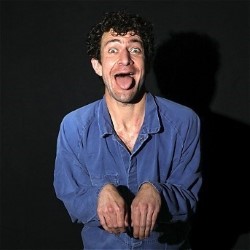
Very sensibly, the script largely kept to Orwell’s beautifully crafted words, with minor alterations, including some references to more recent politics. This was wise, given that Animal Farm is Orwell’s most crafted piece of fiction, in which powerful themes are articulated in deft prose.
The audience entered the theatre to the sounds of Pink Floyd’s Pigs, the blend of melodic and discordant and sounds preparing the audience for what lay ahead. On the stage sat a hat and a whip, another foretaste of how the story would develop.
The performance began starkly, with Old Major’s speech outlining the principles of Animalism, delivered in near darkness. With a lot to cover, the first part was a fraction rushed. Happily, the pace became more measured and varied as the performance progressed and Blythe found his rhythm, giving the words the space and weight they deserved.
The quality of the original text shone through. Its deeper meanings, beyond an allegory of the Russian Revolution and the development of Stalinist Russia, emerged. That Russia is again an authoritarian state, controlled by a deeply manipulative leadership again demonstrates the pertinence of Orwell’s text.
The audience was kept enthralled throughout, even though most were familiar with the basic ark of the narrative. This was impressive given that it was a performance of almost 80 minutes. Most performances in the Fringe are about 50 minutes, with some performers struggling to retain an audience throughout that. This was not the case here.
Given the length, and the sheer volume of lines to be learned, it was to be expected that there would be a few flubs, (“I knew there might be a few”), but these did not badly interrupt the flow. I caught Animal Farm on its first full performance, after two preview shows. As the month progressed, the performance would have become even more polished. While the Fringe can be a grind, its length does allow performances to evolve and gain polish over the three and half weeks.
Particularly well performed were some of the emotional scenes involving the ‘Stakanovite’ cart-horse Boxer (“I will work harder”), including his eventual carting away to the knacker. The words “boxer was never seen again” were delivered in a particularly affecting way, the words hanging in the air. There followed Clover’s emotional, elegiac final performance of the soon to be banned anthem Beasts of England. There were few dry eyes in the house at this point.
The extended applause from the audience at the end was well-deserved. It was an impressive and arresting performance which breathed new life into a familiar text.
*
Julia. 1984 (Summerhall Arts).
My next dose of Orwell was at Summerhall, a multi-arts venue renowned for its diverse offerings in theatre, music, film, and visual arts. The future of Summerhall is very uncertain; its closure would be a major loss for the Fringe and Edinburgh.
At Summerhall I caught Julia. 1984 by Within Theatre. Directed by Tanya Polosina, and with superb lead performances by Sofia Barysevich (playing Julia) and Michael Tcherepashenets (O’Brien), Karina Wiedman’s Julia. 1984 offers a worthy sequel to Orwell’s dark masterpiece. In 2024 Within Theatre performed an acclaimed version of Nineteen Eighty Four; this year they explored what might have happened next.
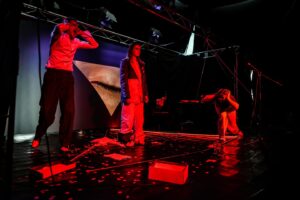
Julia.1984 – by Alina Saffron
Julia. 1984 begins where the original Nineteen Eighty-Four ends, the aftermath of Winston Smith’s final succumbing to days of torture – and his acceptance that the Party and Big Brother represent the only truth, the only reality. This is continued in Julia. 1984. The focus here shifts from Winston to Julia. What became of her?
As the audience entered, they found themselves in an eerie and unsettling space. They had, even if they didn’t yet know it, entered Room 101, ‘the worst thing in the world’. You may come out of Room 101 alive, but you will not be the same person, you will not hold to the same truths. Progress, in Room 101 it’s not like progress elsewhere. Here, “suicide ideation” is apparently “the first step to recovery” and the acceptance that Big Brother is always right – and that truth is malleable (‘2 plus 2 is 5’).
The performance begins with Julia midway through her torture, overseen by O’Brien at the Ministry of Love. It is the relationship and conflict between Julia and O’Brien which is at the centre of Julia. 1984. At the start, Julia is very much the victim, on her knees literally and metaphorically. She is imprisoned, with confession to crimes (real or imagined) the only way out. It takes us back to the conclusion of the original novel and the question that hangs over it; what was Julia’s role, if any, in Winston’s capture? These themes of distrust and double crossing are at the heart of Julia. 1984.
The action onstage was a stark contrast to warmth and sunshine on the nearby Meadows (a large public park); of children playing freely and ice cream being liberally scoffed. The world of Julia. 1984 has no room for such simple liberties and pleasures. The drinking of Victory Gin is done only to blank out the reality, not as a social lubricant. You don’t want to speak freely in a world where no one can safely be confided in. Fear and loathing is here the essence of life, with any personal relationships fractured by the state.
During the performance, the mood changes numerous times. At times, the atmosphere borders on jolly; at others, metaphorical shockwaves are projected towards those seated. At one point, several audience members around me jumped out of their seats as the action took a dramatic turn. At another point, the seating was shaken, further instilling a sense of unease. This is consistent with Room 101, where the punishments are psychological and physical.
The feeling that dominates is of claustrophobia. The characters in the play are trapped, intellectually if not physically, while the audience too feels surrounded, with action occurring in front and sometimes behind them. Who is watching? What are they looking for?
The interactions between the characters were convincing, especially the tense dialogues. These were carried out in simplified English (in line with the principles of Newspeak). The performance was never rushed, giving the audience time to absorb the deeper significance of the exchanges they had just witnessed.
The fluctuating fortunes of the main characters is very well communicated, especially O’Brien’s shift from charismatic, all-powerful master of ceremonies, the head of Room 101 – to a man in an increasingly precarious position. The changing power dynamics between Julia and O’Brien are at the core of the story and the performance.
Their interactions are an increasingly intense cocktail of distrust, loathing, and lust. At root is the question of who is really closest to the Inner Party and to its unseen but all-seeing “captain, engine and guru”, Big Brother. Who will win the power struggle? What emerges is that “everyone is replaceable”, even those in the highest positions within the Inner Party. Parallels with purges in many real totalitarian societies immediately came to mind. This may be a nightmarish vision, but has basis in reality; past and indeed present.
After an intense finale, those involved in the play outlined that what inspired them was their own history as a theatre group. Now based in London, the actors come from a range of Slavic countries where freedom of expression is in short supply. In short, this is “not history but happening now”. This powerful and disturbing performance did justice to Orwell’s vision.
*
1984 (Pleasance Courtyard).
Perhaps it’s a gauge of our political times that a performance of Orwell’s dark dystopia Nineteen Eighty-Four can pull in the crowds at 11.25 on a Wednesday morning!
As the audience entered, they were met with metallic and dirge-like music and a set shrouded in mist. This was not going to be an uplifting show. At the start we were told, slightly menacingly, to “turn off our phones and other surveillance devices”, a nod to the Orwellian aspects of smart phones. In short, the way our movements and activities can be tracked through them. We are also firmly instructed not to make video recordings. There is “no need” as “Big Brother is recording everything anyway!” These instructions set the mood very effectively.
More broadly, the use of off-stage voices throughout the performance adds greatly to it. The highly recognisable voices of Joanna Lumley and Simon Russell Beale give it gravitas and authority. You really feel you should obey what they are saying. Their voices combined with sound effects are particularly effective during the intense ‘2 Minutes Hate’.
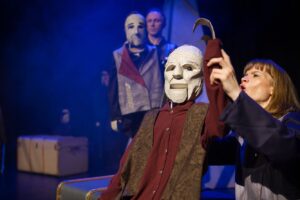
1984 – courtesy of Box Tale Soup
Distinctive of Box Tale Soup’s approach is the use of human-scale puppets, skilfully manipulated by the performers. What they manifest is the way that, in this society, no one is truly as they seem and no one is fully human. They must suppress any inner thoughts and values. Everyone is, quite literally, two faced.
The performances were polished and dynamic, communicating the essence of the narrative impressively within one hour. In the close interactions between the characters, the deep distrust was superbly communicated. The audience (around me at least) was transfixed, held by the performances.
The transitions between the scenes were done with real panache, the perfumers moving rhythmically, in tune with the music. These transitions gave the performance a real sense of drive and momentum. At no point did things sag.
The narrative was not just dark and dispiriting. What gave the performance texture was highlighting the fleeting moments of hope and optimism. These were manifested in the surviving fragments of the past including the old London song Oranges and Lemons. This was sung wistfully; a glimmer of hope – soon extinguished. O’Brien is the only one who knows the full lyric, illustrating that those in the Inner Party have access to this forbidden knowledge.
The Inner Party also has access to luxuries such as real coffee, not the substitutes. This reference to real coffee stems from Orwell’s experiences under rationing in (and long after) World War II, when chicory essence was the only ‘coffee’ most people had access to. That was in a period of national emergency; in the world of 1984, the state of emergency is permanent, scarcity is unending.
When Winston and Julia’s clandestine meetings are revealed, the mood switches dramatically. Winston knows that he will have to confess but hopes he can retain some of his humanity, and cling on to some fragments of truth. The torture scenes are done well, with the acting controlled, not over the top. The ending is inevitable but the sense of Winston being totally and utterly defeated comes across well. He is a broken spirit, willing to accept anything, even that he will love the thing he hates – Big Brother. There is no alternative.
Though the story may be well-known, this was a fine performance, fully deserving of the packed audience and extended applause it garnered.
Conclusion
In all three cases, the performers were all inspired by Orwell’s words and vision to produce intense and unsettling works of real power. It’s often argued that the Edinburgh Fringe is dominated by stand-up comedy. No doubt, comedy dominates the contemporary Fringe, especially in the media coverage of it. These three Orwell-inspired performances illustrated the riches still available on the Fringe, as well as the continuing relevance of Orwell’s work. I am in little doubt that Orwell will again feature in the Edinburgh Festival Fringe in 2026.
*
Charlie Ellis is a researcher, writer and EFL teacher based in Edinburgh. He writes on culture, politics, specialty coffee, sport, and education.
Leave a Reply