
Orwell’s Fortunate Silence
Charlie Ellis
on
‘a voice we can only read, never hear’
*
‘Never judge people by their accent. A man cannot help the way he speaks’, Stafford Cottman, George Orwell’s colleague in the trenches of the Spanish Civil War, recalled Orwell telling him (Coppard & Crick: 151). In Orwell’s case, we are spared the temptation entirely.
It is a ‘truly remarkable fact’ (McCrum, 2009) that no recordings of George Orwell’s voice are known to exist: despite several searches, none of the discs of programmes he recorded for the BBC has yet been traced, although, as Peter Davison tells us, their BBC numbers are given in The Complete Works. One of Davison’s final aspirations was recovering Orwell’s voice, a hope unrealised.
D. J. Taylor recounts a ‘tantalising quest’ in which ‘somebody reckoned they heard a recording of Orwell’s voice and said it sounded like Alan Rickman.’ This might suggest a precise, resonant, and languid form of RP combined with a signature slow, deliberate cadence. But, it seems unlikely that we’ll ever really know. Orwell’s is, in short, a voice we can only read, never hear.
The absence is all the more striking given the strength of Orwell’s voice as a writer: clear, distinctive, often compelling and still fresh. In short, that the authorial voice Orwell developed was, alongside the ideas in his books, a key aspect of the continuing attention he is paid. The strength of Orwell’s literary voice runs through the 1973 BBC programme, In Praise of George Orwell. The strength of his voice meant that, as Noam Chomsky put it, he was ‘able to cut through the ideological constraints’. He was also, according to Michael Foot, ‘the authentic voice of English radicalism’. As a colleague of Orwell’s, Foot heard the man himself speak, bridging the gap between Orwell the person and Orwell the writer. We, by contrast, are left only with his written word, forced to imagine the voice behind the prose.
In this article, I want to suggest that this absence has actually been advantageous to Orwell’s reputation, helping him remain a living presence rather than a figure tethered to a particular era.
Vinyl Memories
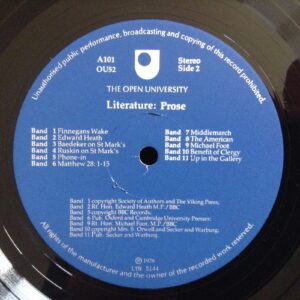
I recall first discovering Orwell’s essays through a vinyl record in my Dad’s collection; Literature: Poems and Prose, designed for an Open University Literature course, released in 1978. This included great works of literature, ‘high art prose’ (several Eliot and Pound poems) plus ‘the prose of persuasion, and the prose of simple information’.
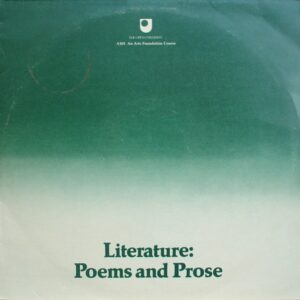
The selection of extracts included some fine public oratory, including a section of Michael Foot’s 1973 Labour Party Conference speech (plus some Edward Heath for balance). Public speaking was my father’s particular interest; I presume that’s why he purchased the LP. The piece of Orwell included was a portion of ‘Benefit of Clergy’, a good example of the ‘prose of persuasion’ and Orwell in didactic monologue mode .
Crucially, the voice uttering the words seemed remarkably ordinary. The accent was not particularly distinctive in its regional character, nor extreme in its social register. What it certainly wasn’t was a voice that exuded upper-class refinement or evoked a bygone era. At that stage, I had little reason to think the recording was not of Orwell himself, as some extracts on the record were indeed read by their authors. In fact, it was the actor Antony Jackson, who grew up in the Midlands. But first impressions are significant. Perhaps lodged in the back of my mind was Jackson’s voice—clear but warm, the comic exaggerations of the essay well expressed. I seem to recall that some of the more extreme sentences (about unsavoury activities in railway carriages and the like) were delivered in a way that made clear the author was exaggerating to make a point.
It’s often said that when you first hear a particular song, it’s that version you regard as the definitive one; all others become variants. In my case, I may have come to perceive Antony Jackson as the embodiment of Orwell.
A dried, scraped feeling
The next time I heard Orwell’s words being spoken was by Chris Langham in George Orwell: A Life in Pictures (2003). Again, whilst aware that the speaker was perhaps upper middle class, there was nothing extreme about the way he spoke. To me at least, brought up listening to Radio 4, it was all within the bounds of middle-class normality. When I’ve subsequently heard Orwell’s words being spoken on the radio and in other audio forms, this style of voice has dominated, emphasising his middle-class normality.
What is interesting is that when Orwell’s words are narrated, the actors doing so generally employ the fairly typical upper-middle-class voices of their era. There’s an element of neutrality in these voices, in that they very much represent the standard radio voices of their time-what we would expect to find on Radio 4. The voice used is generally upper-middle class, but I suspect falls short of the refined accent that would have emanated from the man himself. In short, though he died in 1950, his voice continued to evolve.
Ronald Pickup has, several believe, provided the best approximation of Orwell’s actual voice. For Crick (1989: 213), Pickup ‘got the voice exactly’ and those of Orwell’s friends who saw it were ‘awed at the exactness of the impersonation’. When Pickup was preparing to play Orwell – in The Crystal Spirit: George Orwell on Jura (1983)- he consulted the playwright Michael Meyer, who had known Orwell through the PEN club. Pickup asked Meyer, ‘Can you tell me what he sounded like?’ Meyer’s description was memorable: ‘a dried, scraped feeling.’
In all these cases, Orwell was being portrayed by professional actors, in Pickup’s case it showed ‘what a first-rate actor can do’ (Crick, 1989: 213). This, inadvertently, may have made him sound not just different but ‘better’ than in reality, with greater tonal richness. John Morris, one of Orwell’s BBC colleagues, described Orwell’s broadcast talks as ‘beautifully written’ but delivered in ‘a dull and monotonous voice’ (Coppard & Crick: 171). Robert McCrum (2009) relates that, ‘from the testament of friends’, Orwell’s ‘voice was weak and rather high-pitched’, sounding ‘Edwardian and/or Etonian upper class’. It was also affected by the bullet wound to the throat he sustained while fighting in Spain. Again, Orwell’s reputation may have benefited from the absence of recordings.
The other aspect that this absence facilitates is what I’ve already noted: the ‘de-classing’ of Orwell, disconnecting him from the reality of his ‘lower upper-middle-class’ upbringing and elite public school education. Without a recording to anchor him in time and class, the actors who portray him inevitably soften the edges, presenting a voice that contemporary audiences can more easily accept. The irony is that in attempting to approximate Orwell, they may have created a version of him more palatable to modern ears than the man himself would have been.
The Reality: An Upper-Class Voice
It was only when he met those from different social classes and countries that Orwell’s voice stood out and became a topic worthy of comment. He was clearly a man of a certain social class and education. D.J. Taylor, in his 2003 biography, observed that Orwell’s Etonian drawl ‘immediately enveloped its owner in a pair of spiritual plus-fours.’ The British Communist Harry Pollitt felt Orwell was unsuitable for the International Brigade, citing his ‘cut glass’ accent. For many from other countries he was a sort of epitome of a public school Englishman. Similarly, when he travelled to the north of England for some of his research for The Road to Wigan Pier, he stood out. Sydney Smith, a bookshop proprietor, recalled talking to Orwell in 1936 and that he ‘spoke the language different to us in the north’(Coppard & Crick: 137).
In words that have a contemporary ring, the writer Jack Common talked, in an essay ‘Orwell at Wallington,’ of Orwell as one of the ‘rootless, non-dialect speakers of the public-school elite’ (Coppard & Crick: 141). Family friends of the Blairs described Eric and his sister Avril as having a ‘dry ‘home counties’ monotone’ (Coppard & Crick: 25). William Empson, a colleague at the BBC, described Orwell as a ‘public-spirited Etonian’ who ‘cultivated a funny accent’ (Coppard & Crick: 179).
Of course, people wouldn’t have perceived this accent as ridiculous in that era; they would have been familiar with such voices, likely through the wireless. Members of the royal family and aristocracy, leading politicians, and others all spoke this way. Such voices were also very prominent on the BBC, where varieties of RP dominated. His voice, therefore, was not an oddity.
Retrospectively, however, the perception shifts. We view Orwell as the epitome of ‘common English decency’—a seemingly classless voice representing the ordinary citizen who rejects ideological extremes. Consequently, while we expect the aristocratic tones of an Evelyn Waugh or an Anthony Powell, Orwell’s ‘posh’ background often comes as a shock. This surprise is testament to his skillful construction of a common-man persona, a disguise further maintained by the convenient absence of any surviving recordings.
Of course, voices and accents change over time. The voice we expect to hear from an old Etonian is not static; it evolves. In the same way, the accents of individuals shift, adapting to new trends. Most famously, the Queen’s accent changed over time, particularly in some of her vowel sounds, and not merely in pitch and depth. Obviously it became somewhat deeper as she aged, but the character of her RP altered too. In this she was part of a wider trend.
The difference between the accent of the present King and that of his sons, despite their similar upbringing, is evidence of the way upper-class accents have evolved: from RP to its modern equivalent, SSB (Standard Southern British). As Geoff Lindsay outlines, King Charles’ accent is very much from another era, not dissimilar to his father’s, and somewhat fossilised before the social changes of the 1960s. Having such an accent, Lindsay argues, changed from a source of prestige to a ‘symptom of unfair privilege.’ This is in line with the comedy that emerged during that era, in which upper-class authority figures became targets of humour: Monty Python and so on.
As a result, some find it difficult to take those who still use RP – or what John Honey in Does Accent Matter? calls ‘marked RP’ seriously. By marked RP, Honey means not just a ‘fairly high level of educatedness’ but someone who has ‘had a privileged kind of education,’ such as ‘at a leading public school.’ Such voices sound particularly ‘cultured,’ with ‘every syllable’ of the marked RP accent seeming to ‘assert a claim to a special degree of social privilege’ (Honey: 38-39). This was certainly the social milieu in which Orwell grew up and was educated. What did they sound like?
Voices from Another Era
This question of accent struck me when I was rewatching the BBC Arena series Orwell Remembered, originally broadcast in December 1983.Crick (1989: 213) identified one weakness of the series: the excerpts from Orwell were voiced by producer Nigel Williams. In contrast to Orwell’s ‘upper-class military accent’, Williams had a ‘would-be classless, flat-vowelled, modern South London accent’ that had been ‘invented by Paul Schofield, popularized by Peter Hall in Pinter productions’. However, the series did feature many speakers who actually spoke in a similar fashion to Orwell.
Orwell Remembered included several segments from George Orwell: 1903-1950 (originally broadcast on BBC Two, Saturday 20 November 1965). They were indeed from another age, but one that seemed, in its accents, very distant even from the 1980s.
As D. J. Taylor notes, in the absence of any recording, ‘we can only get an idea of what he sounded like and the words he used – diction, delivery, phrasing, timbre – from the testimonies of his friends.’ These also give us a sense of why not having any recording might be an advantage. The clips from 1965 feature Orwell’s contemporaries, with a number coming from a similar social background to him; in Cyril Connolly’s case, also the same schooling. What struck my contemporary ear was just how posh these people sounded, very much voices from another era, before RP began to evolve.
His friend and putative biographer Malcolm Muggeridge would be a classic case here. Muggeridge was a controversialist and contrarian, so what he said was always likely to jar with lots of people. What added to this was his exaggeratedly upper-class tones. Take for instance this exchange with Sonia Orwell. Sonia Orwell’s pronunciation of ‘totalitarian’ (at 58 seconds) in the clip illustrates this clearly. Both have very posh sounding accents, but Muggeridge really seemed to lean into this.
In short, his ‘high posh’ accent became a key aspect of his persona, perhaps helping him to achieve an impact in the USA, where he conformed to the stereotype of the upper-class English gentleman. Other notable contrarians in the Muggeridge mould, such as Christopher Hitchens and Douglas Murray, have also traded on (and perhaps strategically leaned into) their posh Englishness as a badge of authority and distinctiveness in the US media sphere. Despite his decades in the States, Hitchens’ ‘remained strikingly English’.
Listening to Muggeridge now, it’s hard to believe that people took him seriously; such an accent has long been parodied and pilloried. In his lengthy conversations with William F. Buckley, the two men’s accents come across as stylized and inauthentic. They are looking to add gravitas to their statements; accents that did not alter over time, adjusting to new trends, and hence stood out, even in their era.
A fortunate silence
The argument outlined so far is that when Orwell is portrayed on radio or screen, he’s given an upper-middle-class English accent, but one that belongs more to the era in which the programme was made than to the era in which he lived. In short, the possibility that contemporary listeners and viewers would find him amusingly posh is not something he and his reputation have had to face. Unlike many of his contemporaries, the voice we associate with him is not fixed in time.
What dominates ultimately is his powerful voice as a writer. When we read him, we are not ‘polluted’ by a clear sense of what he sounded like. And this, I think, is where the real advantage lies. When we read Orwell, we hear him. But the voice we hear is our own construction: shaped by our own accent, our own era, our own relationship to the ideas on the page. A reader in working-class Birmingham and a reader in rural Scotland will, in some sense, hear a different Orwell. This is a freedom denied to writers whose voices we actually know.
We cannot read Evelyn Waugh or hear Malcolm Muggeridge without their voices intruding, and in both cases those voices now carry a weight of class association that makes them harder to take at face value. Orwell escapes this. His Etonian drawl, had it survived on tape, might well have become the story, overshadowing the writing in the way that Muggeridge’s mode of speech eventually overshadowed much of what he actually said.
This adds to the sense of ordinariness about Orwell, reinforcing that distinction drawn by some, such as Peter Stansky and William Abrahams, between Orwell the writer and Eric Blair the man. This view was most strongly articulated by Raymond Williams, who saw George Orwell as Blair’s great creation. Williams (1971) critiqued Orwell’s relationship to the working class, suggesting that despite Orwell’s efforts to write about and identify with ordinary people, there remained a distance; outsider’s perspective shaped by his public school background. In short, a profound gap existed between Orwell the Etonian and Orwell the champion of the common man. Crick (1989: 213) is more charitable, describing the ‘comic if morally rather impressive disjunction between’ the ‘military tone of Orwell’s voice and many of the radical things he said’.
The absence of a recording has, perhaps inadvertently, kept the focus where Orwell himself would likely have wanted it: on the words, not the man who spoke them. So whilst many Orwell scholars and followers of his work bemoan the lack of any recordings, the truth is that this absence may well have enhanced Orwell’s ability to endure as a literary figure so many decades after his death. We hear him still, but we hear him as ourselves.
*
Bibliography:
Coppard, A. and Crick, B. (1984) Orwell Remembered. London: British Broadcasting Corporation.
Crick, B. (1989) Essays on Politics and Literature. Edinburgh: Edinburgh University Press.
Honey, J. (1989) Does Accent Matter? London: Faber & Faber.
McCrum, R. (2009) ‘It’s hard to conjure up the spirit of Orwell’, The Guardian, 1 June.
Taylor, D. J. (2003) Orwell: The Life. London: Chatto & Windus.
Williams, R. (1971) Orwell. London: Fontana.
Charlie, thanks.
The lack of a recording removing a potential barrier to people engaing with his work is an interesting observation.