
Presumptuous Task?
*
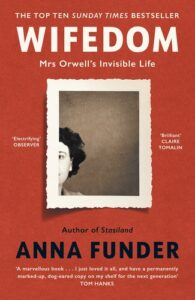
Wifedom: Mrs Orwell’s Invisible Life, by Anna Funder reviewed
*
Attempting to understand the complexities of other people’s marriages and how the relationship tessellates is in many ways an improbable pursuit. We are on the other side of shut doors. Nuances and understandings can only be guessed at, the bargaining and agreements on which each marriage is built are made in low voices.Things said and unsaid built over years create barriers and traps for, say, a future writer who might decide that they need to imagine the wife is up to her elbows in a cesspit while the husband demands a cup of tea.
Anna Funder has set out on, to borrow a phrase from Boswell, the presumptuous task of getting to the essence of a marriage which ended now nearly eighty years ago. That is, Orwell’s marriage to Eileen O’Shaughnessy. So wrote Wifedom. Funder felt, as do many others, that Eileen’s contribution to the development of Orwell as a major literary figure has been neglected. Eileen’s support, ideas and talents can be seen to have helped create and shape Orwell’s work while the woman herself has remained invisible – by biographers, by readers and by Orwell himself.
However, the longer Funder looked, the more she saw a woman not merely undersung, but abused alarmingly, married to a serial adulterer, treated by him as a servant, a secretary and as a nurse, her needs ignored and eventually her life squandered as her husband sat in another room, typing, one year to the next, dominating the good space in bad houses, attempting sex with BBC colleagues, eating Eileen’s rations in the war (the cat’s food, too) and dominating the shape of their marriage to her detriment.
Orwell and his behaviour becomes the subject of the book, not Eileen. Ironically, he takes over, with his maleficence, misogyny and finally his desperate search for a wife, any wife, after Eileen’s early death and he himself had begun to slowly die.
Funder makes factual errors and reaches too far. There are no caveats, and in the process not just the character of Orwell is distorted but that of Eileen as well. She is presented as a woman with no agency who is led unwillingly to rural squalor, deceived into marriage, and drudgery. Orwell slowly becomes a villain, a man with nothing but ill intent. Even on his wedding day:
…Orwell is saying…I can’t believe no one is stopping this. Orwell is getting away with something. He can barely afford to keep himself, and yet he is going to get another person’s labour, for life, for free.
Poor Eileen, if true. But the thoughts presented are conjecture, and such conjecture is diffused across the entire book, inserting real correspondence and known history in amongst the author’s opinion, speculation, assumption and fictional narrative (with attendant spiteful pokes and digs). Any action of Orwell is thought to have had a malicious or selfish motive, where Eileen was merely stoic, angry but compliant.
Funder can write very well (and does) but a reader should not be seduced by good writing to trust the bad narrative. While Eileen rode drab buses around Stockton-on-Tees, to the hospital and her death, Orwell is described (via Hemingway) as amusing himself in wartime Paris. Funder underlines that by naming the chapter just that, “Amusing Himself”. She takes Hemingway’s rather bizarre story at face value. Was Orwell worried about Communists and did he ask Hemingway for a gun? Did Hemingway hand one over and have some of his men “tail” Orwell? Is any of this true? Probably not, we don’t know. But in Wifedom, we are left to assume it is.
I found the frequent disagreements with the unarmed “biographers” a bit tedious. As I did the use of Eileen’s friend Lydia Jackson’s supposed disapproval of Orwell as some sort of vindication for Funder’s point of view. All the while leaving out the context of the time, the type of world the couple inhabited and the difficulties men of Orwell’s class and time had in expressing emotions and feelings in any modern sense.
A saint, or someone who pretends to be, can be toppled as easily as a slaver’s statue. Did Orwell ever claim that for himself? It may be a consequence of the nature of his writing but wasn’t Orwell as prophet conferred upon him posthumously? He spoke about “decency” and his work has huge moral value but he was just a man. With all too human triumphs and failures. This myth of Saint George is unhelpful and allows his obvious failures to become a cudgel with which to beat his work.
This happened with the “list”, a supposed proof that the man wasn’t what he made himself out to be and seized upon by some to dismiss him and the work entirely. It is still being seized upon.
A similar thing may be happening with his approach to sexual politics. He didn’t live to see the second wave of feminism, let alone the third or fourth, so lambasting him for underdeveloped opinions in the area is what C.S Lewis (of all people) described as “chronological snobbery”.
Wifedom is frustrating. Eileen deserves to be explored, and female voices in Orwell studies appears to be growing. For example, A.L Kennedy’s Orwell Lecture on the women in his life is online and is worth seeking out. Also, Sylvia Topp’s 2020 Eileen: The Making of George Orwell deals with the subject in a very different way. I would suggest that book as a counterweight.
*
Wifedom: Mrs Orwell’s Invisible Life, by Anna Funder (Penguin/Viking 9780241482728)
Good Review Jason.
The more I read about that book, the less inclined I am to get started on it…
Too right..it is a terrible book. She has put a whole lot of irrelevant stuff about her own life in Aus suburbia in between castigating Orwell for his general nastiness. Terrible feminist claptrap.
I think you let Funder off lightly, I have read her book and found it not only unpleasant and inaccurate, but a bad book as well. I found especially annoying her criticism of Orwell’s unnamed (except in the footnotes) biographers, and her mixture of (selected and often inaccurate) ‘fact’ and fiction.
Hello Alan. I am perhaps inclined to agree with you.
I nearly abandoned the book, but to be informed, i continued. Funder takes very simplistic views, for example, insisting that Orwell is describing his own relationship when he is writing about husbands and wives. And turning that into a commentary on Orwell as a misogynist. It seems to be writing designed to sensationalise rather than describe. This isn’t for serious readers.
Is the Anna Funder book as an attempt to severely discredit Orwell posthumously, just as his ideas are being realised in our unstable political climate? Using contemporary methods of character assassination via “he said/she said” narratives taken as fact, she paints a picture of an evil man. This leads most liberal minded thinkers to recognise the need to reconsider Orwell’s political ideas. This personal attack on Orwell at a time when his political ideas need to be discussed more than ever is a concern. Orwell’s ideas challenge the power of the ruling elite in a way that few do, through the clear and accurate description of authoritarianism and propaganda. Does anyone know how Anna Funder came across these supposed letters? Does anyone know about her background? Going to primary school in Australia and Paris is no ordinary childhood.
There seemed to be such widespread approval of this book I wondered why I felt so negative about and unimpressed with Anna Funder’s book. A relief to find others had a similar reaction. As pointed out, the overpowering motive of the writing seems to be the tearing down of Orwell rather than the recognition of Eileen.
Funders book is very good on the role Eileen played in Spain and the circumstances of her death. Neither of these aspects are referred to in either the review or the comments above, probably due to the fact that they show unflattering sides of Orwells character which are seldom discussed. This book is worth reading first its excellent analysis of how male artists air-brush out the female support which makes their work possible.
I was looking forward to Funder revealing the contributions Eileen made to 1984 and Animal Farm. Beyond suppositions by friends, I read nothing. Just feelings. Funder expresses a desire to avoid privileging her voice over Eileen’s but of course, that is exactly what she does. Funder’s voice, Eileen’s voice and Funder’s re-creations eventually blend into one so that nothing is trustworthy and the book loses purpose. The book does seem to be more about misandry and feminist polemic than bringing Eileen to life, presenting Orwell as the archetype of the male, adultery as a strictly male problem, and portraying Orwell’s incredible self-centredness as that typical of a ‘man’ rather than an ‘artist.’ I confess that Funder lost me early on when she introduced a goat just so she could create the image of Eileen feeling like she ‘belonged with the animals.’