
Resisting AI – A Review
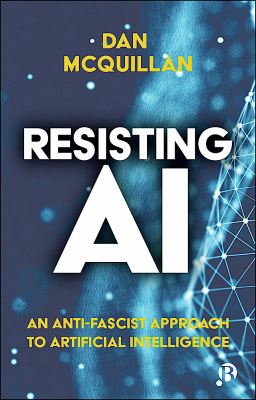
In his new book Resisting AI, an Anti-Fascist Approach to Artificial Intelligence Dan McQuillan includes the following observation:
‘The precaritizing effects of algorithmic labour are made possible by Orwellian levels of data capture… The fear of a privileged algorithmic observer leads to an anxious performance of compliance.’
Now Nicola Rossi reads it with her expert eye, finding a text which ultimately offers more hope than Orwell could muster at the end of Nineteen Eighty-Four.
*
New applications of Artificial Intelligence (AI) hit the headlines every day. Some of these stories, on closer reading, are more like science fiction than fact. For example, the recent BBC piece, Google Engineer Says AI System May Have Feelings, makes significant use of the conditional tense and signals clearly the points at which the report strays into speculation.
However, the cases quoted in Resisting AI, an Anti-Fascist Approach to Artificial Intelligence, by Dan McQuillan, are firmly rooted in the here and now. His well-informed, hype-free take on the current capabilities of AI, and the harms it has enabled, is ultimately concerned with ways to maintain our humanity. Or, in other words, to prevent AI from fueling fascism.
Given the abundance of optimistic narratives about AI’s potential to do everything from curing cancer to solving the climate crisis, it may sound jarring to cite the technology as an enabler of social division and violent ultranationalism. However, the book makes a convincing argument.
To get the most from Resisting AI, you will have to accept some terminology which will be unfamiliar outside of academic and activist circles. That said, McQuillan takes care to explain everything in the book in common language, while substantiating his argument with references to published articles.
He begins with a clear explanation of how AI works, its current capabilities and limitations. Having set the scene, the next two chapters detail harms which AI has caused, notably in reinforcing bias and discriminatory practices in areas such as law enforcement, healthcare and access to money and employment. The expression ‘AI violence’ relates to the idea of ‘structural violence… by which institutions or social structures harm people through preventing them from meeting their fundamental needs’. Among the many distressing examples, are the use of AI systems to create precarious labour markets, and to prevent certain categories of people from accessing loans, benefits, work, pain relief, whole countries or even hotel stays based on data that feeds crude, prejudiced and opaque predictive models.
The situation gets even worse in the chapter on necropolitics, which is the politics of who gets to live, and who gets to die. If you were wondering who, in an AI-powered world is less likely to survive, well, it’s not those who are already privileged. But after COVID you already knew that, didn’t you?
McQuillan also takes time to remind us that the scientific tradition, which has culminated in AI, has been no stranger to deeply immoral and oppressive practices. The hideous spectre of eugenics was used to justify genocide, sterilization and the incarceration of people who were regarded as ‘others’. If all that was possible when oppressors used paper records and other human beings to root out their enemies, the potential for AI to support the enactment of turbo-charged fascism is chilling. The ‘what ifs?’ feel terrifyingly close. One example he hypothesizes would be the combination of AI powered surveillance systems, to enforce the resurgence of state-sanctioned prejudices, such as the creation of LGBT-free zones in Poland.
In the Global North, much of the public debate around how to fix the discriminatory traits of systems powered by artificial intelligence has been focused on creating regulation, establishing ethics boards and finding ways to unpick the bias inherent in both the systems and the data they depend on. However, McQuillan’s position is that these attempts at such remedial action will not go far enough.
In contrast, he proposes a grass-roots counter-political approach, in which we are encouraged, to organize ‘to demand the possible, not the probable’. Through local organization, and with our unique human ingenuity, we can outdo the supercomputers which we are repeatedly told (though not in this book) will be powerful enough to make us live forever and ensure no car on the planet ever crashes again. This has a ring of David taking on Goliath. But the beauty of not being an AI, is that humanity is not constrained by an algorithm that will root us always to the most probable option.
The idea of people’s councils and workers’ councils, which are proposed as part of the solution, have never before appealed to me. While I applaud the open access approach to creating such decision-making structures, my experience of working full time while raising a family, for much of my adult life, left little time to be an active citizen. Many others are in the same position. Perhaps the need for structural renewal is becoming so pressing that people will prioritize organizing in this way. Especially if the alternative would be abdicating their power to faceless and unaccountable algorithms which could end up in the hands of fascists.
In spite of its catalogue of atrocities, the book ends on a hopeful note which makes a powerful case against giving up. Rather than be overwhelmed, we are urged to keep open the question of what is technically and socially possible. We have both the capacity to organize, and the capability to care for each other. Contrary to what numerous evil characters in popular science fiction (Dr. Who, Star Trek, The Hitchhiker’s Guide to the Galaxy and the X-Men) may have tried to tell us, resistance is NOT futile.
In summary, this book is for you if you are interested in understanding how AI really works and is being put to use today. McQuillan presents a convincing argument for how the social, political and the technological are deeply enmeshed. Proving the fallibility (or he would say ‘violence’) of the technology with concrete examples of where it has led to discriminatory and harmful practices, the author makes no attempt to present the counter narrative – that AI will save us. You can find that myth in abundance elsewhere. What this book offers is the much-needed reminder that people, when they come together, have the power to save themselves.
*
Resisting AI, an Anti-Fascist Approach to Artificial Intelligence by Dan McQuillan (Bristol University Press: 2022, ISBN13: 9781529213508).
*
Nicola Rossi is the author of the Rockstar Ending series of books.
Thanks Nicola, for your interesting and well iformed review and the possible means of surviving.
A.I. is with us now in all forms. How many jobs done by Humans will be replaced ? As a life long cinema fan, in the movie industry for example. Proofreading of Angela Smith and Sylvia Topp’s, Eileen: The Complete Letters, it took 6 weeks to correct what A.I. had done. What is frightening is relying on A.I. in the medical profession, who gets care and who doesn’t, who lives and who dies, and of course in surveillance and defence.