
See Orwell At Work
Great news for those who wish to see how George Orwell worked on Nineteen Eighty-Four:

Brown University, in Providence, Rhode Island, have digitised the surviving manuscript and put it online, page by page.
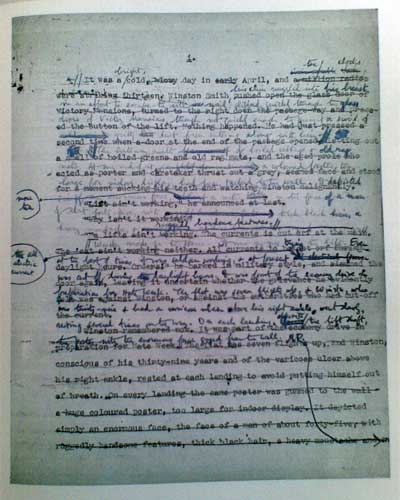
Just consider the difference:-
It was a cold day in early April, and a million radios were striking thirteen. Winston Smith pushed open the glass door of Victory Mansions, turned to the right down the passage-way and pressed the button of the lift. Nothing happened. He had just pressed a second time when a door at the end of the passage opened, letting out a smell of boiled greens and old rag mats, and the aged prole who acted as porter and caretaker thrust out a grey, seamed face and stood for a moment sucking his teeth and watching Winston malignantly.
“Lift ain’t working,” he announced at last.
“Why isn’t it working?”
“No lifts ain’t working. The currents is out at the main. The ‘eat ain’t workin’ neither. All currents to be cut orf during daylight hours. Orders!” he barked in military style, and slammed the door again, leaving it uncertain whether the grievance he evidently felt was against Winston, or against the authorities who had cut off the current.
Winston remembered now. It was part of the economy drive in preparation for Hate Week.
And:-
It was a bright cold day in April, and the clocks were striking thirteen. Winston Smith, his chin nuzzled into his breast in an effort to escape the vile wind, slipped quickly through the glass doors of Victory Mansions, though not quickly enough to prevent a swirl of gritty dust from entering along with him.
The hallway smelt of boiled cabbage and old rag mats. At one end of it a coloured poster, too large for indoor display, had been tacked to the wall. It depicted simply an enormous face, more than a metre wide: the face of a man of about forty-five, with a heavy black moustache and ruggedly handsome features. Winston made for the stairs. It was no use trying the lift. Even at the best of times it was seldom working, and at present the electric current was cut off during daylight hours. It was part of the economy drive in preparation for Hate Week.The flat was seven flights up, and Winston, who was thirty-nine and had a varicose ulcer above his right ankle, went slowly, resting several times on the way. On each landing, opposite the lift-shaft, the poster with the enormous face gazed from the wall. It was one of those pictures which are so contrived that the eyes follow you about when you move. BIG BROTHER IS WATCHING YOU, the caption beneath it ran.
In 1984 Professor Peter Davison published a large volume, in which each page of the manuscript in facsimile was opposed to his transcription (as the image of the first page suggests, not an easy task for any editor). In his Introduction to the book, Professor Davison wrote:
Despite all the rewriting revealed by this facsimile, it is remarkable how closely what has survived adheres to the main sweep of the narrative of Nineteen Eighty-Four. All the principal features, except the Appendix on Newspeak, are present, suggesting that the story had been pretty fully formed in Orwell’s mind by the time he sat down to write it.
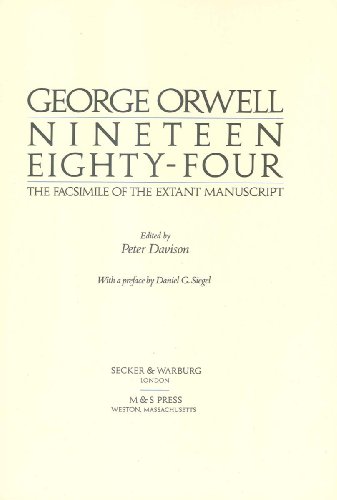
Sonia Orwell, widow of the author, once said that this was “the only MS of any of George’s books in existence”. In 1952 she offered the manuscript to benefit a charity (as she did with a number of Orwell’s shorter typescripts) at Christie’s auction house, who described it as “the original manuscript of Orwell’s last novel, partly in typescript but mainly in his own manuscript [hand-writing]”. After more sales the manuscript was bought by Daniel G. Siegel, who ultimately placed it at Brown University in the USA. Mr Siegel wrote a Prefacr to Professor Davison’s facsimile edition. The Davison edition was published subsequently in Italy with an Introduction by Umberto Eco, and there have been facsimile editions more recently that do not have the transcription, only the images of the pages.
Brown University is also home to The Daniel J. Leab Collection of books and manuscripts by and about George Orwell.
We congratulate Brown on their efforts. They offer a major resource to students in the USA and have now made a significant work available world-wide. Questions can be directed to hay@brown.edu.
In Britain equivalent resources can be found at the Orwell Archive at University College, London, and in the Peter Davison collection placed by the Orwell Society at the Museum of Wigan Life.
*
Thanks Les for highlighting. As you say, a wonderful new resource for Orwell researchers.