
“Seeing What is in Front of One’s Nose”
The Importance of Orwell’s Domestic Diaries
Amongst George Orwell’s greatest obsessions was gardening. He once said: “Outside my work the thing I care most about is gardening.” Yet this aspect of his personality has been downplayed or totally ignored by his biographers and academics studying his writings. Why?
Similarly, Orwell’s domestic diaries have drawn little attention. They are usually seen as dull and dreary since they record in meticulous detail the ordinary everyday aspects of gardening and husbandry – observations about nature and the weather, vegetable growing, raising chickens and goats, the numbers of eggs produced by his chickens and so on. Yet the domestic diaries can be seen as some of his most important and fascinating writings. For they offer crucial insights about his personality, his literary style, his love of the simple life, his emphasis on the constant struggle to see clearly ‘what is in front of one’s nose’ – and the complexities of the creative process of writing more generally.
The collection of diaries edited by Peter Davison (2010) incorporates those for 9 August 1938-5 September when Orwell is living with his new wife Eileen O’Shaughnessy at The Stores, Wallington in deepest Hertfordshire; from 10 April-26 May 1939 when the Blairs return to the UK after a six-month break convalescing in Morocco; from 27 May 1939-2 July 1939 and 5 September-29 April 1940 at Wallington again. Then when Orwell surprises everyone and retires to Jura, a remote Scottish island, he resumes his domestic diary writings – from 7 May 1946-29 October and again from 21 March 1949-September of the year. Days later, in January 1950, Orwell dies – aged just 46.
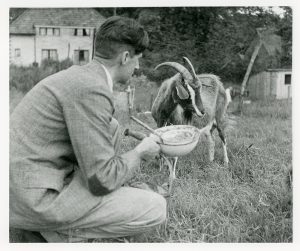 George Orwell at Wallington with goat (probably Muriel)
Intriguingly, Orwell writes a number of kinds of diary. While in Morocco, he writes one in which he notes newspaper coverage, observations about the natural environment, local customs, overheard conversations, food provisions, changes in the weather, agricultural equipment (accompanied by little sketches) and so on. From 2 July-3 September he composes a diary of events leading up to the Second World War – mostly summarising reports from a wide variety of newspapers – both mainstream and left-wing. And during the war, he writes two diaries: from 28 May 1940-28 August 1941 and 14 March 1942-15 November1942 incorporating the major political developments, his opinions and those of friends, newspaper coverage etc. These differ from the domestic diaries in one major respect – they are intended for publication while the domestic diary entries (which continue during the war, some of them incorporated into the war diaries by Davison) are never intended to see the light of day.
And that makes the domestic diaries so utterly fascinating and important. Orwell was constantly at his desk bashing out novels, journalism, letters to family members, lovers, work colleagues, political friends and adversaries, reviews, journal columns, polemics, poems and so on. Yet, amazingly, he still finds the time to write diaries that he knows will never be published. Why? Orwell, in effect, is making important points about the purpose of writing – and the deeper purposes, challenges and joys of living.
He only once wrote about diaries. In his essay, “In Front of Your Nose”, published in Tribune on 22 March 1946, he comments: “One thing that helps is to keep a diary or, at any rate, to keep some kind of record of one’s opinions about important events. Otherwise, when some particularly absurd belief is exploded by events, one may simply forget that one ever held it” (Orwell 2006 [1946a]: 305). Here he is clearly referring to the kind of political diary he writes during the war years. Yet that notion of seeing “what is in front of one’s nose” lies at the heart of his domestic diaries. Orwell has travelled to Burma, to the north of England to report on the plight of the poor, to Spain to fight in the civil war in 1937, to Morocco. But in the domestic diaries, Orwell ‘self-isolates’ and celebrates what is close at hand: the simple joys of working on the land, the aesthetic pleasures of gardening and the wonders of nature. And the act of recording all this in his diary is, itself, a joy. No publication is needed to justify it.
Let us take one, quite arbitrary, example. On 14 March 1940, he writes: “Heavy snow in the night & during a good deal of the day. Nasty slush snow which will not lie long, but makes everything very nasty. Impossible to do anything out of doors. Began water-glassing some eggs, experimentally. It appears you should use eggs 5-12 hours old, as if they have been laid a day or two it takes several months off the time they will stay good. Put 20-30 older eggs (laid about 6 days) in a glass jar, & these can be used first. Am using a large enamelled pan for newer eggs, & shall put in none more than 24 hours old. 16 eggs” (Orwell 2010: 235). So, typically, normal grammar rules do not apply and he uses ‘&’ always for ‘and’. He begins by recording the weather; then shifts to describing in some laborious detail water-glassing eggs and ends, again typically, with his egg count for the day.
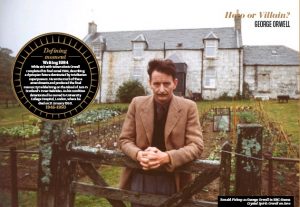 Ronald Pickup as George Orwell in the BBC’s The Crystal Spirit, in the re-created garden at Barnhill
On one level this seems banal. The contents are highly selective, of course. There is no mention of his wife; later, while writing the Jura diaries, Orwell is devoted to bringing up his son, Richard, but he is nowhere mentioned. Yet, for Orwell writing the domestic diary is both psychologically and creatively important. When writing for publication, the author always has in mind their imaginary audience and, to a certain extent, this can be a constraining influence. In “Why I write”, the essay he contributes to the short-lived alternative journal, Gangrel, Orwell stresses: “What I have most wanted to do throughout the past ten years is to make political writing an art” (Orwell 1970 [1946b]: 28) and these “artistic” aspects add to the challenges of communicating to an audience and writing for publication. In contrast, in composing the domestic diary for himself and family, Orwell is entirely free; there is no need even for any self-critique of its contents or shape. It’s the purest form of writing.
There is another fascinating aspect of the domestic diaries. Writing is seen very much as an individual pursuit in the dominant Western tradition. In contrast, in Japan, for instance, rengas are poems composed collaboratively – by two or more people, even entire villages. At times, Orwell’s domestic diaries become a collaborative project. Thus, when he is away from Wallington in September 1939, Eileen Blair fills in the diary and during the winter of 1947-1948 when he is away in hospital, his sister, Avril, jots down entries on his behalf. Both closely follow his style so incorporate basic information about the weather and work undertaken around their houses. In other words, while the obsessive diary entries may seem an idiosyncratic feature of Orwell’s personality and writing process, it is understood by his closest family members. And so they willingly join him in the exercise – making the diaries ultimately a sort of intimate celebration of their life together.
Orwell, then, as an exponent of “close” travel, exploring the near-at-hand as a way of embracing a creative and more ethically nuanced notion of travel and travel writing, is following in a long tradition. At the end of the 18th century, in Turin, for instance, Xavier de Maistre wrote A Journey Around My Room (1794) while imprisoned in his bedroom for six weeks after being caught fighting a duel in the north Italian city in 1790. As a way of coping with his imprisonment he decides to compose a travel book about the contents of his chamber. In a similar vein, the French Oratorian priest Abbé Perreyve (1831-1865) writes that “within all journeys it is the hermit, and those who look closer at things, who attain the real value from travel”. And Henry David Thoreau, in Walden (1854), tells of the time he lives alone in a remote log cabin at Walden Pond, Massachusetts, focusing on simple experiences and on slowing down as an antidote to the stresses he sees being created by modern industrialism (see Stubbs 2020). Like Orwell, Thoreau is an obsessive diary writer, tracking the seemingly trivial aspects of his ‘simple living’ in meticulous detail.
Significantly, Walden is among the list of books Orwell owns at the time of his death that Peter Davison carries towards the end of the last volume of the twenty Collected Works (1998). Orwell had an ambivalent attitude to the simple life (as, indeed, to many other topics). As David Dwan notes (2018: 193): “Orwell had little time for the ‘shallow pantheism’ of committed nature-worshippers.” George Bowling, the anti-hero of his novel, Coming Up for Air (1939), similarly dislikes those who preach the simple life and “roll in the dew before breakfast”. Yet Orwell, in practice, loved the simple life. Sylvia Topp highlights in her superb new biography of Eileen Blair, the primitive state of The Stores. The two-storey building was tiny – just eleven feet deep. The corrugated iron roof, recently added since the original thatch was rotting, made a colossal racket every time it rained which was often. The ceiling downstairs was so low Orwell – at 6ft 3ins – had to bend double all the time (Topp 2020: 126-127). There was no internal water supply, lighting was by oil lamp and heating and cooking by oil stove. The chimney was constantly blocked so any fire was likely to fill the cottage with smoke (Bowker 2003: 185). As Topp writes of the Blairs (op cit: 155): “Some saw their cottage life as masochistic. Certainly they pushed themselves to the extreme, wanting to fill each day completely with fulfilling work. … They got pleasure from the rewards of accomplishment: the garden grew, the eggs and milk fed them, the books and articles were perfected and appreciated.” Similarly, in moving to the remote Scottish island of Jura at the end of his life, Orwell was indulging in his love of the simple life.
And better than anything else, it is the domestic diaries – with their copious entries about work done, animals caught copulating, hedges planted, the changing weather and moods of the sea, fishing exploits and the spraying of fruit trees (apples, plums, cherries, black currants, red currants and gooseberries) – that capture Orwell’s passion not only for gardening but for life.
*
References
Bowker, Gordon (2018) George Orwell, London: Little, Brown
Dwan, David (2018) Liberty, Equality and Humbug: Orwell’s Political Ideals, Oxford: Oxford University Press
Orwell, George (2010) Diaries, London: Penguin
Orwell, George (2006 [1946a]) Orwell in Tribune, Anderson, Paul (ed.) London: Politico’s
Orwell, George (1970 [1946b]) Why I Write, Orwell, Sonia and Angus, Ian (eds) The Collected Essays, Journalism and Letters of George Orwell, Vol. 1, Harmondsworth, Middlesex: Penguin Books pp 23-30; first published Gangrel, No. 4
Stubbs, Ben (2020) Close travel: On the ethics of writing about the near-at-hand, Ethical Space: The International Journal of Communication Ethics, Vol. 17, No. 1 pp 11-17
Topp, Sylvia (2020) Eileen: The Making of George Orwell, London: Unbound
*
Richard Lance Keeble is the out-going chair of the Orwell Society. He writes three diaries – a personal one, a political one (drawing on newspaper and website reports) and one in which he records his dreams – none of them are for publication.
Uploaded 7 April 2020
Leave a Reply