
The Charm of Useless Knowledge?
Even one of George Orwell’s apparently throw-away remarks may open to reveal a much larger world, one of both knowledge and possibly biography. Take his only reference to Rupert Gould, which can be found in his early war-time essay on Victorian novelist Charles Reade:
What is the attraction of Reade? At bottom it is the same charm as one finds in R. Austin Freeman’s detective-stories or Lieutenant-Commander Gould’s collections of curiosities—the charm of useless knowledge. (New Statesman, 17 August 1940)
Orwell went on to list why one might enjoy Reade’s work, which would also apply to Commander Gould:
If you have the sort of mind that takes a pleasure in dates, lists, catalogues, concrete details, descriptions of processes, junk-shop windows and back numbers of the Exchange and Mart, the sort of mind that likes knowing exactly how a medieval catapult worked or just what objects a prison cell of the eighteen-forties contained, then you can hardly help enjoying Reade.
Two of Gould’s books stand out as “collections of curiosities:
Oddities: A Book of Unexplained Facts (first published in 1928)
Enigmas: Another Book of Unexplained Facts (first published in 1929)
He also published, in this vein, A Book of Marvels, The Case for the Sea Serpent, and The Loch Ness Monster, and Others. He was to become a well-known broadcaster, many of his talks given on wonders and historical eccentricities, later appearing as one of the brains on The Brains Trust, but he was also an early and expert horologist, who worked at the National Maritime Museum in Greenwich. Even before he became known on The Brains Trust (which came after Orwell’s reference) he had been a regular factual speaker on BBC wireless’s Children’s Hour, where his subjects lead to him becoming known as The Stargazer.
 The ‘Revised’ edition of Oddities was published in 1944, and reprinted in 1945.
Oddities and Enigmas were reprinted as large octavo editions, but when Gould’s new book The Stargazer Talks was published in 1943, using his Children’s Hour soubriquet, it was a small octavo:
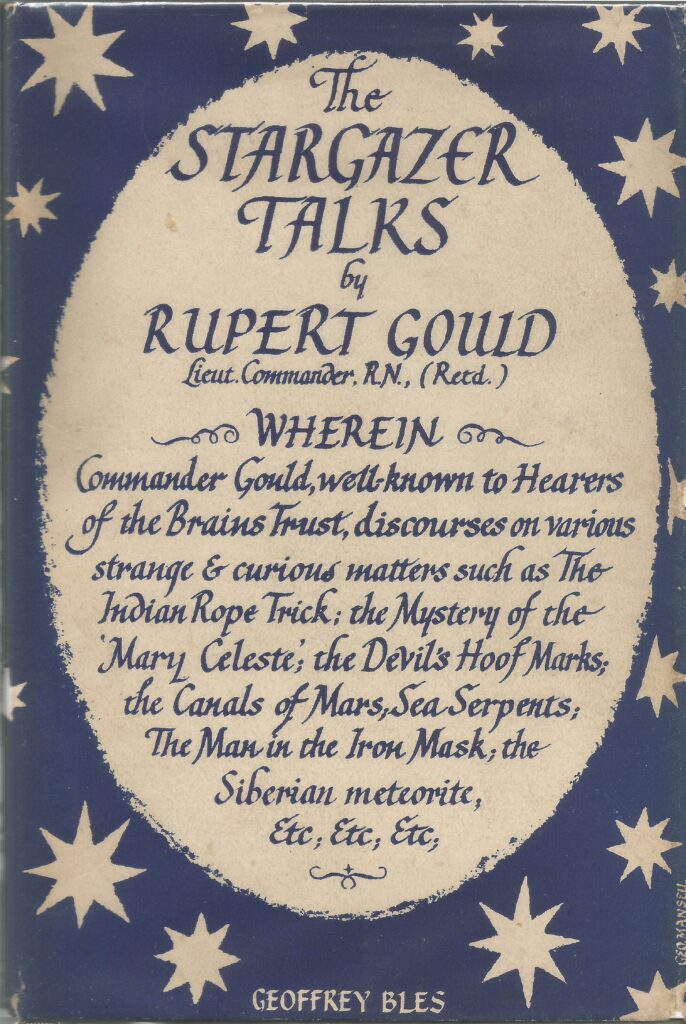
Gould had to wait until after the Second World War had ended for the publication of a revised edition of Enigmas in 1946.
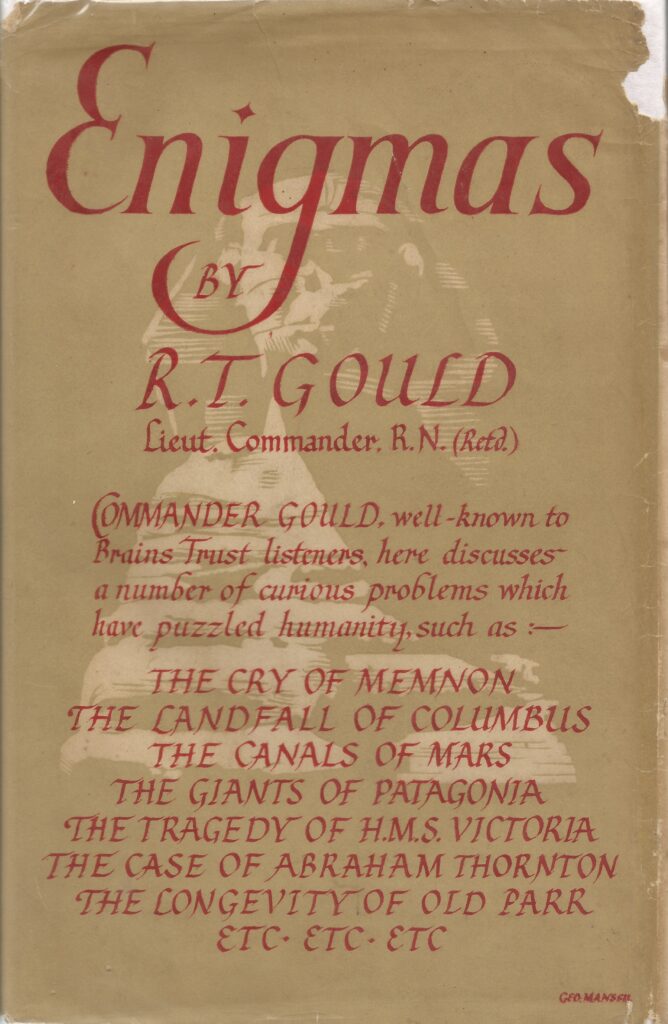
His publishing house, Geoffrey Bless, clearly valued a common design for his book jackets (the artist signs him- or herself Geo. Manseil), a benefit not given to every author, but would make their commonality obvious to book-buyers. The quality of production, given the exigencies of the war, is outstanding.
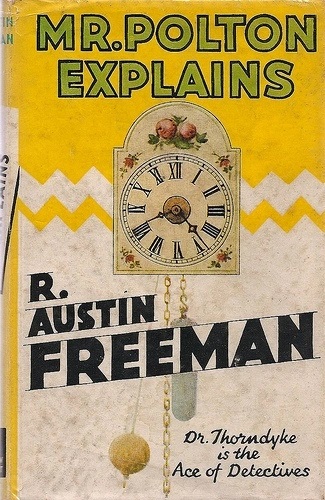
Jonathan Betts in his detailed biography Time Restored (concentrating on Gould’s work as a horologist conserving the Harrison timepieces by which the problem of Longitude was eventually solved) mentions Orwell’s observation, and points out that Gould was a friend of the other figure mentioned by Orwell, R Austin Freeman. Freeman’s penultimate novel, Mr Polton Explains (1940) concerns the survival of a modified long-case clock, and is dedicated to Gould. This is where geography and biography possibly meet. In his Introduction to Mr Polton Explains, Norman Donaldson adds more detail:
The plethora of detail into which Polton [the narrator] enters in his account of the clock’s construction was almost certainly supplied to Freeman by his friend Rupert T. Gould, to whom the book is dedicated. (Gould was well-known in the 1930s as “Stargazer” on the BBC, and was often invited by our author [Freeman] to dinners of the Pudden Club in Gravesend. (page 2597, column 1)
The biographical question becomes – given the geographic proximity – did Orwell ever meet Gould or Freeman ? Orwell began to visit Greenwich in 1935 after he had met Eileen O’Shaughnessy. Eileen’s brother Laurence and his wife Gwen lived on Croom’s Hill in Greenwich, just outside the park gates, and from late 1936 Orwell and Eileen began to use their address as a poste restante. Over the next three or four years the Orwells were out of the country for long periods, but equally after returning home Orwell’s health collapsed and Laurence, a thoracic surgeon, in his professional and personal capacity advised and treated Orwell. In addition, after the outbreak of war Orwell’s income collapsed: Eileen took a job in London while Orwell stayed in at their cottage to look after their small-holding, but clearly visited London and stayed in Greenwich for days at a time before the couple reunited and took a flat in London. What did Orwell do in Greenwich when he was not in the house?
The treatment of time in all of Orwell’s books must be dealt with elsewhere, but just the opening paragraphs of Keep The Aspidistra Flying or Nineteen Eighty-Four make it clear that though he makes few references to clockwork yet Orwell was particularly concerned with time. One suspects that when Orwell mentioned “useless knowledge” he meant something close to its opposite.
*
Works mentioned:
Time Restored: The Harrison timekeepers and R.T. Gould, the man who knew (almost) everything, by Jonathan Betts (Oxford University Press, 2006)
Mr Polton Explains, by R Austin Freeman, in The R. Austin Freeman Omnibus Edition Volume 6, with a Commentary by Norman Donaldson (Shelburne, Ontario: The Battered Silicon Dispatch Box, 1999)
One quote from ‘Why I Write’ instantly entered my head on reading this post:
“Anyone who cares to examine my work will see that even when it is downright propaganda it contains much that a full-time politician would consider irrelevant. I am not able, and I do not want, completely to abandon the world-view that I acquired in childhood. So long as I remain alive and well I shall continue to feel strongly about prose style, to love the surface of the earth, and to take a pleasure in solid objects and scraps of useless information. It is no use trying to suppress that side of myself. The job is to reconcile my ingrained likes and dislikes with the essentially public, non-individual activities that this age forces on all of us.”
An example of Orwell’s tendency never to forget or abandon anything – ‘Why I Write’ was written six years after ‘Charles Reade’ but Orwell still makes his point.