
The Club Men: Part I
*
Introduction. Victor Gollancz’s Left Book Club is the most well-known Twentieth Century political book club in Britain. Publishing one title a month from May 1936 to 1948, its peak membership was fifty thousand.
The Left Book Club published many good books including Orwell’s The Road to Wigan Pier. while its low point was when in 1937 it published the communist lawyer Dudley Collard’s Soviet Justice and the Trial of Radek and Others. This praised the Moscow Show Trials.
Victor Gollancz left the Communist Party in 1939 when the it supported the 1939 Hitler-Stalin Pact, and opposed Britain going to war in 1939 after the German invasion of Poland. This was after its leadership had for five years campaigned for Britain to oppose Nazi aggression in the Popular Front period.
It is less well known that there were other British political book clubs in this period including the Right Book Club, the Liberal Book Club, the Peace Book Club and the National Book Association. In this, part one of my article, I look at the Right Book Club. In part two I will look at the National Book Association and in part three at the others.
The Right Book Club. William Alfred Westropp Foyle and his daughter Christina Agnes Lilian Foyle, founded the Right Book Club in April 1937. They owned Foyle’s, London’s most prestigious bookshop. The club was launched at the luxury Grosvenor House Hotel (this hotel opened in 1929 on the site of Grosvenor House the former London residence of the Grosvenor Dukes of Westminster).
Sir John Lawrence Baird the 1st Viscount Stonehaven presided over the Right Book Club launch ceremony. He was a former Governor General of Australia and Chairman of the Conservative Party. The Right Book Club was endorsed in a posthumous statement by Neville Chamberlain’s older brother Austen Chamberlain a prominent Conservative politician who had died earlier in 1937.
Other endorsements of this club came from George Ambrose Lloyd the 1st Lord Lloyd a former Governor of Bombay and British High Commissioner in Egypt a diehard Conservative and Imperialist; and William Francis Forbes Sempill the 19th Lord Sempill a First World war Royal Flying Corps airman and alleged opponent of appeasement. He was in fact a spy for the Japanese.
A five member selection committee decided which book the Right Book Club should publish or re-publish each month. It initially consisted of:
1. Anthony Mario Ludovici an author, eugenicist and anti-semite, who admired Nietzsche and Hitler. He usually openly expressed these views; but his 1938 anti-semitic book Jews and the Jews of England was published under the pseudonym Cobbett by the Boswell Publishing Company of London.
2. Norman Graham Thwaites a British officer, intelligence agent, foreign correspondent, and diplomat.
3. Trevor Ramsey Villiers Blakemore a poet, author and bon vivant.
4. Harry Collinson Owen a journalist and author who, under the pseudonym Hugh Addison, had written a science fiction novel The Battle of London about a communist take-over and the fight against it. He openly admired Mussolini. Herbert Jenkins, a London publisher, had published this novel in 1923.
5. William Alfred Westropp Foyle (see above).
Right Book Club Authors. The Right Book Club published books by a variety of authors ranging from overtly pro fascists, through ordinary Conservatives and Liberals to Trotskyite communists. Their common dominator was usually a hatred of Stalinism.
Harold Gordon Cordazo’s pro Franco book March of a Nation was the Right Book Club’s November 1937 Book of the Month. He covered the Spanish Civil War for the Daily Mail. To quote Orwell, Cardazo described Franco as a patriot delivering his country from hordes of fiendish reds.
Douglas Francis Jerrold a First World War veteran had served at Gallipoli and on the Somme. He was a Catholic who believed that that war had exposed the evil of the enlightenment and industrialism; and that communism was monopoly capitalism’s final form. He supported Mussolini and Franco, disliked Hitler and hated Stalin. In July 1936 Jerrold helped charter the plane which flew Franco to Morocco. In 1937 the Right Book Club published Jerrold’s book Georgian Adventure about King George V’s reign.
Bernard Charles Newman was the Right Book Club’s most favoured author. It published four of his books the first being Danger Spots of Europe (1939). Another was The Secrets of German Espionage (1940). He was an author and lecturer who had more than 128 non-fiction works and novels published mainly about spying and travel. He was a great nephew of the Victorian author George Eliot and was married with three children. He died in 1968 aged seventy.
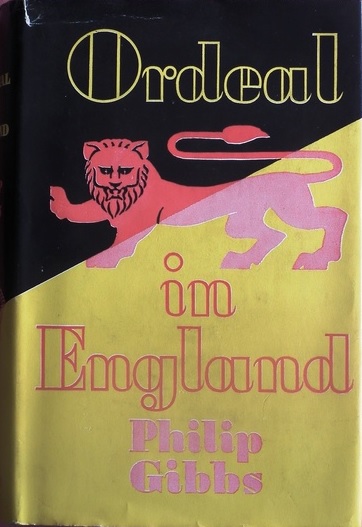
Sir Philip Gibbs a Liberal featured in another of my articles. The Right Book Club published a new edition of his book Ordeal in England in September 1938, with an additional chapter to the original. It was intended as a deliberate riposte to Orwell’s The Road to Wigan Pier, a Left Book Club publication.
Eugene Lyons was born Yevgeny Natanovich Privin in Belarus in 1898 His family moved to the USA in 1907. They lived in the Lower East Side of Manhatta. He joined the American Socialists and although he never joined the Communists he was a fellow traveller. He worked for the Soviet Russian News Agency TASS and the American United Press International.
Eugene Lyons was initially an apologist for and admirer of Stalin but became disillusioned. After leaving Russia he briefly flirted with Trotskyism but then swung far right. The Right Book Club published his Assignment in Utopia in 1938 and Stalin, Czar of all the Russias in 1941. After the Second World War he became a MacCarthyite. He died in New York in 1985 aged eighty six.
George Orwell gave Winston Smith the puzzle “2 + 2 = 5”: this came from Lyons’s Assignment in Utopia. It was originally a Soviet Russian slogan about completing the First Five Year Plan in four years.
Walter Germanovich Krivitsky was born Samuel Ginsberg in the Ukraine in 1899. He became a mid- level Soviet Russian spy controller; but defected to the West in October 1938 because of the purges. The Right Book Club published his I Was Stalin’s Agent in 1940. He was murdered in Washington DC in the USA in 1941 aged forty. His death was made to look like a suicide a common technique used by intelligence agencies and gangsters.
William Henry Chamberlin an American journalist and historian initially supported the Russian Revolution. He and his Ukrainian born American wife visited the Ukraine and the North Caucasus in 1932 and learnt about the catastrophic famine caused by collectivisation. He visited Germany and Japan and disliked Nazism and Japanese militarism. He came to value individual rights and democracy.
William Henry Chamberlin believed that if the western democracies went to war against Germany and Japan this would strengthen Russian and Chinese communism. In 1937 the Right Book Club published his A False Utopia an inside portrait of communism and fascism. In March 1938 it published his Japan over Asia about Japanese foreign policy. He died in 1969 aged seventy two.
Gerald Vernon Wallop the 9th Viscount Lymington. This was an honorary title as he was heir to the 8th Earl of Portsmouth. The Right Book Club published two of his books – Famine in England (1938) and Alternative to Death: the Relationship between Soil, Family and Community. He died in 1984 aged eighty six.
Viscount Lymington was interested in organic agriculture and helped found the Soil Association but he supported various fringe pro-Nazi movements. In 1938 he and William Joyce founded the British Council against European commitments. William Joyce made radio broadcasts for the Nazis in the Second World War, was known as Lord Haw Haw, and in 1946 was convicted of treason against Britain and hanged.
The Memory Hole. During the Second World War the Right Book Club switched from supporting appeasement to patriotism.
Ivor Halstead was a Yorkshire born British journalist and editor. In 1941 the Right Book Club re-published his 1940 book Wings of Victory: a Tribute to the RAF. It was the first book about the Battle of Britain. In 1942 it published his book Heroes of the Atlantic: a tribute to the Merchant Navy.
Ian Hay i.e. John Beith Hay was a Scottish playwright, novelist and non-fiction writer whose book The First Hundred Thousand fame about the 1914 British Expeditionary Force was published in 1915. The Right Book Club published his book The Unconquered Isle; Malta GC (George Cross) in 1944. The Maltese had endured a more than three years siege between 1940 and 1943.
Eduard Benes was the Czech President whose well-armed democracy was betrayed by the appeasers cheered on by the Right Book Club. It published three of his books the first being Democracy: Today and Tomorrow (1940). The Right Book Club continued criticising Soviet Russia until June 1941 when it temporarily changed its tone.
Ernest Stuart Bates’s book Soviet Asia: Progress and Problems took a balanced view of Soviet achievements in Central Asia. The Right Book Club published it in 1942. After the Second World War the club resumed its hostility to Russia.
John Fischer was an American journalist, editor and author. The Right Book Club published his book The Scared Men in the Kremlin in 1948.
Henry William Williamson a First World War veteran’s 1927 book Tarka the Otter which was later filmed endeared him to millions. He visited Germany in 1935, was impressed by Hitler, and was fooled into believing that Hitler wanted peace. Henry Williamson joined Oswald Mosley’s British Union of Fascists. The Right Book Club published Williamson’s books The Sun in the Sands in 1946; and Life in a Devon Village in 1947.
Siegfried Lorraine Sassoon was the greatest writer to write for the Right Book Club. It published his books, The Weald of Youth in 1943; and Siegfried’s Journey 1916-1920 in 1947. He was moving in mixed company but he intensely hated war.
The Readers. By 1939 the Right Book Club had more than 20,000 members. This was less than half the number of Left Book Club members. Christina Foyle invited the writer, journalist, satirist and First World War veteran Archibald Gordon Macdonell (the author of England Their England; he had stood as a Liberal candidate) to join the Right Book Club. On 3 November 1939 he replied that he did not know that there were twenty thousand people on the political right in Britain who could read.
The Broader Picture. The Right Book Club was part of an offensive by Conservative intellectuals who believed that first Liberals and then Socialists had dominated high level intellectual discourse for too long. The club was linked to the Conservative Party centre Ashridge College, founded in Hertfordshire in 1929.
Some Ashridge College lecturers had books published by the Right Book Club. They included Douglas Jerrold; and the historian Sir Charles Alexander Petrie who admired Charles I and the Jacobites. The club published Petrie’s books Lords of the Inland Sea: A Study of the Mediterranean Powers in 1937; and The Chamberlain Tradition in February 1938.

The predilictions of some authors must have been more difficult to identify. For instance, in March 1944 George Orwell reviewed and praised The Way of a Countryman, the memoirs of Sir William Beach Thomas. A year later it was issued as as a Right Book Club volume (pictured).
Conclusion. The Right Book Club had less than half the readers the Left Book Club had but they were probably more influential. The authors published by the Right Book Club ranged from those on the lunatic fringe of the far right, to those who just hated war, wanted peace and supported appeasement.
Gollancz was never a member of the CPGB, so couldn’t have resigned from it in 1939, although, yes, he did break off relations over the Soviet Union’s pact with Hitler.