
The Joys of St Cyprian’s: II
*
Introduction. George Orwell, (Eric Arthur Blair), attended St Cyprian’s, an Eastbourne Prep School, from 1911 aged eight, to 1916 when he was thirteen. He then went to Eton via Wellington College on a scholarship for which St Cyprian’s staff had crammed him. He had few happy memories of St Cyprian’s. His essay “Such, Such Were the Joys” bitterly criticised it.
In Part One of this article I looked at the history of St Cyprian’s; at its headmaster Lewis Chitty Vaughan Wilkes and his wife Cicely Ellen Philadelphia Wilkes née Comyn and their family; and at the controversy surrounding Orwell’s article about it. In this part, I look at the 1931 Board of Education report on it; and in more detail than in part one at its fiery end.
The Board of Education Report. From its early Edwardian days a distinguished academic annually inspected St Cyprian’s. This task was initially undertaken by Charles Grant Robertson an Oxford Don who was later Vice Chancellor of Birmingham University and was knighted.
On 27-28 October 1931 two Board (Ministry) of Education Inspectors, Arthur MacDonell Morley and Alfred Finch Page inspected St Cyprian’s. Their report survives in the National Archives, and is publicly available. A copy of it was sent to the headmaster Mr Wilkes with a covering note from Theodore Hunter Hastings Walrond a Board of Education Principal Officer.
This note from Theodore Walrond said:
…after considering this report the Board have decided to place the school upon the list of preparatory schools recognised by them as efficient. It will be understood that this recognition does not entitle the school to receive grants from the Board under the regulations for Secondary Schools.
The copyright in the report belonged to HMSO i.e. Her Majesty’s Stationary Office. It could not be published without the express consent of the St Cyprian’s authorities. If published it must be published in its entirety and it must be made clear that copyright belonged to HMSO.
Nature and Scope of School. St Cyprian’s admitted boys from seven to nine who at the end of their course usually went to public schools or the Royal Naval College at Dartmouth. Of those who left between 1928-1931 most went to Harrow, Eton, Canford, Marlborough, Stowe, Haileybury, Rugby and Uppingham. Failure in the Public Schools Common Entrance Exam was rare and many boys won scholarships. All were Boy Scouts or Cubs.
Premises and Equipment. The buildings were commodious and well planned. There were eight classrooms of various sizes and on the whole very satisfactory. The equipment was generally satisfactory but some of the tables and chairs are by no means new. The walls of many rooms were decorated with attractive pictures. There was a good library.
There were twelve dormitories with five to nine beds housing seventy six boys in all. For the seventeen older ones there were cubicles some single, others with two, three or four beds in them. There were two sick rooms one with three beds and the other two and a lavatory for them. This sick accommodation could be isolated from the rest of the school and could be extended to include one of the dormitories.
The first floor had two indoor staircases and the second floor one. An iron fire escape stairway served both these floors and the school was well provided with fire extinguishers. It is suggested, however, that it would be wise to practise fire drill from time to time. The outside buildings included a chapel with stained glass windows, a gym which contained a film projector, a carpenter’s shop, a fives court and a small rifle range.
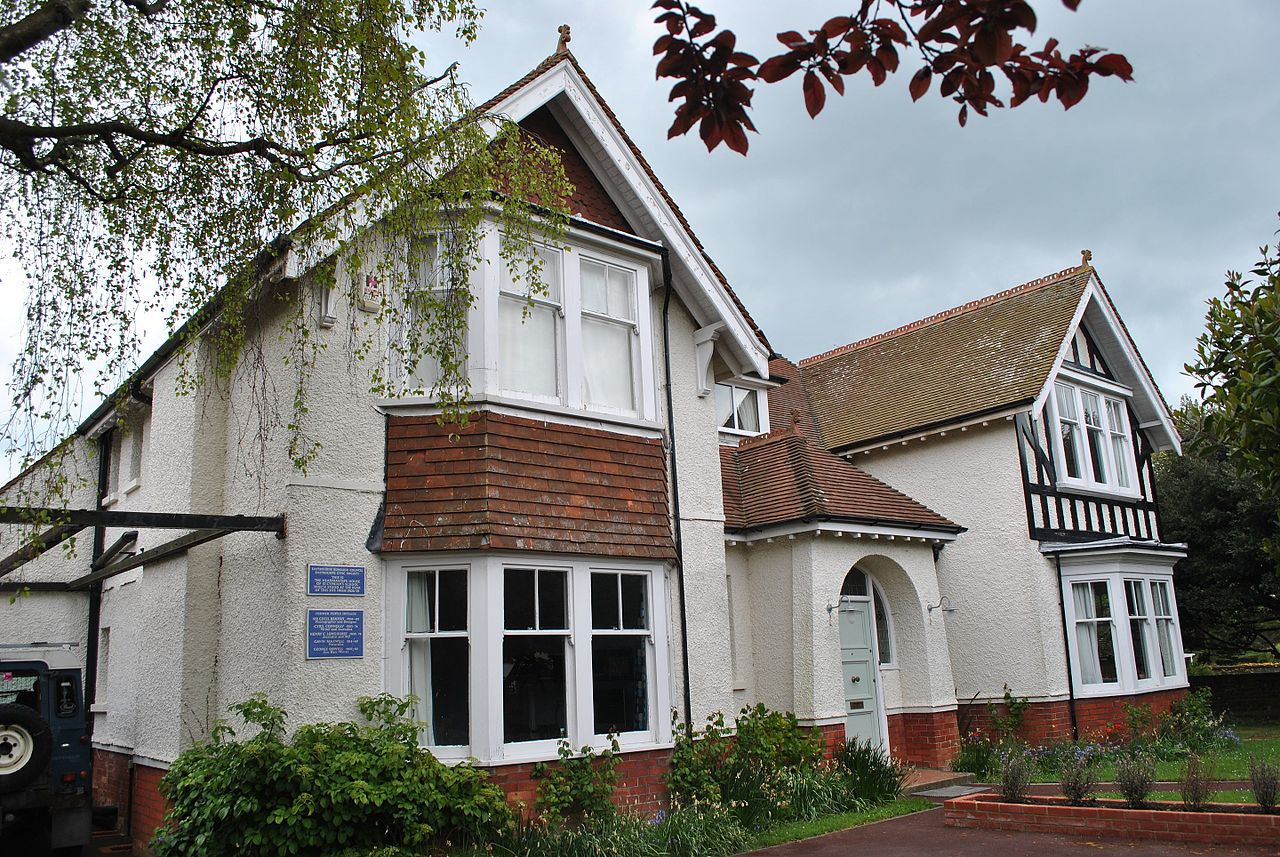
All that survives of St Cyprian’s
The staff. The Headmaster, a former classical scholar of Hertford College, Oxford, is an experienced and capable teacher. He taught the top form boys classics, occasionally taught lower forms and set frequent exams. He was assisted by a very well qualified and competent staff.
Of the seven Assistant Masters six were graduates including three Oxbridge men. The woman who taught the youngest boys, an able and experienced teacher, had the National Froebel Union Certificate. The child centred Froebel System was named after Friedrich Fröbel the German teacher who developed it. Emily Ronalds introduced it into Britain and by 1931 it was widely used in prep schools and middle class homes.
Miss Wilkes, a daughter of the head, taught French, and the head’s wife ran the domestic side and taught French and history. Visiting Masters did some classics, French and music teaching. A Sergeant Instructor taught PT, boxing and shooting, and the Estate Carpenter taught woodwork.
Organisation, Curriculum and Standards of Work. The school was large by Prep School Standards with ten forms. In the top forms two classes prepared boys for scholarships and two for the Public Schools Common Entrance Exam. The Forms are regrouped for various subjects and altogether the organisation is very elastic. The division of responsibility between teachers mixed the form and specialist systems.
A full school day had seven forty five minute lessons with fewer for the youngest boys who had only one afternoon lesson, were allowed time for open air play and were treated in a kindly manner. There was no time set aside for preparation. The subjects taken were the normal prep school ones. The boys show full and accurate knowledge, and more than usual ability to give clear and comprehensive answers.
Subjects and General Activities. Scripture was taught as were English Language and Literature, History, Geography, French, Latin, Greek, Maths, Art, Carpentry which about a third of the boys studied, music and Physical Instruction. Science was still not taught. The school had an annual journal The St Cyprian’s Chronicle and school plays were occasionally performed.
Conclusion and appendices. The report concluded:
… this is a very successful school with many admirable features, including a measure of vigorous self-government. The boys are well behaved in school and full of life out of school, and the relations between the assistant staff, and those in charge of the school, appear to be particularly happy.
The first appendix reported that there were ten regular staff including two part timers; and five visiting staff. The school fees were £173 5s pa for board and tuition; £6 6s pa for laundry; and £3 3s pa for medical attendance. There were extra fees for piano, drawing, wood-work, swimming and dancing lessons.
A second appendix detailed pupils’ ages. Five were under nine, nine aged nine, twenty one aged ten, twenty five aged eleven, nineteen aged twelve, and twenty three aged thirteen. This made a hundred boys including two day pupils.
For Official Eyes Only. A confidential supplement to the report listed the staff and their salaries. The head’s son in law William James Vincent Tomlinson, was deputy and was paid £300 pa. The other male teachers got £200 pa. Mrs Jay the woman teacher got £150 pa. The head’s daughter Miss Wilkes got £90 pa and lived with her parents.
A standard questionnaire asked who owned the property; if there was proper accommodation for married staff; about toilets and dormitories; if the domestic servants’ quarters were properly separated from the boys’ quarters; medical provision; fire precautions; food; hours of sleep; and if there was a playground. All these were satisfactory except that there were no regular fire drills.
The inspectors noted that Mr Wilkes knows his school well, but is incapable of giving a clear account of its organisation; and that such ideas as we were able to formulate were derived from Mrs Wilkes who is possibly the real driving force of the school. The staff resemble a cheerful family; and the head called all his staff by their Christian names.
The confidential supplement noted that the English Language and Literature work seemed rather formal. Less formal work in this subject depended on Mrs Wilkes and may have been done out of regular hours or on days other than when the school was inspected. Finally the supplement said that there were no definite science lessons.
A fiery end. In his memoir George Orwell wrote that he remembered hearing a rumour that St Cyprian’s school had burned down. It was more than a rumour.
The School Inspectors’ remarks about fire precautions were prescient. On Sunday 14 May 1939 the main St Cyprian’s building caught fire. The fire was first noticed at five that morning but had reportedly burnt for some time. The school nurse Beryl Nixon heard noises. At first she thought it was the boys playing but she then looked out of her door and saw flames shooting up the stairs.
Beryl Nixon alerted Mrs Wilkes who gave the fire alarm. Mr and Mrs Wilkes, Mr Tomlinson and the resident masters marched the boys to safety via a back staircase but the maids were in a dangerous situation in their top floor quarters. By this time Mr Wilkes had retired as headmaster and become the St Cyprian’s Warden. His son in law Mr Tomlinson had replaced him as head master.
Sidney Albert Phillips the Eastbourne Fire Brigade Chief Officer had recently inspected the building and advised Mrs Wilkes to install automatic life lines from the maids’ quarters to a flat roof below. Such rope lines had been installed and four of the maids successfully used them to escape from their rooms where they were trapped by the flames.
A fifth maid Winifred Mary Higgs, aged sixteen, misused the safety rope, and fell heavily onto the flat roof fracturing her skull. The Fire Brigade arrived and she was taken to the Princess Alice Hospital dying there three hours later. Another maid Winifred Smith was treated there for burns. The Fire Brigade also rescued the school cook.
The blaze was fierce and Chief Fire Officer Phillips, Second Officer Charles James Murrant and their men concentrated on confining it to the central block. It was seven in the morning before it was controlled. It was later extinguished. One fireman Charles Guy Suter fell to the ground floor when the first floor gave way. He was treated at St Mary’s Hospital for shock and a broken wrist.
About half the main building and much of its contents were saved. One pupil played a salvaged piano during the fire. The Eastbourne Gazette compared him to Nero fiddling while Rome burnt. Some boys lost their clothes and swapped with boys whose clothes were salvaged.
St Cyprian’s School temporarily moved to Ascham St Vincent’s, an Eastbourne Prep School that had recently closed because its headmaster, Arthur Willis, a First World War veteran, had re-joined the British Army. Edgar George Horn an auctioneer announced that the planned auction of the Ascham St Vincent’s furniture was postponed.
On Tuesday 16 May 1939 the Eastbourne Coroner Edward Fitzwilliam Hoare opened an inquest into Winifred Mary Higgs’s death. John Theodore Goddard a solicitor represented the school and Charles William Mayo a solicitor represented the dead girl’s family.
The witnesses were the dead girl’s father James Higgs a bus cleaner; Police Sergeant William Henry Webber; Dr Geoffrey Ridings Staley the Princess Alice Hospital House Surgeon; three kitchen and parlour maids who had successfully used the escape rope; Chief Fire Officer Phillips who said that without the rope equipment the maids’ quarters were a death trap; and by William Tomlinson the headmaster.
The jury returned a verdict of accidental death with a rider that the delivery of the rope escape apparatus should automatically be followed by a demonstration of how it worked. The coroner concluded that he hoped that the company that installed it would do so. Its representative explained that they usually did so.
Winifred Higgs’s funeral was held at Langney Cemetery on Friday 19 May 1939. The Reverend Jenkin Alban Davies the Vicar of Westham, near Eastbourne, conducted it. A former Welsh Rugby Union International he had been a British Army Chaplain in the First World War. The funeral was well attended.
In July 1939 St Cyprian’s School moved to Whispers near Midhurst in Sussex staying there for eighteen months until the army requisitioned the buildings in 1941. The number of pupils dwindled. St Cyprian’s briefly combined with Rosehill School in Gloucestershire. Mr Tomlinson then took his pupils to Summer Fields Prep School in Oxford. The St Cyprian’s playing fields were sold to Eastbourne College a public school.
The Wilkes family still lived at the former Eastbourne St Cyprian’s Lodge. St Cyprian’s School was never rebuilt. During the Second World War Eastbourne suffered many Nazi air raids. Lewis Chitty Vaughan Wilkes died on 14 February 1947 at the Holloway Sanatorium at Virginia Water in Surrey aged seventy seven. His wife died on 11 August 1967 at Eastbourne aged ninety one. Orwell’s memoir was only published in the United Kingdom in 1968, after she had died.
Going Off at a Tangent. Eastbourne College a public school bought the Ascham St Vincent’s buildings later in 1939 and used them as a boarding house. In June 1940 Eastbourne College left Eastbourne and the Royal Navy used the Ascham site. In 1945 Eastbourne College returned and the Ascham site became a prep feeder school for it. The Ascham site was sold for property development in 1977.
Leave a Reply