
The letter than inspired a novelist
In March 1947, B. J. Taylor, of Merthyr Tydfil, Glamorgan, writes out of the blue to George Orwell asking for advice on becoming a writer.
Until I recently accessed the Malcolm Muggeridge archive, hidden away in Wheaton College library, Illinois, Orwell’s remarkable 1,136-word response has been missed by biographers and literary critics. In his letter, Orwell explores a range of fascinating issues: how working as a miner can help or hinder a writer, how the experience of suffering is crucial – and so on. Most remarkably, Taylor, following on from Orwell’s note, goes on to write a novel, which is published by Dent in 1954.
So how come Orwell’s letter ends up with Muggeridge? Well, in 1955, editing Punch at the time, he is approached by Orwell’s widow, Sonia Brownell, to write the official Orwell biography. With his close ties to intelligence (during WWII he was first assigned to the Intelligence Corps and then MI6) Muggeridge can clearly be relied on to keep sensitive matters secret. He places adverts in various London-based journals asking for letters, memories and so on and even resigns his post as editor of Punch in 1957 to work on the assignment. But the task quickly bores him and so he drops it. According to Richard Ingrams, in his 1995 biography of Muggeridge, he had ‘found out too much about Orwell that he would rather not have known’. Perhaps Sonia was merely going through the motions – knowing all along that Muggeridge would eventually tire of the task.
The organisers of the Orwell Archive, set up at University College London in 1960, write to Muggeridge inviting him to donate material but he declines. Instead, in 1985, he hands over, for an undisclosed sum, all the material gathered for his doomed biography project to Wheaton College, a private, Evangelical liberal arts establishment. This includes the Taylor correspondence – and many other fascinating items (which I discuss in an article in George Orwell Studies, Vol. 6, No. 1)
‘Mining Leaves No Energy for Anything Else’
Writing from 27B Canonbury Square, Islington, London N1, on 22 March 1947, Orwell first responds to Taylor’s question on whether working as a miner will help as a background to becoming a writer. ‘If you are physically equal to this it might not be a bad idea to take it up for a few years.’ But he continues: ‘Mining, i.e. under ground, is the most appalling physical labour which leaves no energy for anything else and after a few years would make it difficult to have a continuous mental development. … I think it is true that in order to write one must have experience, which must include hardship and insecurity.’
Replying to Taylor’s query about writing and political perception, he says: ‘I don’t agree with you that in the face of the injustice and suffering of the modern world, there is something selfish or dilettante about a life given up to art. Any intellectual worker – artist, scientist, political organizer, philosopher or what have you – is really supported by downtrodden manual workers, just as Plato or Aristotle was supported by slaves. … I think one can remain undamaged by being a favoured person so long as one retains a humble attitude, which involves being in contact with ordinary people and also having some contact with reality, which usually means suffering. I do not think one could write a good book if one had never had a serious misfortune, and it must be a misfortune of a kind that makes one not accept current standards as absolute.’
In his note to Muggeridge on 4 April 1955, Mr Taylor (his first names were Bevis James) comments: ‘It is a remarkable letter, carefully thought out and very penetrating, all for the benefit of a complete stranger.’ He tells him about the publication of his novel and jokes that, while it has not yet been reviewed in Muggeridge’s Punch, it ‘received an excellent mention in the Fish Trades Weekly, incorporating the Poulterers’ and Rabbit Dealers’ Gazette’ so ‘my feet are firmly placed on the ladder’.
The Steam Trawler Uganda
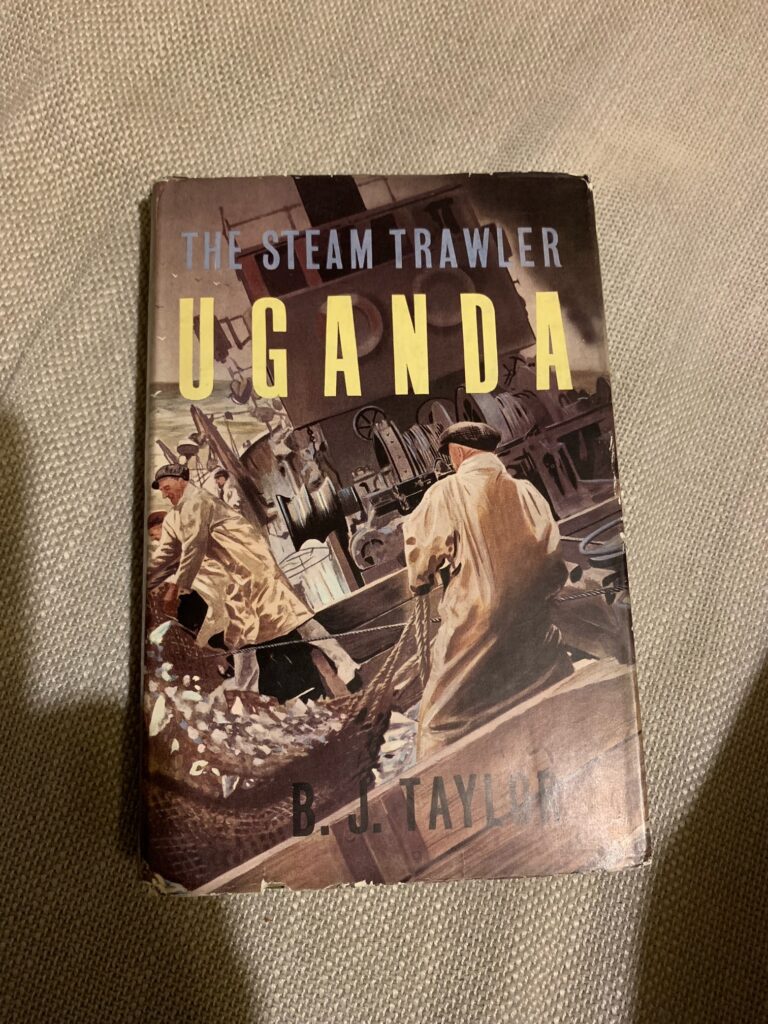
In the novel, The Steam Trawler Uganda, Taylor draws extensively on his experiences as a trawlerman –so showing how he has clearly ignored Orwell’s advice to avoid physical labour! The narrative follows the lives of a dozen deep-sea fisherman who are first shown on their last night ashore, in the few ‘happy’ hours before they join the Uganda in the docks at Holpool. George Grantham, for instance, has quit his job as a watchmaker to earn more money as a fisherman and so help pay for his future planned marriage to Hilda. The Flying Angel, the fishermen’s club run by the Holpool Mission to Seamen, is full so he ends up at the sort of Orwellian, down and out ‘doss house’. It ‘was largely occupied by old unshaven men, called Geeks by the younger inmates (Geeks being the name given to ape-men in a side-show). But the spectacle of these roused no reaction in his mind other than humorous curiosity’ (so hardly an Orwellian response).
The ship heads for the fishing ground, the men tied together in a sense of joint endeavour. But then a serious leak threatens them with disaster and destruction. As Taylor writes: ‘Courage and ingenuity and leadership bring them to land again where they are paid off to become separate individuals once more and again resume their private lives.’ Hilda is at the train station to meet George and asks him if he intends to return to the ship. He replies: ‘Don’t worry, love. Leave it to me. We’ll be all right. We’ll talk it over later. But just for now we’re on holiday. Now you tell me how your mother is.’ ‘Then Hilda relaxed completely in his care, assured of the future, not by her thoughts but by her feelings. It was sweet to be at his side again. She put her arm in his. Through countless generations the torch of life has been handed on to these two: a young Englishman and a young Englishwoman. They walked out of the tall station together, chattering, happy, arm in arm.’ And so the novel ends.
At times, it can be quite a challenging read, with Taylor dwelling on the intricate details about the trawler and the men’s work. At one point, he even writes about the trawl: ‘What follows is an explanation of its construction, the established method of operating it, and the reasons for that method. The reader is urged to struggle through this knotty chapter somehow so that he may later come to feel at home on the Uganda through an understanding of the dangers and problems which face her crew.’ And the text is accompanied by intricate, pen and ink drawings – one shows towing the trawl, another the otter doors moving along the sea-bed.
But there are also lyrical sections. Dead fish are thrown overboard and Taylor writes: ‘The gulls went mad with anticipation. This was the moment for which they had waited throughout the gutting. They flurried round the ship like a storm of great snowflakes and their squeals, as harsh as knives on grindstones, rose to a crescendo. The heap of guts began pouring over the side. A throng of seabirds swooped at once, cackling with delight, following the guts as they streamed aft and sank; just as heirs, after fidgeting through a lawyer’s long preamble, grab with their ears at the essential valuables of the corpse.’
Conclusion
Overall, the novel is well worth a look (I bought it for a few pounds from an internet-based bookshop). Orwell’s ‘Why I Write’, of 1946, is justly famous. The letter to Mr Taylor could be seen as his companion ‘How to Write’ essay. What a shame it is, then, that Muggeridge buried it (and much else) in his archive.
- Richard Lance Keeble was chair of The Orwell Society (2013-2020). His latest book is Orwell’s Moustache (Abramis).
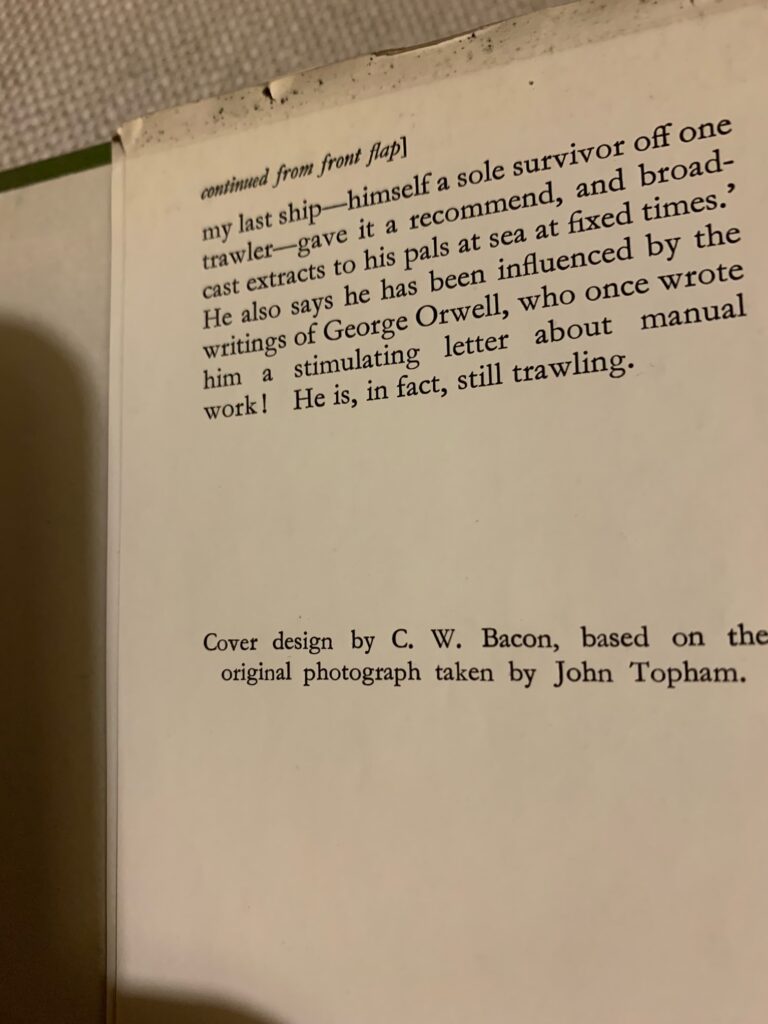
- The author would like to thank Richard Young for alerting him to the existence of Taylor’s novel and for supplying the images of the front and back covers. The content of the article is the author’s responsibility alone.
Leave a Reply