
The Play’s the Thing: Orwell and Drama (Second of Three)
Dramatic times at the BBC
While working as a talks assistant and later talks producer in the Indian section of the BBC’s Eastern Service from August 1941 until November 1943, Orwell composes a number of original dramatic dialogues. They include adaptations of ‘Crainquebille’ by Anatole France (on 11 August 1943), ‘The Fox’, by Ignazio Silone (on 9 September 1943), ‘A Slip Under the Microscope’, by H. G. Wells (on 6 October 1943) and ‘The Emperor’s New Clothes’, by Hans Andersen (on 18 November) (West 1985a: 130-167). Their international scope is particularly striking. Biographer Michael Shelden singles out ‘The Fox’ for special praise, describing it as ‘excellent’ (Shelden 1991: 374). He continues: ‘There is a hint in it of his future work in Animal Farm. The adaption begins in a pig-sty, and one newborn pig is christened Benito Mussolini.’
On the Wells adaptation, Tim Crook comments: ‘It has an orthodox exposition of traditional narrator and dialogue through characterisation. The narrative voice is deployed as a lens for the listener and indirect focus for a character’s thoughts and feelings. … Orwell was a radio dramatist who preferred to write with clarity rather than play with his listener’s cognitive perception’ (Crook 2015: 205).
The adaptations are produced along with his other work which includes providing political commentaries: 56 for India, 30 for occupied Malaya and 19 for occupied Indonesia (Davison 1996: 116; West 1985b). Indeed, drawing on his experiences teaching in the early 1930s, he presents a wide range of topics in an always accessible language and format. There was an element of ‘cultural imperialism’ in the series since there was no attempt to highlight any aspect of Asian culture for the Indian audience. But elsewhere in his talks programmes Asians – such as K. Shelvankar, Mulk Raj Ananad, Cedric Dover and R. R. Desai – were well represented. Crook comments: ‘Orwell became an expert in making radio for news, editorial propagandizing, and education through entertaining sound dramatization and cultural discussion. It was the equivalent of devising a multimedia syllabus for an Open University of the Air’ (Crook 2015: 194).
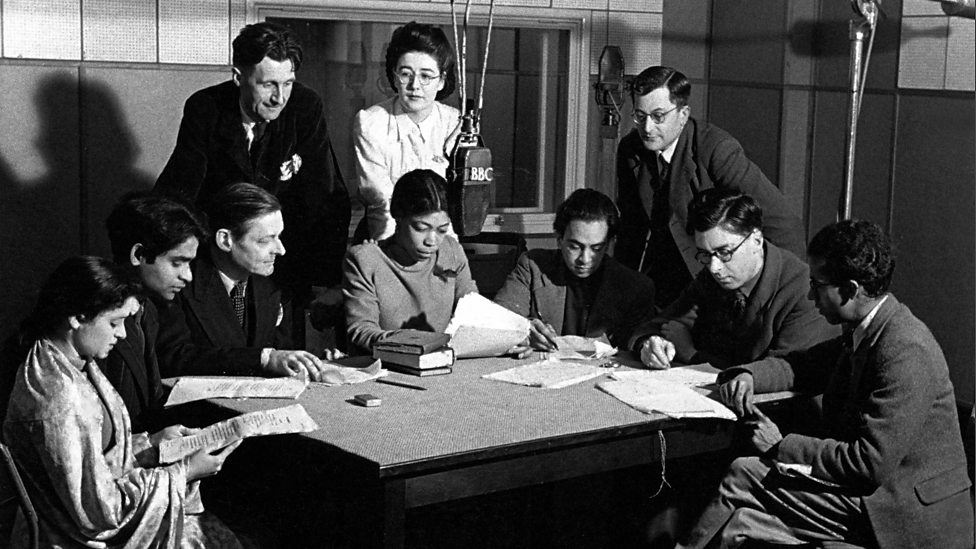 Orwell and some of his broadcasters at the BBC Eastern Service
Of the six commentaries he gives on writers, three of them are dramatists. The talk on Bernard Shaw, given on 22 January 1943, focuses on Arms and the Man, first performed in 1894. The play clearly ties in with Orwell’s long-lasting preoccupations with a host of issues; for instance, those relating to war, peace and violence in general, comedy and satire, politics and the theatre. He begins by providing a critical overview: ‘It is probably the wittiest play he ever wrote, the most faultless technically and, in spite of being a very light comedy, the most telling’ (West 1985a:118).
Then, after describing the plot in detail, he explores its major themes and ‘message’. For Orwell, seeming to draw on his experiences fighting alongside a Republican militia during the Spanish civil war in 1937: ‘Shaw is saying, in effect, that war, though sometimes necessary, is not glorious, not romantic. Killing and being killed isn’t the heroic, picturesque business that the propagandists make it out to be…’ (ibid: 119). Orwell next personalises the talk telling of the two, contrasting occasions when he has seen the play performed. The first was in 1918 and the theatre was full of soldiers just back from the front in France. At one point they all ‘burst into a laugh which almost lifted the roof off’ when Shaw mocks heroism during a cavalry charge. The second time was with a highbrow audience in 1935. This time there was no laughter at that point in the play. ‘War was far away and very few people in the audience knew what it was like to have to face bullets’ (ibid).
According to Orwell, Shaw’s plays today lack their original freshness ‘because in them he is attacking illusions which no one any longer believes in’. This comment sends Orwell off into a critical overview of Shaw’s other plays. Mrs Warren’s Profession deals with prostitution suggesting its causes are largely economic. ‘This idea was a novelty in the eighteen-nineties, but now, when everyone has read Marx, it seems a commonplace, hardly worth uttering.’ Widowers’ Houses is an attack on slum landlordism. ‘Slums still exist and people still make a profit out of them, but at least no one thinks this normal and proper any longer.’ The satire in John Bull’s Other Island depends largely on Ireland being under English rule ‘a state of affairs which has long ceased to exist’. And even Major Barbara and Androcles and the Lion depend on orthodox religious belief ‘being very much more general than it is today’ (ibid: 119-120).
Orwell next, rather brilliantly, examines Shaw’s brand of satire in its political, economic and historical contexts. ‘For the background, the springboard as it were, of his witticisms, Shaw needed the solidity, the power and the self-righteousness of the late-Victorian society in which he first lived and worked’ (ibid: 120). In other words, the world of late Victorian England was ‘easy meat for a satirical writer’. That world has now disappeared. ‘No one, nowadays, could make his reputation as a “shocker”. What is there any longer to be shocked at? … The self-satisfied, prudish, money-ruled world that Shaw made fun of has been washed away by the spread of scepticism and enlightenment; and for that scepticism and enlightenment Shaw himself, as much as any one writer of our time, is responsible’ (ibid: 121).
Orwell returns at the end to Arms and the Man, praising it as ‘a miracle of stage technique’ in which Shaw’s genius ‘reached its high water mark’. ‘There are not even any verbal fireworks; brilliant as the dialogue is, every word of it helps the action along.’ He rates it as highly as The Devil’s Disciple, and just beneath these two in quality he places Captain Brassbound’s Conversion, Ceasar and Cleopatra, Androcles and the Lion and The Man of Destiny ‘all of them brilliantly witty comedies’.
Orwell’s love of Shakespeare, born in his youth, shines through his talk on Macbeth, given on 17 October 1945. As with the Shaw talk, he begins with a general comment, spends some time carefully outlining the plot and finally explores the play’s central themes.
For Orwell, Macbeth is his most perfectly constructed play. Its theme is ambition. His focus is entirely on Macbeth the man so the crucial role of Lady Macbeth – and the terrible darkness of her personality – is missed. He compares it to other plays, perhaps over-simplifying in the process – in Antony and Cleopatra the theme is the power which a worthless woman can establish over a brave and gifted man; in Hamlet it’s the divorce between intelligence and practical ability; in King Lear, it’s the difficulty of distinguishing between generosity and weakness. But the power of Macbeth comes because it is ‘the nearest of all to normal experience’. ‘If you like, Macbeth is the story of Hitler or Napoleon. But it is also the story of any bank clerk who forges a cheque, any official who takes a bribe, any human being in fact who grabs at some mean advantage which will make him feel a little bigger and get a little ahead of his fellows’ (ibid: 160).
In conclusion, Orwell argues that Macbeth is the only Shakespeare play in which the hero and villain is the same character. ‘Nearly always in Shakespeare you have the spectacle of a good man, like Othello or King Lear, suffering misfortune; or of a bad man, like Edgar or Iago, doing evil out of sheer malice. In Macbeth crime and misfortune are one; a man whom one cannot feel to be wholly evil is doing evil things. It is very difficult not to be moved by this spectacle’ (ibid: 161).
Orwell’s commentary on Lady Windermere’s Fan reflects his life-long interest in Wilde. As Kristian Williams comments, Orwell loaned Dorian Gray to his friend, Cyril Connolly, at Eton, read at least two biographies, reviewed the Soul of Man for the Observer, alluded to Wilde in A Clergyman’s Daughter and Coming Up for Air while amongst his readings during his last year were two accounts of Wilde’s trials and his prison letter ‘De Profundis’ (Williams 2017: 42). Williams further suggests that as a young man, disgusted by his experience of imperialism in Burma, Orwell adopted the Wildean, anarchistic theory ‘that all government is evil, that the punishment always does more harm than the crime and that people can be trusted to behave decently if only you will let them alone’ (ibid). Moreover, according to Philip Bounds, Orwell acknowledges his debt to Wilde by deliberately overturning his ideas in his novel Keep the Aspidistra Flying. ‘Where Wilde speaks of altruism as a universal duty under capitalism, Orwell evokes a flyblown aesthete whose sympathy lies only with his own class. Where Wilde regards aesthetic relativism as a precondition of personal liberation, Orwell sees it as a nightmarish source of uncertainty. And where Wilde insists that the socialist society of the future must be libertarian or nothing, Orwell sympathises with a character for whom the planned economy is a synonym for tyranny’ (Bounds 2016 [2009]: 190). In addition, Bounds suggests there are Wildean overtones to the section in Nineteen Eighty-Four in which Winston Smith gazes at the old paperweight which he buys from Mr Charrington’s junk shop. Simply by illustrating the aesthete’s maxim that a work of art should always create a world of its own, the paperweight defies ‘the crushing sameness of a totalitarian culture’ (ibid: 91).
Orwell begins his talk on Lady Windermere’s Fan by highlighting Wilde’s contradictions. While arguing that every work of art is completely useless, he contradicts this ‘by making nearly everything that he writes turn upon some point of morals’ (West 1985a: 168). Moreover, he is never certain whether he is attacking current morality or defending it.
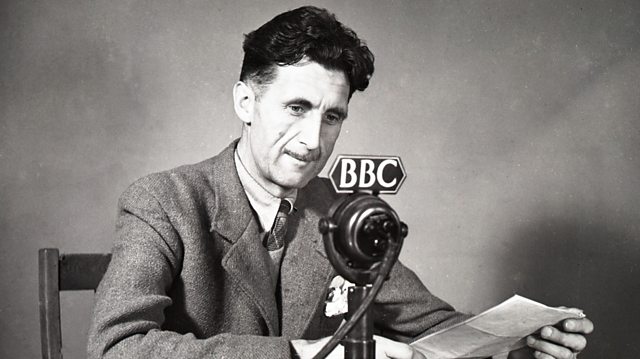 George Orwell, contemporary BBC publicity photograph
Just as Orwell placed Shaw’s comedy, critically, in its broader political, economic, cultural and social context, he now does the same with Wilde’s play suggesting that it has lost some of its impact because of changing social mores: when it was written ‘it was an accepted fact that a divorced woman must become almost an outcast; she was practically debarred from decent society for the rest of her life’. Now, a divorced woman is no longer ruined for life (ibid: 169). Having outlined the plot, Orwell argues that it draws on a number of popular themes of the Victorian stage – the situation in which someone is the child of somebody else, the parent being aware of it, the child not, the mother sacrificing herself for her child and the unjustly suspected person suffering in silence rather than reveal some deadly secret were all favourites.
With his life-long interest in humour (Keeble 2015), Orwell next focuses on Wilde’s witticisms. ‘These are stuck all over his writings as arbitrarily as the decorations on top of a cake. Nearly always they the form of debunking of something that his contemporaries believed in, such as religion, patriotism, honour, morality, family loyalty, public spirit and so on and so forth’ (West 1985a: 170). His dialogue remains charming, even when it has ceased to seem wicked or iconoclastic. But Orwell concludes suggesting Wilde won an easy fame ‘by pushing over an idol that was toppling already. In its fall the idol killed him, for Wilde never recovered from the shock of his trial and imprisonment, and died soon after he was released’ (ibid: 171).
Orwell’s inventiveness while at the BBC does not stop with the dramatic dialogues. On one occasion he engages in an imaginary interview with Jonathan Swift (one of my favourites in the whole Orwellian oeuvre). Swift, like Shakespeare, was a favourite of Orwell since his prep school days. As Meyers writes (2000: 14): ‘He stole and devoured Gulliver’s Travels, intended as a present, just before his eighth birthday. Taking a hint from Swift’s rational horses, Orwell idealized the horse in Animal Farm and transformed Swift’s Floating Island of Laputa into the Floating Fortress in Nineteen Eighty-Four.’ In 1940, Orwell listed amongst the authors he most cared about Shakespeare, Swift, Fielding, Dickens, Zola, Flaubert, Joyce, T. S. Eliot and D. H. Lawrence – all of them interestingly male (ibid: 100). While at the BBC, he launches a talks series called ‘Books that have changed the world’ and begins it, significantly, with Narayana Menon on Gulliver’s Travels (West 1985: 39). And in 1946, in his long essay, ‘Politics vs. Literature’ for Polemic, he examines at length Gulliver’s Travels. It’s influence on the horrifying, dystopian world of Nineteen Eighty-Four is clear when he writes (Orwell 1976 [1946]: 774): ‘Swift’s greatest contribution to political thought, in the narrower sense of the words, is his attacks, especially in Part III, on what would now be called totalitarianism. He has an extraordinarily clear prevision of the spy-haunted “police State” with its endless heresy hunts and treason trials, all really designed to neutralize popular discontent by changing it into war hysteria.’ And on a personal note, he says that while he is against Swift ‘in a political and moral sense’: ‘Yet curiously enough he is one of the writers I admire with least reserve and Gulliver’s Travels, in particular, is a book which it seems impossible for me to grow tired of. … If I had to make a list of six books which were to be preserved when all others were destroyed I would certainly put Gulliver’s Travels among them’ (ibid: 779).
It is not then surprising that Orwell’s delight in Swift should shine through his wonderfully inventive and witty BBC ‘interview’. Take this section, for instance, where Orwell, a constant critic of the mass media throughout his life (Keeble 2020b) cleverly inserts yet another jibe at the newspapers of his day:
ORWELL: Tell me candidly, do we stink as we used to?
SWIFT: Certainly the smells are different. There was a new one I remarked as I came through the streets – (sniffs) –
ORWELL: It’s called petrol. But don’t you find that the mass of the people are more intelligent than they were, or at least better educated? How about the newspapers and the radio? Surely they have opened people’s minds a little? There are very few people in England now who can’t read.
SWIFT: That is why they are so easily deceived… (West op cit: 115).
And Orwell is able to conclude with this typical celebration of human decency: ‘His vision of human society is so penetrating, and yet in the last analysis it’s false. He couldn’t see what the simplest person sees, that life is worth living and human being, even if they are dirty and ridiculous, are mostly decent’ (ibid: 116). Desmond Avery comments (2017: 80): ‘There is a note of sadness in this public parting with his oldest and favourite teacher, as if he felt he was on his own now.’
 George Orwell at the BBC, group photograph
In the end, Orwell grows tired of the heavy censorship regime at the BBC (which he describes as ‘something half way between a girls’ school and a lunatic asylum’) and resigns on 23 November 1943 to take up the post of literary editor at Tribune. He is typically self-deprecatory over his BBC experience damning it as ‘two wasted years’. But according to Crook: ‘Far from being a bureaucratic grind of exhaustion and disillusionment, Orwell’s experiences at the BBC were predominantly a process of positive creativity and cultural enlightenment both for himself and his audience. The contrasting roles of scripting both factual and fictional programming for the radio served a writer who had the mind of a robust and independent public intellectual and the feelings of the common person’ (op cit: 206).
*
References can be found at the end of Part One.
My heartfelt greetings to the Orwell Society. I am researching and writing about the great George Orwell in Bengali from Bangladesh. I express my deepest gratitude.