
The Road to Caphouse Colliery
The Orwell Society’s visit to the National Coal Mining Museum for England
Wakefield: 14-15 March 2020
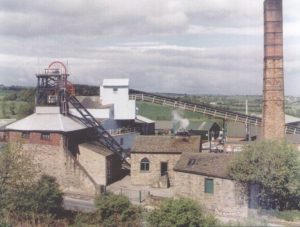
We gathered at the Museum, which lies just off the M1 and a few miles from Wakefield. Once suitably fortified by a hearty lunch, we set off for our trip down the mine. Our guide, a seventy-five year old ex-Miner, Dave, with a Yorkshire accent as hard as the coal he once mined, took us through the history of the Caphouse colliery from its beginning is in the late 1700`s to its closure in 1985. The mine was converted to a museum, opening to the public in 1988; there are similar museums in Newtongrange, Scotland and Pontypool, South Wales.
Dave briefed us on safety aspects, removing watches, mobile phones, lighters and anything else that might cause a spark, as gases remain present even in disused mines. Suitably equipped with hard hat and torch, the group photograph taken, we entered the cage, ready for the descent. Orwell described the cage as being as wide as a telephone box, but two or three times as long. We were more than snug at fourteen; apparently there was capacity for five more.

Richard Blair to right of ‘ghost’ and Sylvia Topp below
The unlit cage descended 86 fathoms, about 520 feet, reaching speeds of up to sixty miles per hour. Orwell said that because of the speed at which the cage has brought you down, and the complete blackness through which you have travelled, you hardly feel yourself deeper down than you would at the bottom of the Piccadilly tube (one of London’s deepest underground railway lines). He also used the London underground to describe the distance that the miners had to walk from the cage to the coal face (i.e. their place of work). He had imagined only a few yards, but found the distance was the equivalent of walking from London Bridge to Oxford Circus, and this was both before and after finishing work.
We learnt that through the early part of the 19th century, mining was a family business, and not just for the owners, but for those working at the coal face too. The father would dig out the coal, while the mother (hurriers) would put it into baskets and, along with their children, would move it to the main shaft ready to be taken to the surface. The younger children would open and close the doors that separated the divisions of the mine along the way, working for 12 hours in complete darkness, damp and always dangerous conditions. Dave said these gave rise to the colloquialisms “keeping your trap shut” and that the children’s labours were “not worth a light”, as they could not afford candles for the children, only for the miner cutting coal.
In 1838 there was a mining disaster at the Huskar Colliery, near Barnsley, in which 26 children were killed. Following a Royal Commission of Inquiry, the Mines Act of 1842 was passed, prohibiting women and girls and boys under 10 years old from working down the pits. One of the outcomes was the increased use of pit ponies and by 1913 there were some 70,000 ponies working in the coal mining industry. Because ponies were stabled underground, vermin thrived.
Orwell described a working mine as being “like hell, or at any rate like my own mental picture of hell. Most of things one imagines in hell are there – heat, noise, confusion, darkness, foul air, and above all, unbearably cramped space. Everything except the fire… only the beams of Davy lamps and electric torches, which scarcely penetrate the clouds of coal dust”… or sometimes picking out “mice darting from the beams of the lamps.”
We were fortunate not to put our hands on chewed quids of tobacco, which Miners used to quench their thirst, and so revolted Orwell, nor to see the rats, which proliferated in this colliery, feasting on food, human and animal waste. Orwell only mentioned mice, perhaps supressing the thought of rats deliberately. “Rats in this room?” “Of all the horrors in the world – a rat”.
The presence of the toxic gases methane and carbon monoxide were an ever present danger underground. Our guide spoke of the various methods used to detect these from canaries, the fireman and the miner`s safety lamp, invented we were told, not by Humphrey Davy, but by “Geordie Boy” George Stephenson. The former beat the latter to the patent office, but the debate continues.
Male canaries were used because only they sing; if they stopped singing or started to sway on their perch, the miners knew to leave the area immediately. Contrary to popular myth, most canaries didn`t die and would be revived by the miner pumping air into their lungs using a small bellows that they carried with them. The fireman was used to eliminate small quantities of gas. His protective clothing was minimal and might consist of wool, or leather, well damped, with the face and head protected as best they could. Using a long stick with a lighted candle attached to the end, he would crawl the last few yards toward the explosive gas, his head and body close to the floor to avoid the resulting blast. If there was a large build-up of methane, the fireman often paid with his life.
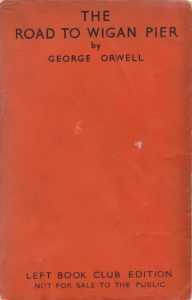
Orwell recommended that when you go down a coal-mine it is important to try and get to the coal face when the ‘fillers’ are at work… The time to go is when the machines are roaring and the air is black with coal dust and when you can see what the miners have to do. In 21st Century Britain there are no longer deep coal mines; we prefer to delegate any continuing horrors of extracting coal to others, importing coal from Colombia, the USA and Russia. Do we know (or care) about their operating conditions, as long as the price is right?
We made our way along dark passages, to be shown how the mine operated in its different eras, with heights of ceilings varying from just a few feet to other areas where it was possible for all to stand comfortably. Orwell said that most (Miners) were small; big men, including visitors like Orwell who described himself as exceptionally tall (about 6 feet 4 inches), were at a disadvantage. Walking stooped or bent double, to avoid the beams and girders, gave him a constant crick in the neck, but this was nothing compared to the pain in his knees and thighs. Going on all fours gave relief, until the moment when you try to get up again. Both his and our guide, were sympathetic and gave opportunities to rest for a minute or two, particularly on the return journey which is even harder, because it is slightly uphill.
Orwell admired the toughness of the ‘fillers’, an almost superhuman job by the standards of the ordinary person. In the hotter mines, the Miners worked in just a thin pair of drawers, clogs and knee-pads. He described seeing the noble bodies of the naked miners, wide shoulders tapering to slender supple waists, and small pronounced buttocks and sinewy thighs with not an ounce of waste flesh anywhere. Most have buttons down their backs, a scar on each vertebra, from banging backbones on the beams. We never found ourselves stooping quite that low, but there was the frequent sound of beams hitting our hard hats.
It is probably true to say that none of our visiting party could boast such “noble bodies” and on our return it took a moment or two to straighten. Our host was kind enough not to ask ‘How’d ta like to work down pit? Like Orwell, with no conceivable amount of effort or training could we become coal-miners; the work would have killed him (and us) in a few weeks.
Opting against “the bread-and-butter and frayed looking sweet cakes or pale flabby Lancashire cheese and ‘cream crackers’ served by the Brookers to Orwell in Wigan”, we went instead to a nearby Turkish restaurant for dinner.
*
The second part of our trip took us to Wakefield’s Red Shed, home to the local Labour party club since 1966, where Orwell Society members were welcomed warmly. On Sunday morning we heard an impassioned account of the decline of the mining industry in the United Kingdom and the strikes of the 1970s and 1980s, from life-long National Union of Mineworkers activist and National Executive Committee member, Ken Rowley.
Robin Stokes then spoke about Eddie Collins, a Yorkshire Miner, whose life ran in parallel to that of George Orwell. Both had contact with “luminaries” of the left, including Harry Pollitt, although there is no evidence, yet, of Collins and Orwell meeting.
Finally Les Hurst spoke about G.A.W. Tomlinson’s autobiographical book Coal-Miner and its mis-use by Arthur Bryant, who used the foreword to criticise Orwell’s Road to Wigan Pier. Coal Miner was published through Hutchinson (1937) and the National Book Association, which Bryant had founded alongside the Right Book Club. In January 1939, Bryant also published a new edition of Mein Kampf, using that foreword to write in praise of Adolf Hitler, comparing him to Benjamin Disraeli (sic).
An interesting, active and thought-provoking weekend for which we are grateful to Quentin and Liz Kopp for their arrangements and to the other Society members, including Patron Richard and Eleanor Blair, for making this such an enjoyable weekend away. Perhaps the last we shall be able to enjoy for a while.
*
NB -The mine’s Ghost is visible at the back on the left of the photo!
Kevin and Sandra Carter
16th March 2020
Uploaded 18 March 2020
First class report Kevin, well done.